

Cypressaurus was a late Eocene iguanian lizard. Two pieces of lower jaw from Saskatchewan provided the basis for its name. Their tall tooth crowns later helped researchers identify similar jaw bones from North Dakota.
Quick facts
| Group | Iguanians (Iguania) |
|---|---|
| Age | Late Eocene |
| Region | North America, Canada and the United States |
| Type species | Cypressaurus hypsodontus |
| Scientific name | Cypressaurus |
| Diet | No direct evidence |
What can the fossils tell us?
The Canadian species was described from two incomplete dentaries, the bones that carry the lower teeth.
The Canadian and North Dakota fossils share tall crowns. The American crowns narrow more strongly toward their tips.
The North Dakota fossils can be assigned to the genus. A species-level match to the Canadian material remains uncertain.
Two finds near Eastend
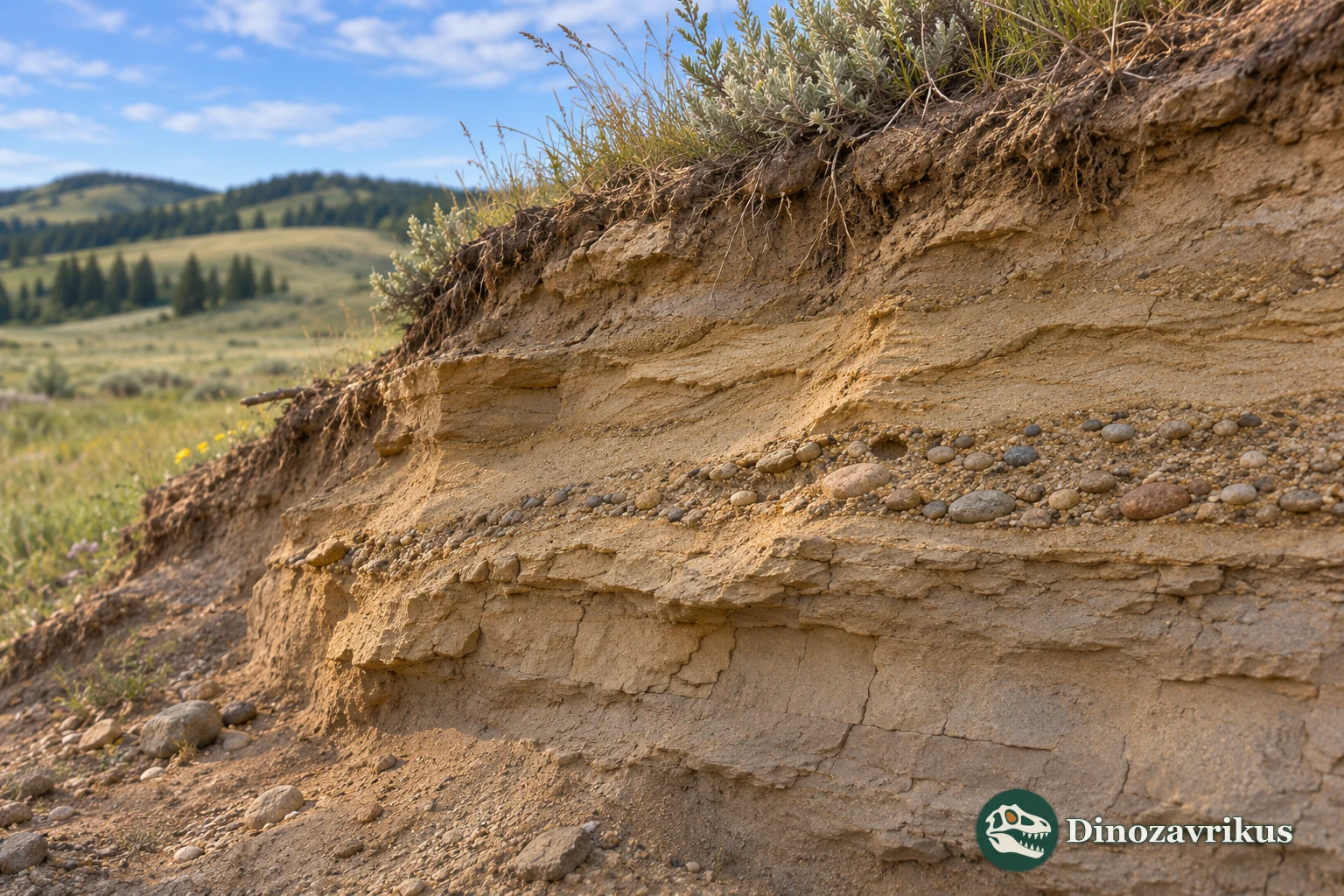
Alan Holman described Cypressaurus in 1972 from two partial dentaries found at Calf Creek, near Eastend in Saskatchewan. Loose sandy sediments there preserve the bones of small vertebrates. The original description called the locality early Oligocene. Later comparisons of North American fossil assemblages placed Calf Creek in the late Eocene.
Tall crowns on both sides of the border
Krister Smith referred a partial maxilla, PTRM 2623, and a dentary fragment, PTRM 5321, from late Eocene deposits in North Dakota to Cypressaurus. The central cusp appears taller in the Canadian material, a difference that may reflect wear. The American crowns also taper more strongly near their tips. Smith therefore used Cypressaurus sp. for the North Dakota specimens.
An iguanian of uncertain family
The jaws support placement among iguanians, with the family unresolved. Another Eocene iguanian, Suzanniwana, preserves additional parts of the skull for comparison. In Cypressaurus, the teeth and the bones that carry them provide most of the anatomical evidence.
Frequently asked questions
Where were the original specimens found?
Both dentaries came from Saskatchewan, Canada. Similar fossils were later identified in North Dakota.
When did Cypressaurus live?
Calf Creek and the North Dakota locality are now dated to the late Eocene.
What does Cypressaurus sp. mean?
It identifies the genus while leaving the species unresolved.
Do the teeth reveal its diet?
The crowns help identify and compare the fossils. There is no direct evidence of the food this lizard ate.