

Cyrtoproetus was an Early Carboniferous trilobite. The type species was described from Yorkshire. Material from neighbouring Derbyshire preserves large eyes and rounded cheek corners. English and Polish tail shields show up to twelve rings along the axis.
Quick facts
| Group | Proetid trilobites |
|---|---|
| Age | Early Carboniferous |
| Genus name proposed by | F. R. C. Reed, 1943 |
| Type species | Cyrtoproetus cracoensis |
| Lectotype | Head shield E 3532, Sedgwick Museum |
| Records | England, Poland and Czechia |
What can the fossils tell us?
The University of Cambridge museum holds it as E 3532. It was selected from specimens in the first description.
That proportion was reported from Treak Cliff specimens. The free cheeks have rounded outer corners without spines.
There are 10–12 rings along the axis. One smaller specimen has a faint border.
From the Yorkshire fossils to the genus name
In 1899 Frederick Reed described Phillipsia cracoensis from the limestone of Butterhaw Knoll near Cracoe in Yorkshire. He originally placed the species in Phillipsia and introduced Cyrtoproetus as a subgenus in 1943. Other studies subsequently used it at genus rank.
Halszka Osmólska selected the head shield E 3532 as the lectotype when she revised the material. It is held by the Sedgwick Museum at the University of Cambridge. She compared the British fossils with specimens from Viséan limestone in the Holy Cross Mountains of Poland.
Large eyes, rounded cheeks and a flat tail shield
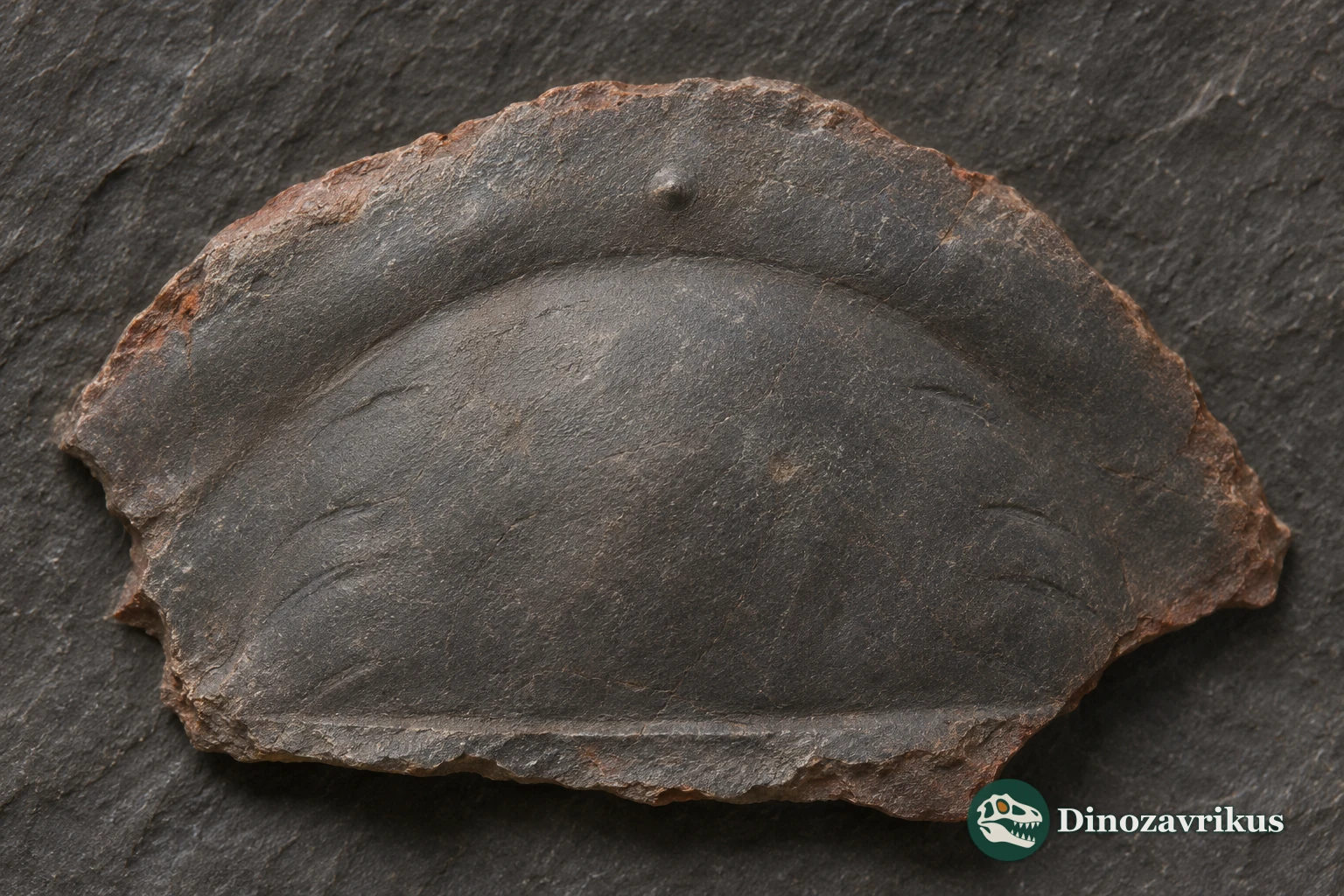
The Viséan reef limestones at Treak Cliff in Derbyshire yielded four cephala, 18 cranidia and 15 tail shields assigned to the species. The nearly parallel sides of the glabella taper slightly forwards. The eyes are large and the free cheeks end in rounded corners.
The revision of English and Polish material reported 10–12 rings along the broad axis of the relatively flat tail shield. Large shields have no clearly separated border, but one smaller Polish specimen develops a faint one. Low-relief detail and delicate granulation can be hard to see on moulds.

A head shield from near a stage boundary
The Mokrá Quarry near Brno yielded the cranidium SR 14. It has a narrow, flat front rim and a small, distinct bump on the occipital ring. Its head furrows are poorly preserved. The level is latest Tournaisian based on conodont and foraminifer zones. The authors compared the specimen with the type species and left the identification tentative.
Frequently asked questions
Where was the type species discovered?
At Butterhaw Knoll near Cracoe, Yorkshire, in limestone of Viséan age.
Where is the lectotype kept?
At the University of Cambridge Sedgwick Museum under specimen number E 3532.
Do the Treak Cliff specimens have cheek spines?
Their free cheeks end in rounded corners without spines.
Why was the Moravian fossil compared with the type species?
Its cranidium has a similar form. Poor preservation of some furrows leaves the species identification provisional.