

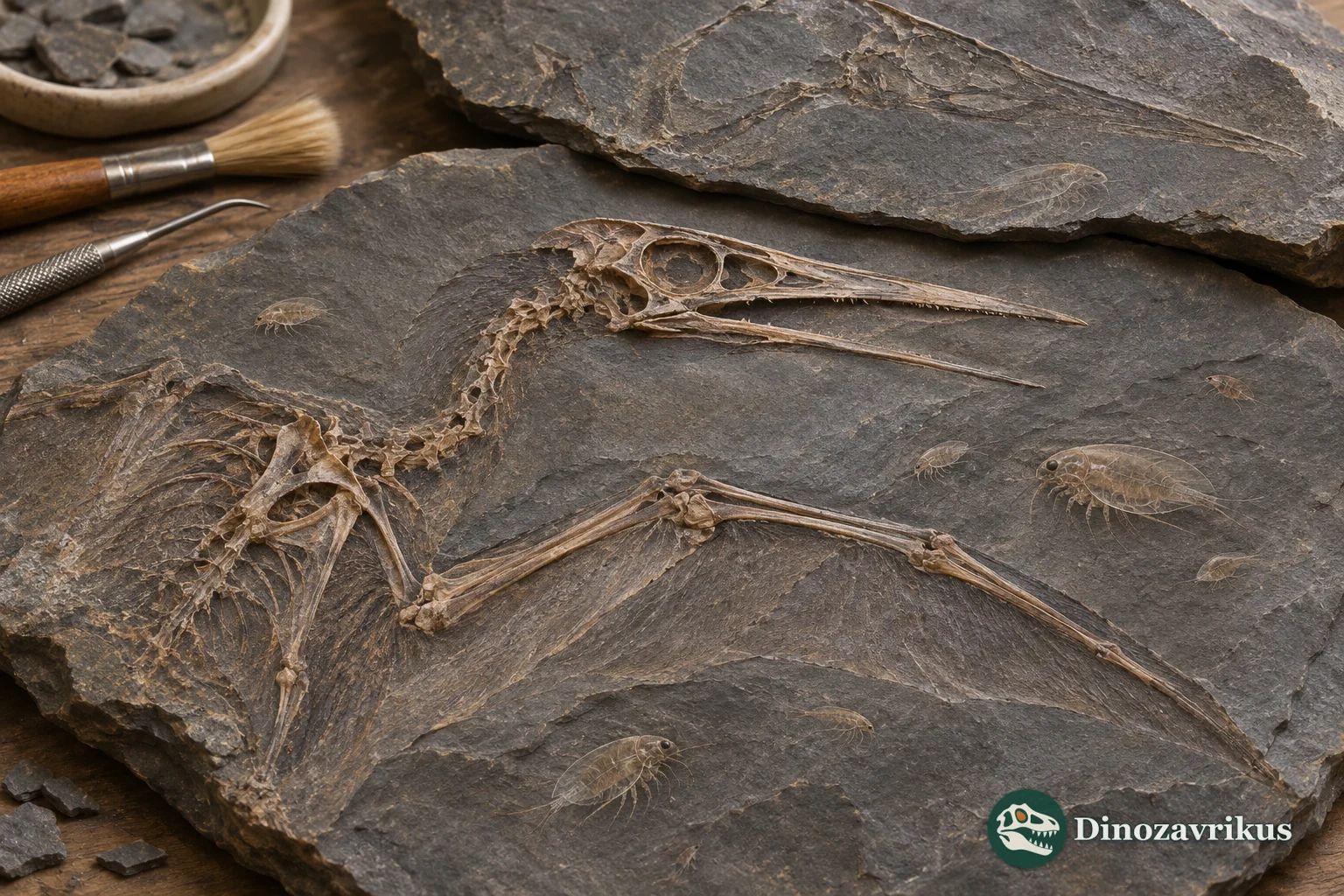
Daohugoupterus delicatus is based on one partial skeleton from the Jurassic Daohugou beds of Inner Mongolia. The slab preserves a nearly complete skull lacking its front, neck and back vertebrae, shoulder and wing elements, and small patches of fibrous soft tissue. These observations are more specific than a complete body outline or feeding scene, which remain reconstructions.
Quick facts
| Scientific name | Daohugoupterus delicatus, Cheng and colleagues, 2015 |
|---|---|
| Holotype | IVPP V12537, partial skeleton on slab and counterslab |
| Locality | Daohugou, Ningcheng County, Inner Mongolia, China |
| Age | Jurassic; bed correlations have been discussed |
| Skull | Nearly complete but missing the front of the snout |
| Soft tissue | Fibre impressions near neck and shoulder |
| Humerus | 41.8 mm in the original measurements |
What can the fossils tell us?
The skull, cervical and dorsal series, shoulder and part of the forelimb are visible. Sacral and caudal elements are absent.
Irregular fibres were compared with pycnofibres; parallel strands were interpreted as possible actinofibrils of a wing membrane.
Fusion of selected skull, wrist and shoulder elements supported the authors’ interpretation of an adult despite its small size.
Small crustaceans on the slab and the shale suggest a lake deposit, but they do not identify the pterosaur’s diet.
A specimen from Daohugou
The type specimen IVPP V12537 is housed at the Institute of Vertebrate Paleontology and Paleoanthropology in Beijing. It comes from Daohugou in Inner Mongolia and is preserved on a grey shale slab and counterslab. The describing paper was accepted in 2014 and appeared in the 2015 volume. The genus name recalls the locality; the species name refers to the specimen’s small, delicate build.
Its skull is nearly complete except for the front of the snout. The lower jaw, cervical and dorsal vertebrae, parts of the shoulder girdle and forelimb are present. The sacral region and tail are missing. The original authors described short neck vertebrae with cervical ribs, a broad sternal plate and features of the humerus as diagnostic observations.
Fibres and a freshwater deposit
Dark material near the neck vertebrae and right coracoid preserves fine fibres. Irregular strands were interpreted as pycnofibres of the body covering, whereas parallel strands were compared with actinofibrils in a wing membrane. The preserved traces do not show the animal’s colour or a complete wing outline.
Small crustaceans occur on the same slab. Together with the sediment, they suggest freshwater, probably lake, deposition. They are not gut contents. The published table records a 41.8 mm humerus, a measurement of one bone rather than a wingspan.
Size, maturity and relationships
Fusion in some skull, wrist and shoulder elements led the authors to regard the small type specimen as an adult. Size alone would not establish maturity. Short neck vertebrae and the humeral crest distinguish it from pterodactyloids, but a fine placement among non-pterodactyloid pterosaurs remains less certain.
Kunpengopterus preserves a different Jurassic pterosaur anatomy. Cuspicephalus is known chiefly from a skull, illustrating a different preservation gap. Neither supplies the missing Daohugoupterus tail or complete wings.
What the images can show
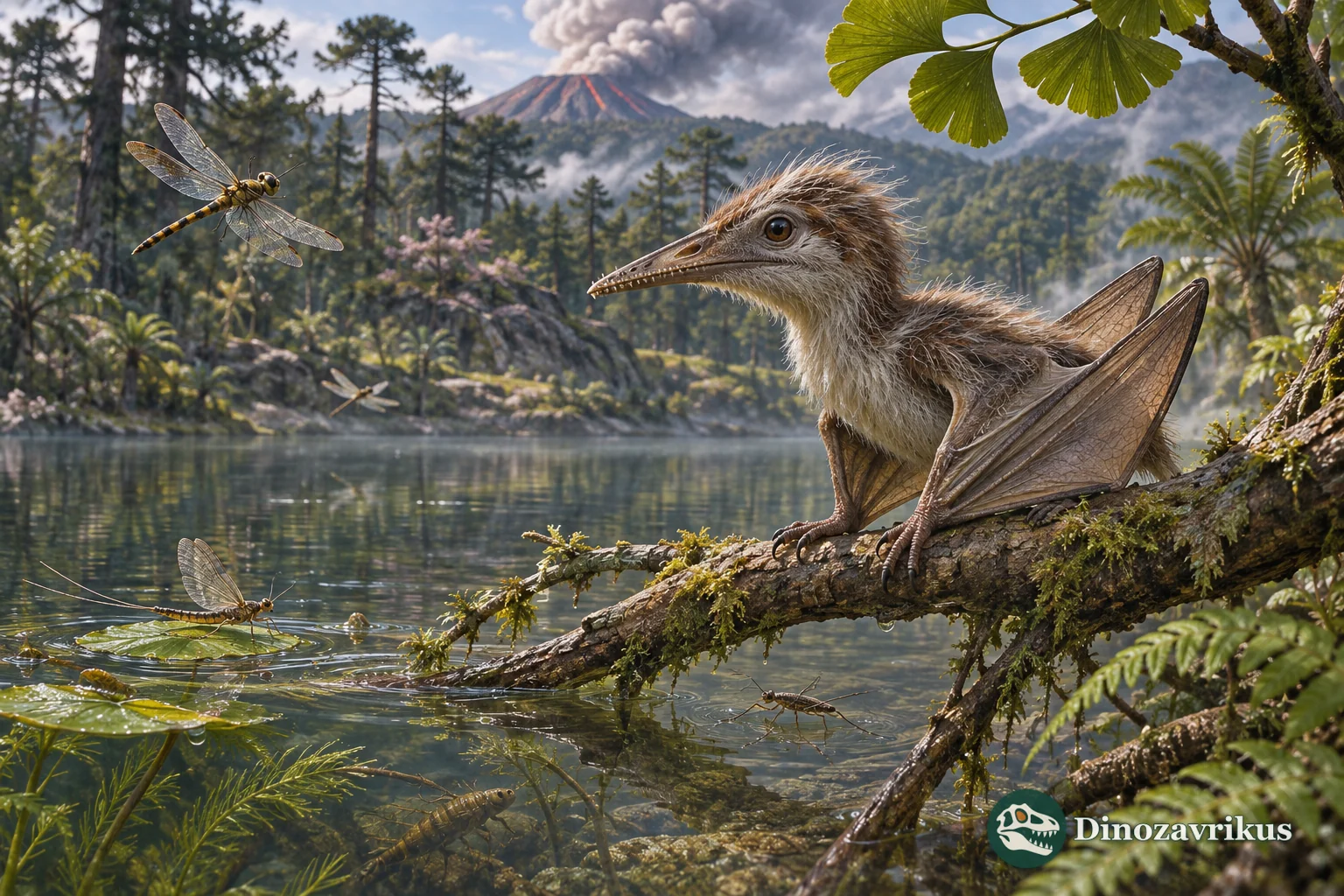
The original description used a Late Jurassic assignment for the Daohugou beds, although correlation of the local units has been discussed in subsequent work. The article therefore avoids a precise numerical age for the specimen. The life artwork is a plausible lake scene, not a direct record of the animal’s posture, prey or colours.
Frequently asked questions
Where was Daohugoupterus found?
Its only described specimen comes from the Daohugou beds of Ningcheng County, Inner Mongolia, China.
Is its wing membrane preserved?
Parallel fibres near the bones were interpreted as membrane-related actinofibrils, but no full wing outline survives.
Was the small specimen a juvenile?
The describing authors noted fused bones and interpreted it as adult; size by itself does not decide maturity.
What did it eat?
No stomach contents were found. Crustaceans on the slab indicate a freshwater deposit, not a demonstrated diet.