

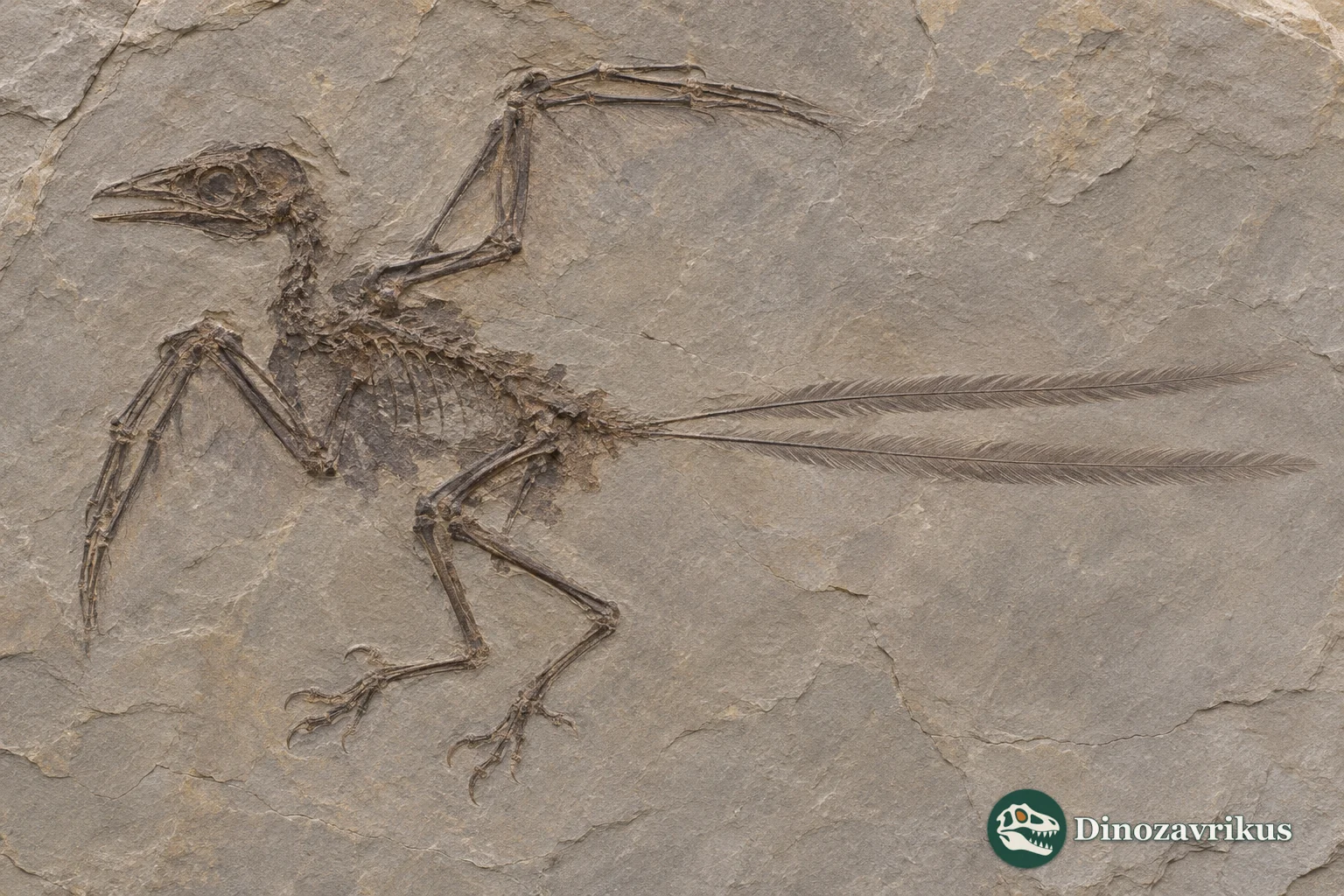
Dapingfangornis was an Early Cretaceous enantiornithine from the Jiufotang Formation of northeastern China. Its nearly complete skeleton lies on a single slab with wing, crown and tail feathers. CT imaging helped distinguish individual bones in the crushed skull.
Quick facts
| Group | Enantiornithines (Enantiornithes) |
|---|---|
| Age | Early Cretaceous |
| Region | East Asia (western Liaoning, China) |
| Diet | No direct evidence |
| Type species | Dapingfangornis sentisorhinus |
| Holotype | PMoL-AB00027, formerly LPM00039 |
| Deposits | Jiufotang Formation |
| Plumage | Two elongated tail feathers with expanded tips |
What can the fossils tell us?
The specimen has a documented quarry and stratigraphic source. Both surface study and CT imaging contributed to its description.
The feather tips are recognisable. A length of about 135 mm depends on reconstructing the blurred bases from their probable position on the tail.
The nasal and frontal bones are broken and displaced. The feature seen in the first description probably represents a fragment of one of these bones.
The fossil from Yuanjiawa
A field team from Shenyang Normal University collected the specimen in October 2004 at quarry No. 2 near Yuanjiawa village, Dapingfang. Yang Shurui prepared the slab. Li Li and colleagues named the species in 2006. The Paleontological Museum of Liaoning now catalogues the holotype as PMoL-AB00027. It was originally labelled LPM00039.
The slab preserves feathers near the wings, lower legs, crown and tail. The crown feathers reach up to 13 mm. Two long central tail feathers widen near their tips, where their barbs can be seen. The researchers estimated their length at about 135 mm by tracing the visible portions back to the pygostyle, the bone formed from the last tail vertebrae.
The teeth, the spike and the bird's relatives
CT images helped identify four closely spaced teeth in the premaxilla, at the front of the upper jaw. The precise number farther back remains uncertain. A protrusion described as a thorn-like nasal process in the original paper sits where the bones of the skull buckled. The later study identified it as probably a broken piece of a nasal or frontal bone.
The wishbone, keel and hand bones support its identification as an enantiornithine. Other birds in this group, including Bohaiornis, preserved pairs of elongated tail feathers. The feathers may have served as ornaments. The single Dapingfangornis skeleton leaves open whether feather shape varied with sex or age.
Frequently asked questions
Where was Dapingfangornis found?
The holotype came from the Jiufotang Formation at a quarry near Yuanjiawa village in Liaoning, China.
What did its tail look like?
The fossil preserves two elongated feathers with wider tips. Their reconstructed lengths are about 135 mm.
Did it really have a spike on its nose?
The spike probably represents a broken piece of the frontal or nasal bone in a crushed part of the skull.
Do its teeth reveal its diet?
The scan confirms that the jaws bore teeth. No gut contents that could identify its diet were reported.