

Deckera was a Late Cambrian trilobite of Laurentia. Its type species has fixed cheeks that rise steeply beside the central lobe of the head. When older fossils with relatively level cheeks turned up in Nevada and Newfoundland, Katie Welch and Stephen Westrop had to reconsider which features defined the genus.
Quick facts
| Group | Trilobites |
|---|---|
| Age | Late Cambrian, Paibian and Jiangshanian |
| Region | North America (United States and Canada) |
| Diet | Unknown |
| Type species | Deckera aldenensis |
| Type specimen | Cranidium OU 4305, Oklahoma |
What can the fossils tell us?
The fixed cheeks of the type species rise nearly to the crest of the glabella. Some Paibian specimens have low cheeks, so this feature alone cannot identify the genus.
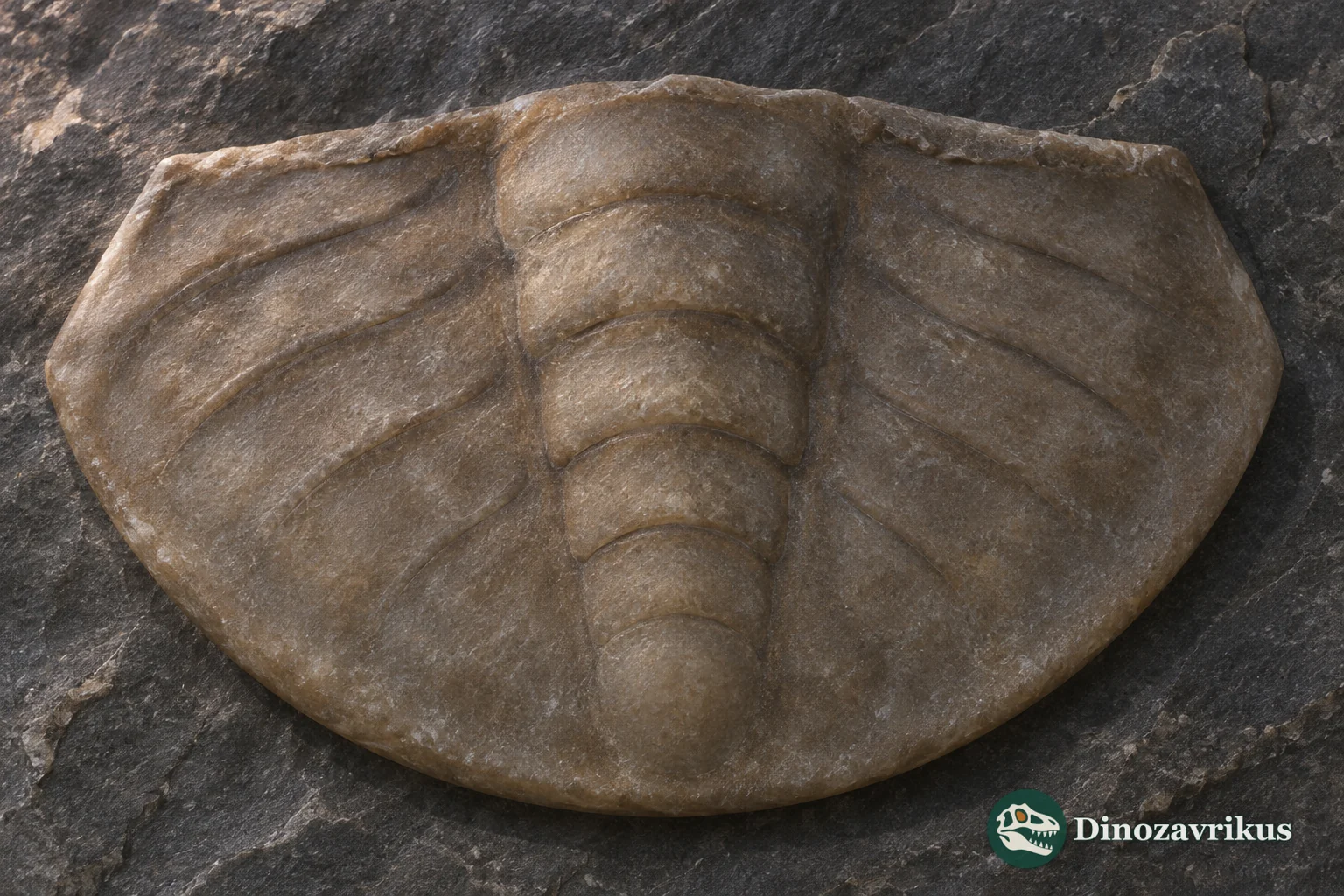
A known pygidium carries at least five axial rings before the terminal piece. Rear views reveal the deflection of its margin. It preserves no record of the number of free trunk segments.
Paibian material from Nevada and Newfoundland extends the documented range below the strata that yielded the named species. Its stratigraphic position establishes relative age, while the proposed relationships depend on anatomical comparisons.
The Oklahoma fossils
Frederickson named Deckera aldenensis in 1949 from the Honey Creek Formation. The holotype, a cranidium from the Blue Creek Canyon area, is catalogued as OU 4305 at the Oklahoma Museum of Natural History. A cranidium includes the central lobe, or glabella, and the fixed cheeks. The outer cheeks are separate pieces.
Welch and Westrop re-examined the old collections and illustrated additional cranidia and a pygidium from Ring Top Mountain. The fossils came from a glauconitic carbonate bed with ripple marks and fine sediment drapes. Other trilobites place the sample in the upper part of the Elvinia Zone.
The comparison with Pennsylvania
In the type species, the eye lobe is about 21% as long as the glabella. In Deckera completa from the Ore Hill Member of the Gatesburg Formation, that proportion is about 36%. The Pennsylvanian species has steeper fixed cheeks and fewer coarse granules. Its name was fixed to the original cranidium YPM 18565, selected as lectotype in the 2024 revision.
Preservation complicates the comparison because an internal mould can accentuate a shallow furrow. The revision also uses the width of the tail shield’s lateral fields and the course of their grooves. Shell ornament likewise helps to sort species of another Late Cambrian trilobite, Ptychaspis.
The earlier members of the genus
The Paibian material includes cranidia from Nevada’s Dunderberg Formation and two forms from the Shallow Bay Formation of western Newfoundland. The early forms differ in how the fixed cheeks slope, and some show more distinct grooves on the glabella. The authors broadened the diagnosis to allow for this variation and left the three early forms without formal species names.
Other material from Utah and Missouri can be identified only to genus or compared tentatively with named species. The disarticulated shields provide useful details of the exoskeleton. They leave the length of the whole animal and its diet unresolved.
Frequently asked questions
Where was the type of Deckera found?
The type cranidium of Deckera aldenensis came from the Honey Creek Formation near Blue Creek Canyon in Oklahoma.
Which rocks produced Deckera in Canada?
Cranidia attributed to two early forms were found in the Shallow Bay Formation of western Newfoundland.
How can the two named species be told apart?
Deckera completa has a relatively longer eye lobe, steeper fixed cheeks and fewer coarse granules than Deckera aldenensis. Their known tail shields also differ.
How did the new material change the diagnosis?
Several older cranidia have gentler cheek slopes. That variation led the authors to allow for lower cheeks within the genus.