

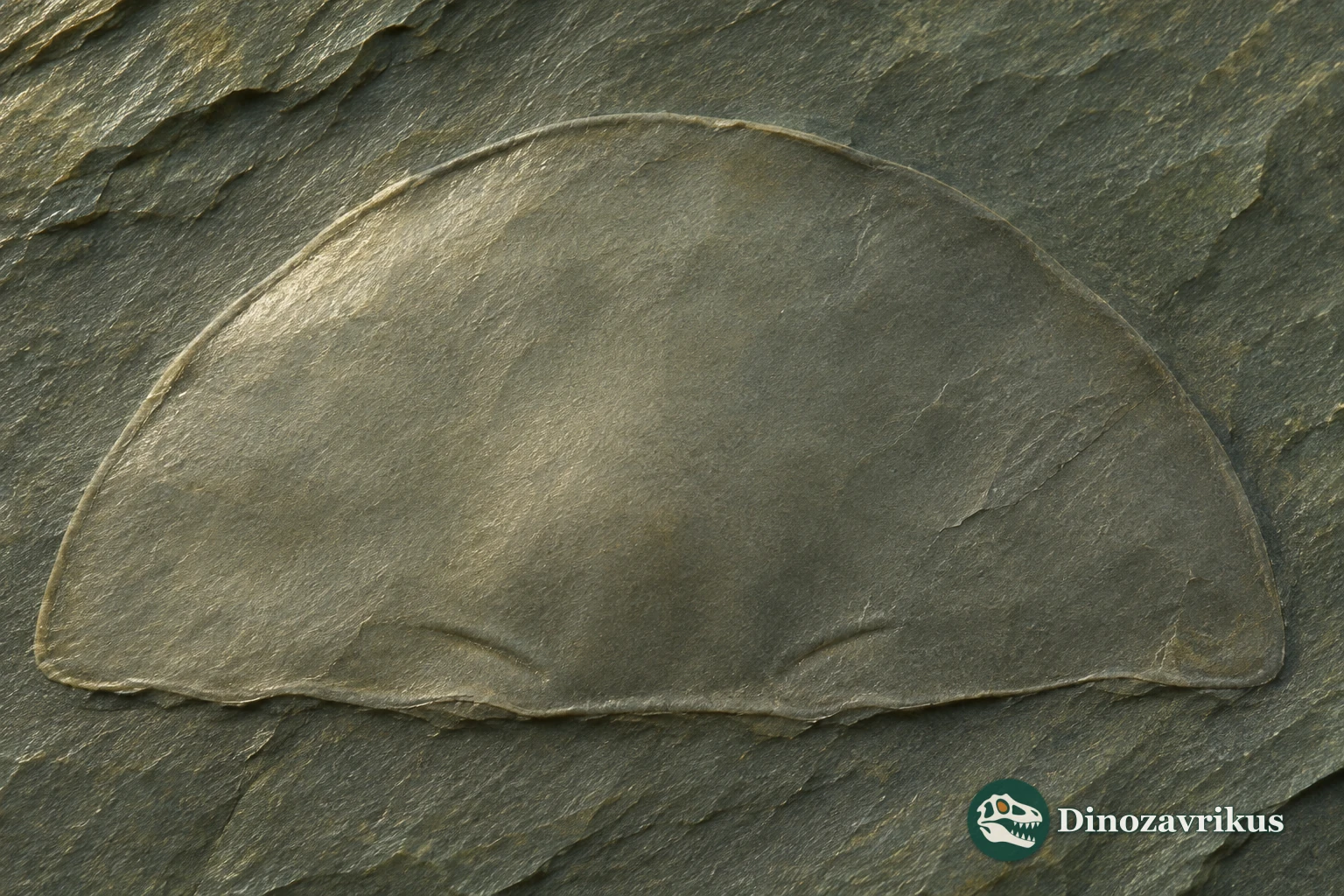
Delgadella was a small Early Cambrian trilobite. The first Portuguese tail shields were mistaken for separate shell valves. The fossils were reinterpreted, but deformation still complicates comparisons with similar specimens collected elsewhere.
Quick facts
| Group | Eodiscoid trilobites |
|---|---|
| Age | Early Cambrian |
| Genus description | C. D. Walcott, 1912 |
| Type species | Delgadella lusitanica |
| Iberian records | Vila Boim, Portugal and Nogales, Spain |
| Size of figured pieces from Nogales | About 3–4 mm |
What can the fossils tell us?
The type species was published under a brachiopod name. The fossils were later identified as parts of a trilobite shell.
Internal moulds record the inside of the shell and preserve part of its relief. An external mould records the outside.
Compression or stretching in the surrounding rock can change how an eye lobe or the rear of the tail appears.
Why the trilobite was first identified as a brachiopod
In 1904 Joaquim Nery Delgado described some small fossils from near Vila Boim as Lingulepis lusitanica. He interpreted them as brachiopod valves. Charles Walcott listed Delgadella in 1908 and published a description in 1912. Further study of the Portuguese fossils identified the objects as detached trilobite tail shields.
Delgadella belongs to the eodiscoids, as does Serrodiscus. Published material of Delgadella shows much reduced surface relief. A border can be seen, while the outline of the raised central axis is only partly traceable.
Millimetre-scale moulds from Spain
Forty-six fossils collected near Nogales in the Spanish province of Badajoz were assigned to D. souzai caudata. About a third preserved the identifying characters clearly enough for close comparison. Most were external or internal moulds of tail shields. The figured shell parts measure about 3–4 mm.
The central lobe is barely set off from the cheeks on some Nogales head material. The rounded tails narrow slightly towards the rear midline. These observations describe specimens that were published under the historical identification used for the Nogales assemblage.
Why the limits of the genus have changed
The Portuguese fossils have been deformed in the rock. Some features, including the appearance of a rear projection, may reflect distortion. Similarity between isolated shields from different basins therefore has to be considered alongside the quality and style of preservation.
The Siberian name Delgadella anabara is used for a zone of the Atdabanian Stage. Some Siberian material has been grouped with Delgadella in one classification and retained in Pagetiellus in another. A 2025 study kept Pagetiellus separate and noted that direct comparison with the Portuguese type requires clearer images.

Frequently asked questions
Where was the Delgadella type material found?
In Early Cambrian deposits near Vila Boim, Portugal.
Why was Delgadella first described under a brachiopod name?
Isolated trilobite tail shields were mistaken for brachiopod shell valves.
What is preserved in the Nogales material?
Mainly external and internal moulds of tail shields. The figured pieces measure about 3–4 mm.
Why are some of the Siberian identifications disputed?
They are difficult to compare directly with the deformed and incompletely documented Portuguese type material.