

Dendrochen is an extinct duck genus named from a fossil found in South Dakota. Its type species lived in the early Miocene. Limited material has placed the bird within a long-running debate about ancient duck relationships: similarities between individual bones do not always indicate close ancestry.
Quick facts
| Group | Ducks and relatives |
|---|---|
| Type species | Dendrochen robusta |
| Locality | Flint Hill, South Dakota |
| Age of type material | Early Miocene |
| Named by | Alden Miller, 1944 |
What can the fossils tell us?
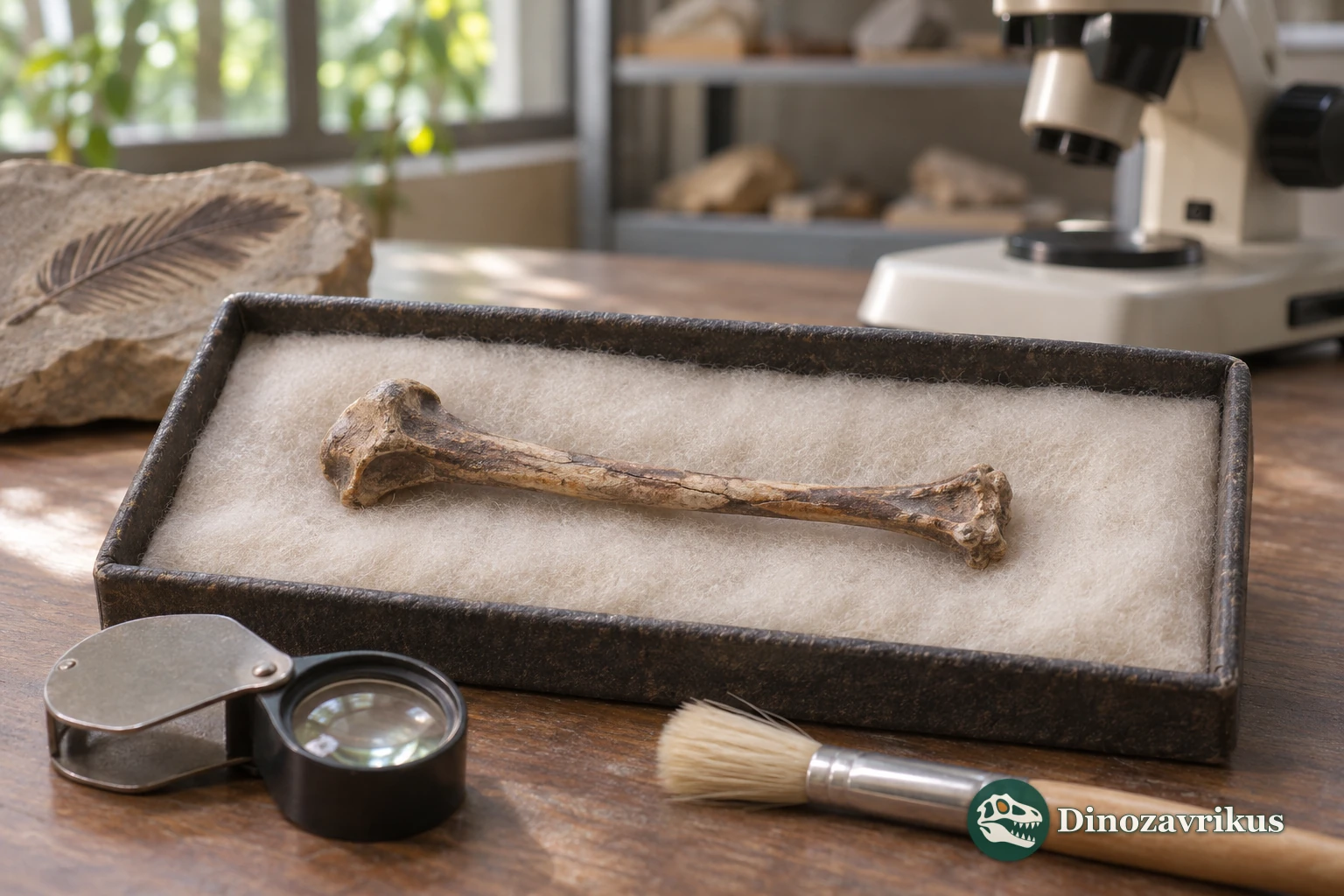
The type material is a left humerus from the Rosebud Formation of South Dakota. It anchors the name of the species.
The wing bone was compared with whistling ducks; later work discussed stiff-tailed duck affinities. These are competing systematic interpretations.
This material does not establish plumage, nest structure or a complete diet. The genus name does not demonstrate an arboreal lifestyle.
Where Dendrochen was found
Alden Miller established Dendrochen and its type species, Dendrochen robusta, in 1944, in a study of early Miocene birds from South Dakota. The name was based on a left humerus from Flint Hill, about 14 km west-southwest of Martin in Bennett County. The fossil comes from the Rosebud Formation and belongs to the University of California palaeontological collection.
The humerus is the bone of the upper wing. Its joint surfaces, fossae and muscle attachments provide characters for comparison with other ducks. A single element, however, cannot supply a dependable portrait of the whole bird.
Why its relationships have been reconsidered
Dendrochen was originally associated with whistling ducks, also called tree ducks. The shape of its humerus played an important role in that comparison. Later discussion emphasised differences in proportions and in fossae near the upper end, as well as muscle-attachment features near the lower end.
During the 1980s, some European fossil species were also placed in Dendrochen. They were subsequently separated into Mionetta. French skeletons and biological evidence for Mionetta therefore cannot automatically be treated as material of the North American genus.
In their 2008 analysis, Trevor Worthy and Michael Lee recovered Mionetta among stiff-tailed ducks and their relatives, and discussed the implications for Dendrochen. This is a cautious systematic interpretation. It does not establish that the ancient bird shared every behaviour of a living stiff-tailed duck.
What can be inferred about its life
Its placement among ducks makes an aquatic setting a reasonable context for discussing Dendrochen. Reliable evidence for particular foods, diving depth or seasonal migration is lacking, however. Tree-hole nesting cannot be inferred merely from comparisons with whistling ducks or from the genus name.
Dendrochen is especially informative as evidence of early duck diversity and of the difficulties of classifying birds from isolated bones. A more detailed reconstruction requires securely identified remains from other parts of the skeleton.
Frequently asked questions
When did Dendrochen live?
The type material from South Dakota is assigned to the early Miocene. Ages of other birds once included in the genus should not be transferred to its type species without checking their identity.
Are Dendrochen and Mionetta the same bird?
No. Some European species were formerly included in Dendrochen and later separated into Mionetta. Their histories are connected through changes in classification.
Why is Dendrochen compared with whistling ducks?
The comparison arose from the anatomy of the humerus. It concerns morphology and relationships, not direct evidence that the fossil bird lived in trees.
Do we know what Dendrochen looked like?
General duck-like features are plausible, but a detailed reconstruction is not secure. Plumage, soft tissues and precise whole-body dimensions remain unknown.