

Discosaurus vetustus is one of the early names given to a North American plesiosaur. Joseph Leidy proposed it in 1851 after examining a single incomplete vertebra from Cretaceous deposits in Alabama. No skull, flippers or connected skeleton accompanied that bone. Other isolated vertebrae were later placed under the name, but whether they all represent the same animal remains open to debate.
Quick facts
| Historical name | Discosaurus vetustus, Joseph Leidy, 1851 |
|---|---|
| Group | Plesiosaur; precise taxonomic placement disputed |
| Age | Late Cretaceous; the type vertebra's exact stage is not established |
| Original provenance | Alabama, United States; exact collection site unrecorded |
| Name-bearing material | One incomplete vertebra from Joseph Jones's collection |
| Collection | Academy of Natural Sciences of Philadelphia; two possible specimen numbers remain unresolved |
| Size | Total body length unknown; the original centrum was about 5 cm long |
Evidence guide
Leidy described a single Alabama vertebra supplied by Joseph Jones in 1851. Its processes were broken. No associated skull, limb or complete skeleton was reported.
Leidy initially called it cervical. A 2013 historical review describes Jones's first specimen as caudal. Its position in the spine matters when making anatomical comparisons.
Leidy discussed similar isolated vertebrae from several places in 1865. Two Alabama bones were so alike in size that a later review could not securely match the illustrated specimens to the original type.
Cope moved the species to another genus, while Welles regarded Discosaurus as insufficiently diagnosable. A 2013 Alabama inventory still lists it as valid, demonstrating that assessments differ.
One vertebra and a new name
Joseph Jones sent Leidy a vertebra from his Alabama fossil collection. At a December 1851 meeting of the Academy of Natural Sciences of Philadelphia, Leidy presented it as the basis for a new genus and species. His short description recorded broken processes, concave articular surfaces and a relatively broad centrum. He measured the centrum at about 2 inches long and 2¾ inches wide, roughly 5 and 7 cm.
Jones's bone was attributed only to the Cretaceous of Alabama. The original notice gives no quarry, mapped formation or geological stage for that individual specimen. Santonian ages appear in broader Alabama fossil lists, but they should not be applied to this type bone without a separate locality record. The historical illustration below imagines the kind of work involved; it does not depict Leidy, Jones or the actual type fossil.
Why later material became hard to separate
Leidy's first description called the bone a neck vertebra. A 2013 review of Alabama collecting history instead describes the vertebra Jones originally sent as a tail vertebra. This discrepancy is consequential: the expected shape of a vertebra varies with position along the spine, so an old anatomical label cannot be treated as settled evidence.
In 1854 Jones donated more fossils to the Philadelphia academy. Leidy's 1865 monograph discussed a second Alabama vertebra under Discosaurus and also compared isolated bones from Mississippi and New Jersey. These finds were not one connected skeleton. The two Alabama bones are so similar in size that the later historical review could not confidently tell which illustrated specimen was the original type. Both ANSP 9258 and ANSP 9282 have been proposed as possible catalogue numbers.
Cimoliasaurus is another nineteenth-century plesiosaur name founded on vertebrae and later repeatedly reassessed. Similar isolated bones explain why historical assignments shifted, but resemblance by itself does not prove that the two names identify the same species.

A changing classification
In 1869 Edward Drinker Cope combined the species as Cimoliasaurus vetustus, considering its material close enough to Cimoliasaurus to share a genus. Leidy later reconsidered the limits of these old groups and expressed doubt that every vertebra assigned to Discosaurus belonged together. In 1943 Samuel Welles listed Discosaurus among names requiring more diagnostic material from their type horizons. That judgment concerns whether the name can reliably identify a taxon, not whether a Cretaceous plesiosaur existed in Alabama.
The assessments are not fully uniform. A 2013 inventory of Alabama vertebrates retained Discosaurus vetustus in a table of valid names while its accompanying historical account described the type confusion. The responsible description is therefore a disputed old name rather than an unquestioned distinct genus or a demonstrated synonym. The much more informative skeleton of Elasmosaurus cannot simply supply Discosaurus with its own body proportions.
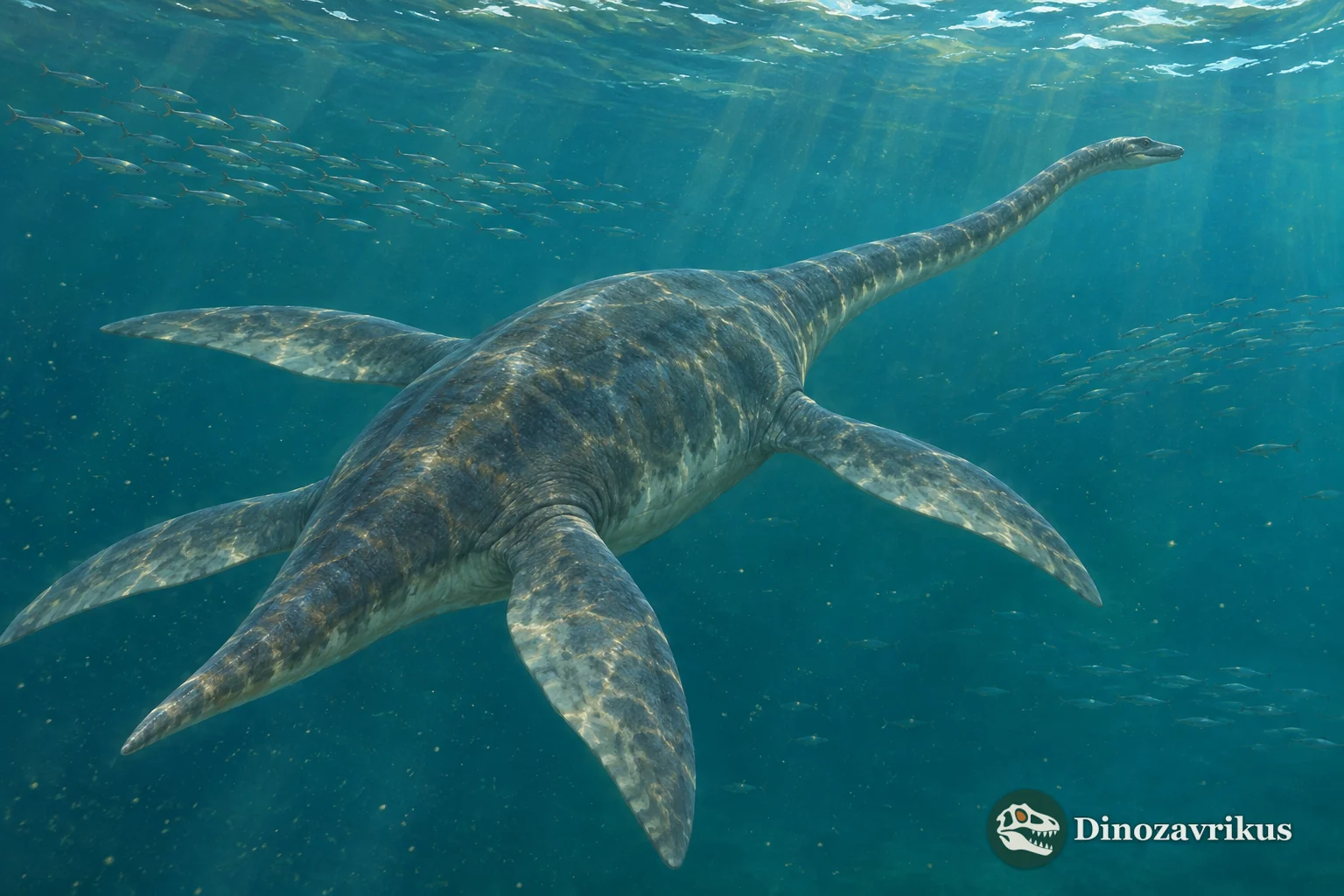
What might the animal have looked like?
An isolated vertebra permits study of one part of the spine. It cannot establish total neck length, skull shape, tooth count, flipper structure or overall body length. Even the width of a large centrum is not a dependable whole-animal measurement without an adequately comparable skeleton. The original fossil says nothing direct about prey, hunting, growth or skin colour.
Artwork can depict four flippers because that is known across plesiosaurs. The more complete Thalassomedon helps show the anatomy of a long-necked member of the group, but it cannot function as a measuring template for Discosaurus. The second illustration is a generic plesiosaur scene, not an image of an observed individual.
What the name means today
Discosaurus matters in the history of American palaeontology. A small Alabama fossil prompted nineteenth-century researchers to distinguish marine reptile names; later scholars then tested their comparisons against collection records and better skeletons. One label eventually encompassed isolated bones from different places. The central question is whether the original name-bearing bone can distinguish its animal from other plesiosaurs.
Resolving that question requires renewed study of the museum specimens and their provenance. Until diagnostic material can be securely connected to the original horizon, any complete-animal portrait or precise size remains a comparative reconstruction rather than an observed feature of Discosaurus.
Frequently asked questions
How many bones formed the original description of Discosaurus?
Leidy founded the name in 1851 on one incomplete vertebra from Joseph Jones's collection. Other isolated vertebrae were referred to the name later, but they did not form one skeleton with the original bone.
Where was the type vertebra found?
Leidy reported Cretaceous deposits in Alabama, United States. The original notice did not identify the exact site, geological formation or stage.
Is the body length of Discosaurus known?
No. The single original vertebra was measured, but the type animal has no documented associated skull, connected spine or limbs from which a reliable total length could be calculated.
Is Discosaurus accepted as a distinct valid genus?
Assessments differ. Some researchers regarded the original material as insufficient to diagnose the genus confidently, whereas a 2013 Alabama fossil inventory retained the name as valid. The uncertainty reflects the limited type material.