

Dissacus was a genus of mesonychid mammals known from the Palaeocene and Eocene. The best sampled North American species, Dissacus praenuntius, comes from Wyoming's Bighorn Basin and spans fossil intervals around the Paleocene–Eocene Thermal Maximum, or PETM, about 56 million years ago. Its teeth give researchers a way to compare feeding evidence and body-size proxies across this rapid warming event.
New finds expanded the once sparse Wa-0 sample, and microscopic tooth-surface work suggests that the animals consumed more bone during and after the PETM than before it. That is a research inference from wear texture, not a preserved menu. Dissacus is included in the ancient mammal catalogue alongside other Paleogene mammals such as Mesonyx.
Quick facts
| Scientific name | Dissacus Cope, 1881 |
|---|---|
| Featured species | D. praenuntius Matthew, 1915 |
| Group | Mesonychia, Mesonychidae |
| Age | Palaeocene to early Eocene; the Wa-0 sample overlaps the PETM |
| Range | North America, especially Wyoming's Bighorn Basin |
| Type material | AMNH 16069: teeth and fragmentary postcranial remains |
| Diet | Animal tissue; microwear suggests bone consumption |
| Body size | Possible late-PETM decrease is uncertain because the sample is small |
What can the fossils tell us?
Canines and cheek teeth indicate a carnivorous specialization. Tooth shape cannot identify a particular prey animal or distinguish hunting from scavenging.
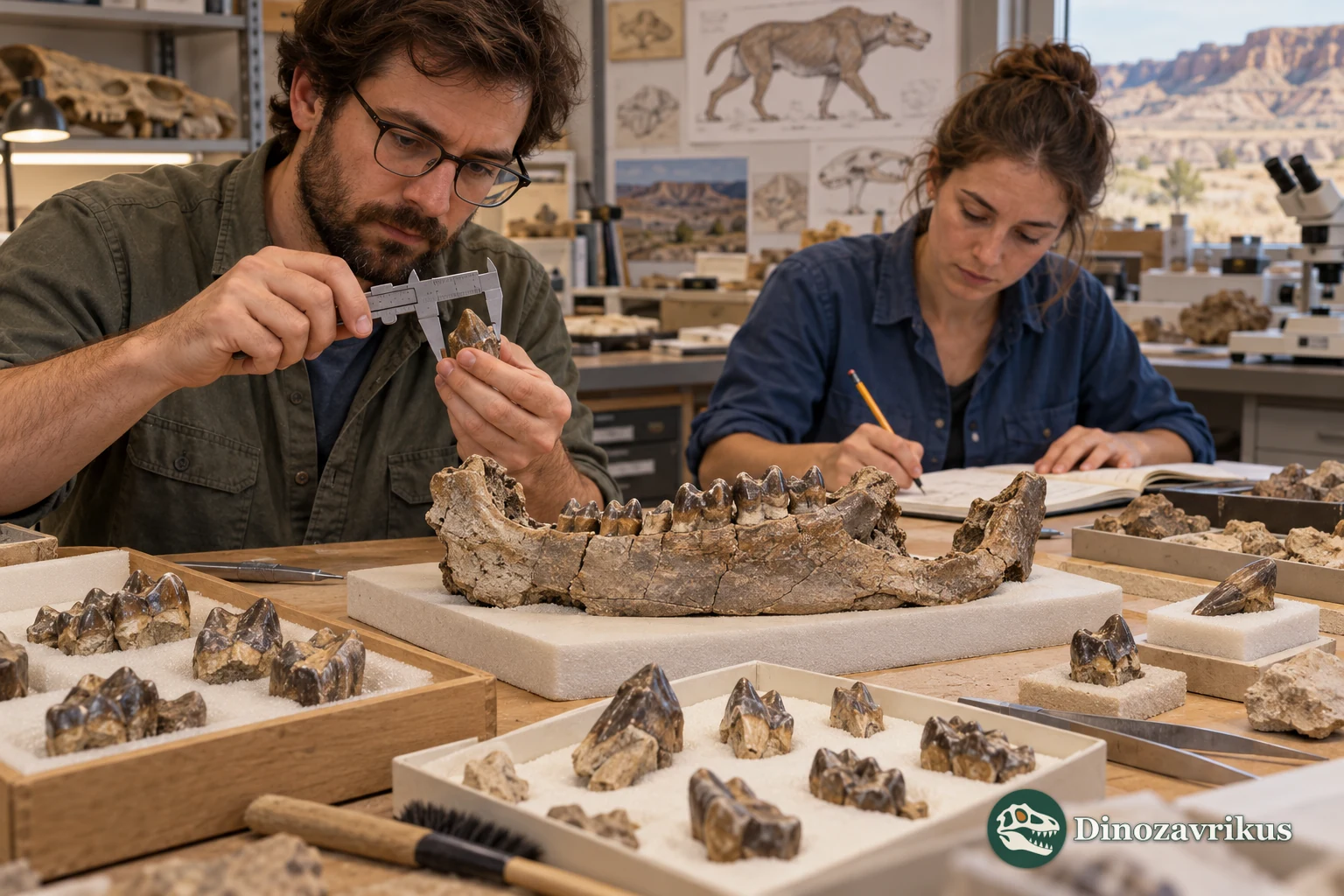
The holotype AMNH 16069 includes several teeth and fragmentary postcranial bones. Later Bighorn Basin finds provide the largest and most complete known Wa-0 sample, not a single complete skeleton.
Late Wa-0 teeth appear smaller than pre- and post-PETM samples. Tooth dimensions are a proxy for body mass, and the number of fossils is too limited for a secure evolutionary-dwarfing conclusion.
Dental microwear analysis indicates less flesh and more bone consumption during and after the PETM than before it. This is an interpretation of tooth-surface traces, not direct observation of a meal.
A fragmentary type and a growing fossil sample
Edward Drinker Cope named the genus Dissacus in 1881. William Diller Matthew described D. praenuntius in 1915. Its holotype, AMNH 16069, is a collection of teeth with fragmentary postcranial material from the Willwood Formation in Wyoming. It is not a complete animal, and it cannot by itself establish the full proportions of the species.
Later collecting in the Bighorn Basin recovered a larger and more complete sample from the Wa-0 biozone. A 2021 study described the largest known set of D. praenuntius from this interval, including jaw fragments with multiple teeth. Comparing several individuals is a meaningful improvement over a handful of isolated crowns, though it still leaves important parts of the skeleton unknown.
Teeth, flesh and bone
Mesonychids had differentiated teeth suited to processing animal material. The canines and cutting cheek teeth of Dissacus support a broad carnivorous interpretation. They do not tell us whether a particular individual hunted live prey, scavenged, or shifted between food sources.
Dental microwear texture analysis adds a different kind of evidence. Researchers quantify microscopic pits and scratches on enamel and compare them with patterns associated with food hardness and abrasiveness. A 2024 study of D. praenuntius found a shift toward less flesh and more bone consumption during and after the PETM compared with before it. The pattern suggests a change in feeding mechanics or resource use; it cannot tell which carcass supplied a tooth's last meal.
Did warming make Dissacus smaller?
The PETM was a brief, intense warming event around 56 million years ago. Some early Eocene mammal lineages show changes in body size across the interval, making D. praenuntius a useful comparison because fossils occur before, within and after Wa-0.
The 2021 study used molar dimensions as a proxy for body weight. Late Wa-0 specimens appear smaller than the pre-PETM and post-PETM samples, but the authors caution that sample sizes are still too small to say this with confidence. The result is a possible muted size response, not proof that the species underwent evolutionary dwarfing. A tooth-based estimate is also not a direct measurement of the animal's weight.
What kind of mammal was it?
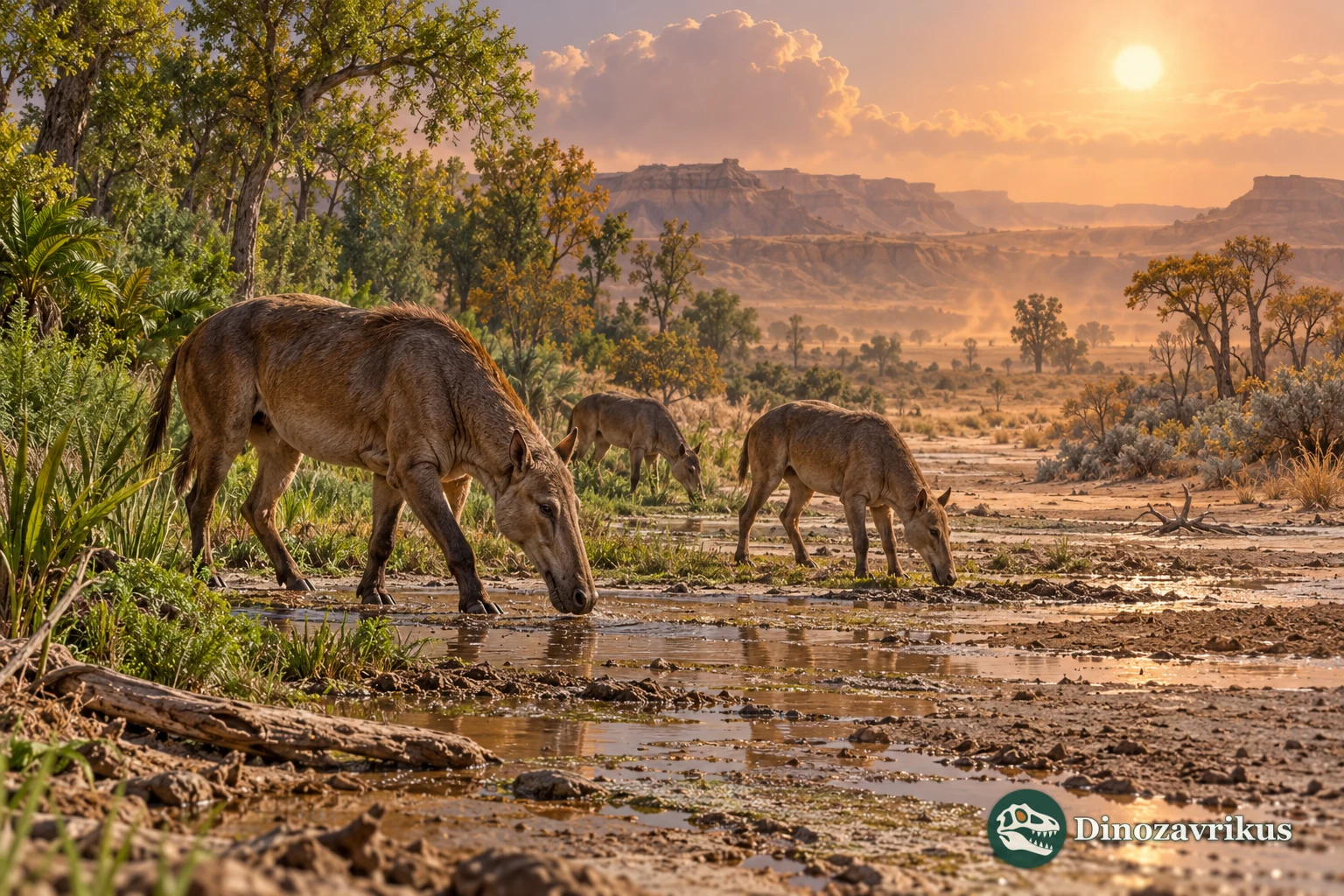
Dissacus belonged to Mesonychia, an extinct lineage of hoofed mammals with carnivorous teeth. Its long-snouted outline can look dog-like in artwork, but this resemblance does not make it a wolf or a close relative of living carnivorans. Comparisons with the better postcranial record of Mesonyx can help frame the broader group, but body proportions and ecology should not be transferred automatically from one genus to another.
The exact appearance in the cover scene remains uncertain. No fur, colour pattern or complete skeleton of the featured animal is represented by the holotype. The reconstruction is a way to picture a plausible mesonychid, while the reliable conclusions come from the fossil teeth, jaws, stratigraphy and measured surface textures.
Reading the evidence in context
The Bighorn Basin record lets researchers compare faunas through a narrow interval of geological time. Fossil horizons, isotope records and biozones help place each specimen relative to the PETM. A locality label alone is not enough: two animals found in the same basin may come from different layers and ages.
For Dissacus, the most compelling story is therefore a sequence of testable comparisons: teeth before, during and after warming; microwear traces associated with food mechanics; and body-size estimates with small sample sizes. These findings make the genus valuable for studying ecological response without claiming that every uncertainty has been resolved.
Frequently asked questions
When did Dissacus praenuntius live?
It is known from late Palaeocene and early Eocene deposits. The Wa-0 sample overlaps the PETM, about 56 million years ago.
Was Dissacus a dinosaur or a wolf?
Neither. It was a Paleogene mammal in the extinct group Mesonychia. A dog-like outline in art is only a visual analogy.
What did Dissacus eat?
Its teeth support animal-based feeding, and microwear suggests it consumed bone. The fossils do not identify exact prey or prove whether it hunted or scavenged.
Did Dissacus shrink because of the PETM?
That remains uncertain. Late-PETM tooth measurements suggest a possible decrease, but the sample is too small for a confident evolutionary conclusion.