

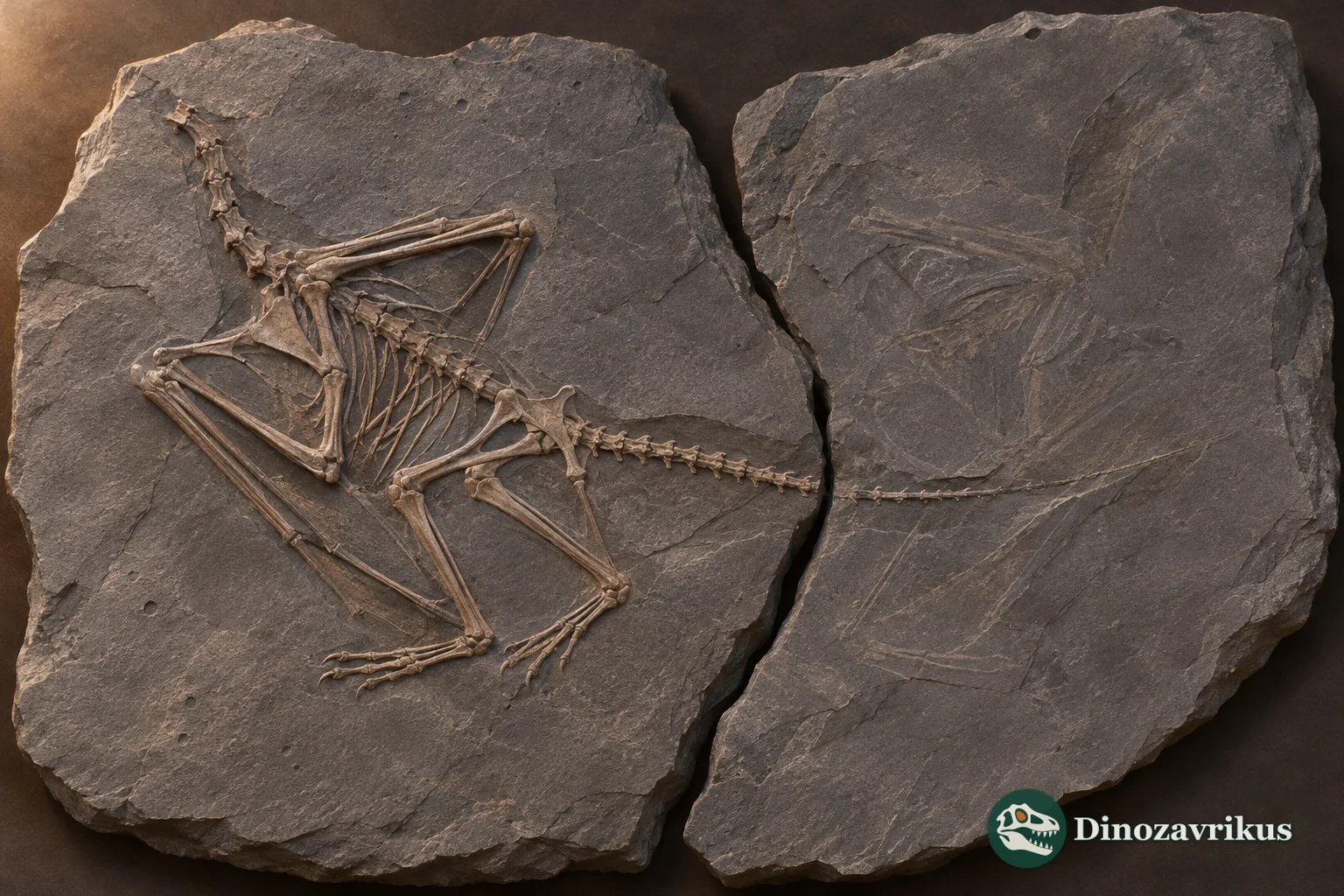
Douzhanopterus zhengi is known from an articulated body skeleton on a slab and counterpart from western Liaoning. Its skull is missing, but the tail, wing bones and fifth toe give unusually direct evidence for comparing long-tailed Jurassic pterosaurs with pterodactyloids. This combination places it near their branch in one published analysis; it does not identify the individual as a direct ancestor. The head in the cover artwork is imagined.
Quick facts
| Scientific name | Douzhanopterus zhengi, Wang and colleagues, 2017 |
|---|---|
| Holotype | STM 19–35A and B, slab and counterpart |
| Repository | Shandong Tianyu Museum of Nature, China |
| Locality | Linglongta, Jianchang County, Liaoning |
| Age | Early Late Jurassic in the describing study |
| Preservation | Nearly complete postcranial skeleton; skull absent |
| Tail | 22 vertebrae, 83.86 mm in total |
| Wingspan | About 0.74 m, calculated from limb elements |
What can the fossils tell us?
The counterpart plates preserve vertebrae, girdles and limbs in articulation. Teeth, snout shape and feeding behaviour are unknown because the skull is absent.
The 83.86 mm tail is about 1.73 times the humerus length. Its intermediate proportion is a comparison between fossils, not a direct ancestral link.
The first phalanx measures about one fifth of the third metatarsal. This ratio contributes to a phylogenetic analysis but does not reveal a gait.
Fused wrist, shoulder and lower-leg elements led the authors to regard the small specimen as osteologically mature.
A purchased slab with a precise anatomical record
The type specimen STM 19–35 is held at the Shandong Tianyu Museum of Nature. The authors reported that the museum bought it from a local farmer and reassessed its source using the surrounding rock and their fieldwork at Linglongta. They described it in 2017. The genus name evokes the title awarded to Sun Wukong in Journey to the West; the species name honours Xiaoting Zheng, who supported the research.
Slab and counterpart retain articulated cervical, dorsal, sacral and caudal vertebrae, shoulder and pelvic elements, and much of both pairs of limbs. There is no skull. It would be misleading to use a reconstructed head as a diagnostic feature or infer a diet from unpreserved teeth. Daohugoupterus, known from a different fossil assemblage, cannot fill those gaps.
A tail unlike either extreme
The study counted 22 caudal vertebrae with a combined length of 83.86 mm. Long processes brace the anterior series; the terminal centra become tiny. Relative to its 48.49 mm left humerus, the tail is about 1.73 times as long. Several non-pterodactyloid relatives have far longer tails in comparable proportions, whereas pterodactyloids have much shorter ones.
The wing metacarpal is about 53% of the ulna length. The fifth toe retains two short phalanges, with the first only about 20–23% of metatarsal III. The authors analysed these character ratios and placed Douzhanopterus near the pterodactyloid branch. They compared it with Darwinopterus and Kunpengopterus, while noting that some basal relationships were sensitive to taxon sampling. A branch placement is a research inference rather than a fossil sequence of direct ancestors.
Size, maturity and a disputed bed correlation
The original wingspan estimate is about 0.74 m. It was calculated by doubling the summed lengths of the coracoid, humerus, ulna, wing metacarpal and four wing phalanges, not by measuring a preserved membrane. Fusion in the wrist, scapulocoracoid, tibia and fibula, along with the extensor tendon process, supported the interpretation of a mature individual despite its modest size.
The authors assigned the Linglongta fossil to the Daohugou beds or Tiaojishan Formation and treated it as early Late Jurassic. Correlation of these beds has been debated, so that interpretation is more defensible than a precise date for this particular slab. No stomach contents, hunting traces or original colour were preserved.

Frequently asked questions
Why does artwork show a head when none was found?
Artists add a plausible head from relatives. STM 19–35 lacks a skull, so its exact shape and teeth remain unknown.
How was its wingspan estimated?
The authors doubled the sum of measured shoulder and wing bone lengths and obtained approximately 0.74 m. No membrane span was measured directly.
Was the small specimen immature?
Fusion in several wrist, shoulder and leg elements led the original authors to regard it as osteologically mature.
Was Douzhanopterus a direct pterodactyloid ancestor?
That cannot be established from one fossil. A published analysis placed it close to the branch using tail, wing and foot characters.