

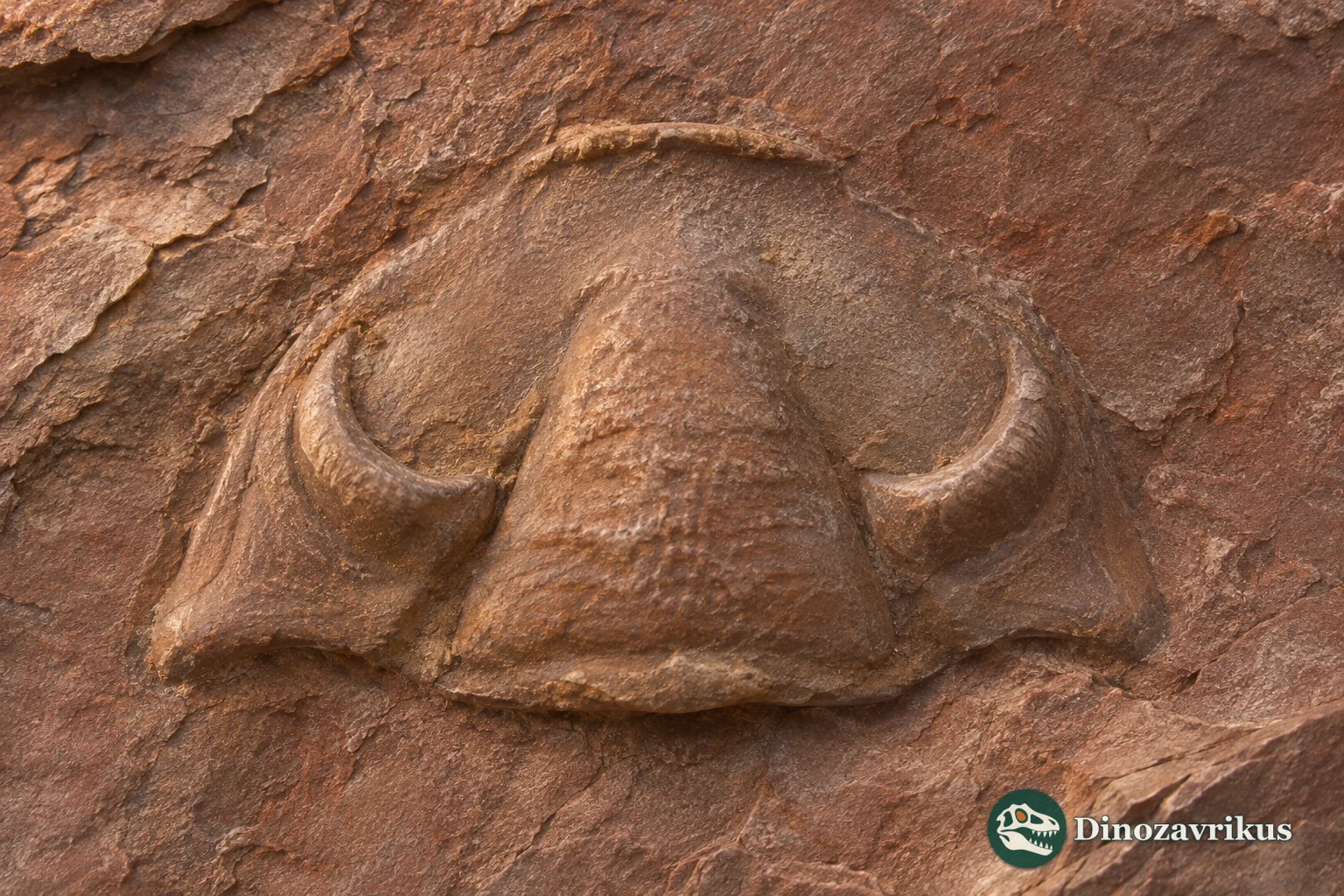
Drabia was a Late Cambrian trilobite genus from North America. Its head shield has a trapezoidal central lobe and conspicuous crescent-shaped eye lobes. The long axis of its tail shield helped distinguish Drabia from trilobites with similar heads.
Quick facts
| Group | Trilobites |
|---|---|
| Age | Late Cambrian, Furongian |
| Region | North America (United States and Canada) |
| Diet | Unknown |
| Type species | Drabia acroccipita |
| Genus named by | James Lee Wilson, 1951 |
What can the fossils tell us?
D. acroccipita was named from fossils from the Ore Hill Member of the Gatesburg Formation in Pennsylvania.
The rings and the terminal piece extend along nearly the full length of the oval shield. The furrows on either side are faint.
The Lyell Formation holotype of D. occidentalis retains crescent-shaped eye lobes and much of its granular surface.
Appalachian and western Canadian finds
James Lee Wilson established Drabia in 1951. The type species, Drabia acroccipita, comes from the Ore Hill Member of the Gatesburg Formation in south-central Pennsylvania. The same formation also yields Buttsia. D. acroccipita was later recorded in the Davis Formation of Missouri.
Stephen Westrop described D. occidentalis from the Elvinia Zone of southern Alberta. Its holotype is a cranidium from the Lyell Formation at Chaba Creek. Other material from the Lyell and Bison Creek formations includes separate tail shields. The head has a short, steeply sloping frontal area and a granular surface over much of the cranidium.
What the tail shield changed
Drabia was tentatively assigned to the Elviniinae on the basis of the head. The tail axis turned out to be longer and more finely divided than in that group. Westrop compared its tail and eye lobes with those of Cliffia. Later work proposed including both genera in the family Cliffidae along with Aphelotoxon.
The depth of the furrows provides another clue. Those dividing the outer areas of the tail shield are clearer in Cliffia and faint in Drabia. This difference helps when head and tail shields are recovered separately.
Frequently asked questions
Which species defines Drabia?
D. acroccipita, from the Ore Hill Member of the Gatesburg Formation in Pennsylvania.
What distinguishes the tail shield of Drabia?
The axis extends almost to the rear edge and has four to six rings followed by a terminal piece.
Which species was described from Alberta?
D. occidentalis. The holotype was found at Chaba Creek in the Lyell Formation.
How do the head shields of Drabia and Cliffia differ?
Cliffia has more forward eye lobes and more inflated fixed cheeks.