

Drepanodus is a genus of conodonts recognised from separate mineralised elements. Its type species, Drepanodus arcuatus, was named by Karl Heinrich Pander in 1856. Later researchers returned to material from the Baltic type region and compared large Swedish collections to clarify which curved forms belonged to this species.
Even a rich collection does not show a complete conodont. The elements are small and often occur separately; damage or mineral infill may obscure diagnostic details. The genus is important for the changing interpretation of element apparatuses and the wide Ordovician record of some species, but its body remains unknown.
The early animal catalogue gathers marine fossil taxa; the catalogue’s broad scope does not alter the Ordovician age of Drepanodus.
Quick facts
| Scientific name | Drepanodus Pander, 1856 |
|---|---|
| Type species | Drepanodus arcuatus Pander, 1856 |
| Group | Conodonts, early vertebrates |
| Main material | Separate phosphatic elements |
| Key revision | Topotype material and Swedish collections, 2003 |
| Studied range | Early to Middle Ordovician; records span varied regions |
| Articulated body | Not known for this genus |
| Limit | Element counts and positions vary among revisions |
What can the fossils tell us?
Pander described D. arcuatus in 1856. A 2003 revision examined topotype material from the St Petersburg area, including a specimen designated as neotype. Similar-looking elements from other samples are not automatically this species.
Researchers compare cusp curvature, base shape, margins, lateral faces and basal cavities. Breakage or mineral filling can hide traits needed for a confident species assignment.
Studies differ in how many morphotypes they distinguish and where they place them. Isolated finds require comparative reconstruction; no single arrangement is preserved as a complete mouth.
D. arcuatus has been reported from Ordovician collections in the Baltic region, Sweden and elsewhere. Those sections have different ages and settings, not one simultaneous population.
Pander and the type species
Pander described Drepanodus arcuatus in his 1856 monograph on fossils from the Russian-Baltic provinces. At the time, conodonts were interpreted as fish remains because many elements resemble teeth. Rare articulated fossils of other conodont genera later revealed a notochord and muscle blocks, supporting their placement among early vertebrates. Those body fossils do not belong to Drepanodus.
Later authors differed in how they separated simple coniform elements and reconstructed apparatuses. A curved cusp alone is insufficient for identification. The shape of the base, margins and lateral surfaces, as well as basal cavities, help distinguish species; preservation may erase exactly those features.
Revising Drepanodus arcuatus
In 2003, Anita Löfgren and Tatiana Tolmacheva examined topotype material from the Prioniodus elegans Zone in the St Petersburg area and large Swedish collections. Their paper designated specimen LO 8468T as a neotype and traced Swedish D. arcuatus from the Tremadocian Paltodus deltifer Zone to the base of the Darriwilian Pygodus serra Zone.
The study also separated related forms, including D. reclinatus, and named D. parformis. This matters for distribution maps: similar isolated elements from different places should not be merged without checking the diagnosis and type material. Literature reports extend broadly through the Ordovician, but confidence at the range limits depends on identification quality and species concepts.
Elements and apparatus models
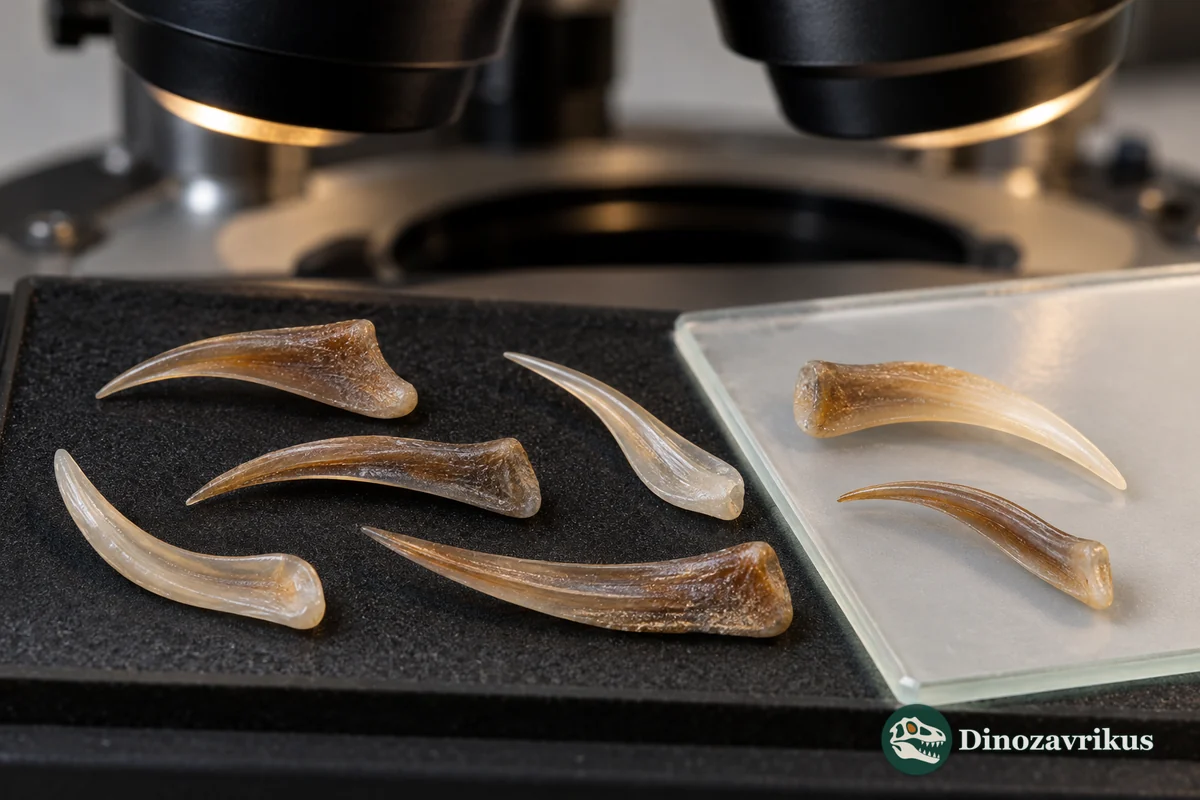
Each conodont element has a cusp, base and surfaces that may carry ridges or costae. In studied Drepanodus samples, some forms have a long base and curved cusp, while others differ in symmetry and proportions. These traits help build groups, but resemblance does not prove that all pieces came from one individual or even one species.
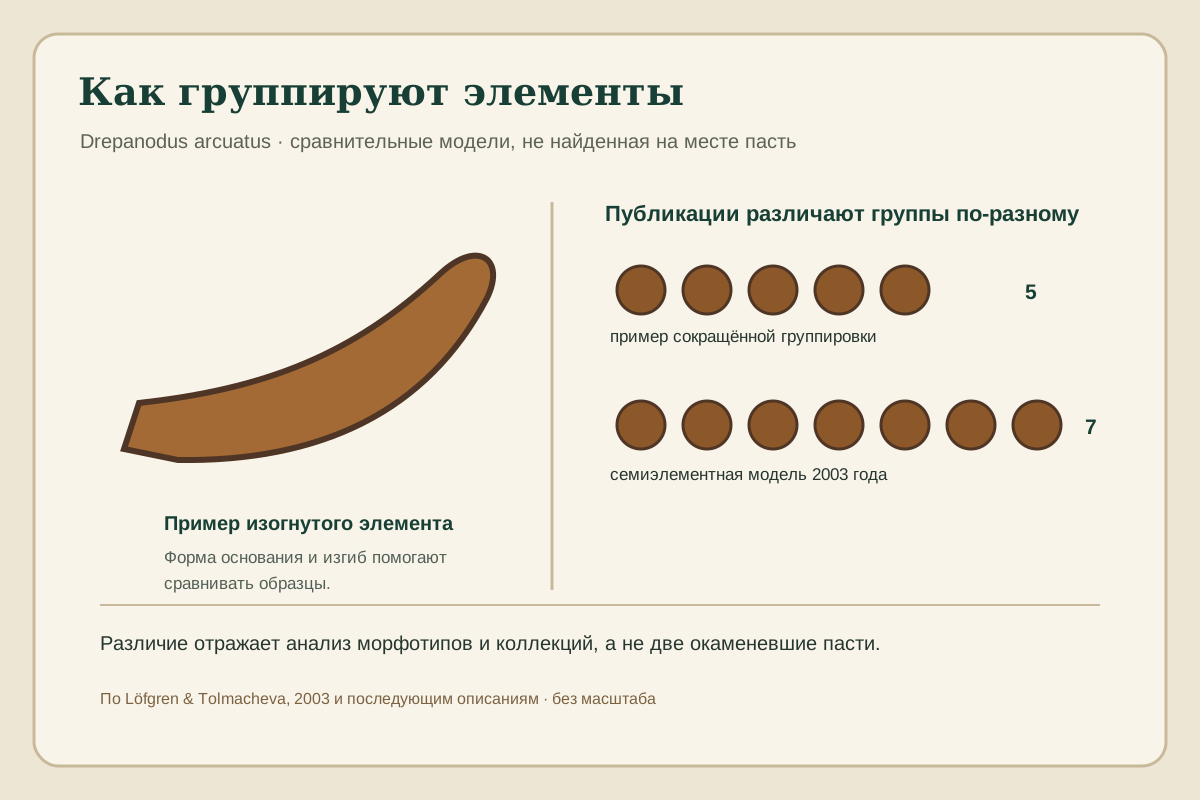
The apparatus of D. arcuatus has been reconstructed in different ways. Löfgren and Tolmacheva described a seven-morphotype model; later accounts have distinguished fewer forms or interpreted their positions differently when working with other collections. The changing counts concern comparative morphology and sampling, not alternative mouths found fossilised in place.
Age and geography
D. arcuatus is among the widely reported Ordovician conodont species. The 2003 revision compared Swedish material from the Tremadocian through the Darriwilian with records from the Baltic region. Other Ordovician collections extend its reported geographic range. Sites of different ages do not represent animals living together, and the compiled record does not provide an exact date of biological origin or extinction.
Conodont elements are useful for correlating strata, but an individual specimen’s age comes from its section and accompanying fauna. The Ordovician overview provides geological context, while Protopanderodus offers a related case of apparatus reconstruction from isolated elements.
What the fossils say about the animal
Conodonts are regarded as early vertebrates, but no Drepanodus specimen preserves a notochord, muscles, fins or internal organs. Exceptional body fossils from other genera inform group-level comparison only. The elements do not establish the total length or mass of this genus.
Apparatus shape may help assess how mouth structures worked, but a precise diet is unknown. Drepanodus should not be called a predator merely because its elements resemble small teeth. Swimming speed, depth, seasonal movement and social behaviour are likewise not demonstrated by the available fossils.
Frequently asked questions
Who named Drepanodus?
Karl Heinrich Pander named the genus and type species D. arcuatus in 1856.
Where was the type material studied?
A 2003 revision examined topotype material from the St Petersburg area and substantial Swedish collections.
Why are similar elements not always the same species?
Identification uses the base, edges, lateral surfaces and basal cavity as well as curvature; breakage can hide these features.
Is the body of Drepanodus known?
No articulated body is known for the genus. Conodonts are classified among early vertebrates from evidence for the group, but body size and soft anatomy of Drepanodus remain unknown.