

Drepanosorex names an extinct Pleistocene shrew lineage from Eurasia. Its fossils are mainly small teeth and jaws rather than whole bodies. Some studies accept a separate genus, while others write Sorex (Drepanosorex) and rank it as a subgenus. These are competing classifications of related material, not two different animals. The cover suggests a shrew-like body; fossil jaws cannot reveal its fur color.
Comparisons among Villány, Tegelen, West Runton and a Caucasian cave show how distinct sites contribute different parts of the record. The boundaries between species and the proposed evolutionary sequence depend on combined dental characters and the age of each assemblage.
Quick facts
| Group | Soricidae; genus or Sorex subgenus in different studies |
|---|---|
| Type species | D. tasnadii Kretzoi, 1941, synonymized with earlier D. savini |
| Age | Early and Middle Pleistocene; sites and species differ in age |
| Range | Europe and the northern Caucasus |
| Evidence | Skull pieces, jaws, incisors and cheek teeth |
| Diagnostic combination | Fissident upper incisor and enlarged anterior cheek teeth |
| Diet | Specific prey is not documented by these fossils |
What can the fossils tell us?
Kretzoi named D. tasnadii in 1941. Reumer's revision, issued in 1985, reported its synonymy with the earlier D. savini. That judgment compares dental and jaw characters, not a complete skeleton.
A split-tipped upper incisor and bulbous antemolars help identify specimens. Some other Sorex also have fissident incisors, so one tooth cannot settle the generic rank.
S. (D.) savini is common in the West Runton fluvial assemblage. That context prompted an aquatic-habitat hypothesis, but it does not establish how the animal hunted or where it spent most of its life.
How the name and type were established
Miklós Kretzoi erected Drepanosorex in 1941 for D. tasnadii from Gombaszög. Jelle Reumer's revision treated it as a genus but reported Jánossy's synonymy of its type with D. savini, a shrew named by Hinton in 1911 from West Runton, England. The name attached to the genus can therefore differ from the valid older name used for that species.
Reumer also examined D. praearaneus from Villány in Hungary and Tegelen in the Netherlands. Its type is a partially toothed skull from Villány, MÁFI Ob.3681. He regarded it as the earliest known member of the lineage and discussed a series of later forms. Similarity across time is evidence for an evolutionary hypothesis, not a documented parent-to-offspring chain.
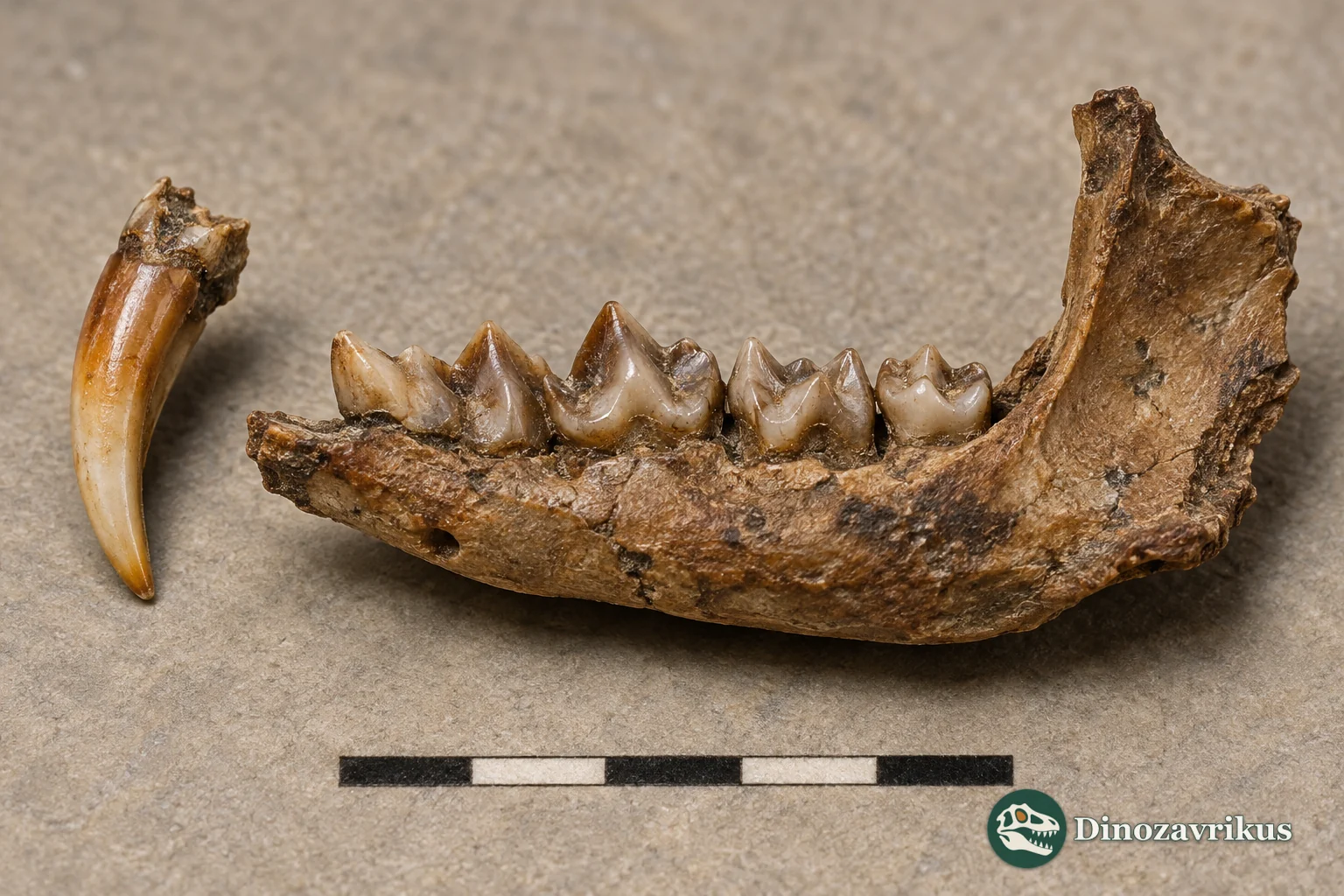
What teeth and jaws actually show
A fissident upper incisor has an extra small cusp. Enlarged, outward-bulging antemolars add another characteristic of the group. Reumer cautioned that fissident incisors also occur in some ordinary Sorex, so he compared the whole tooth row and the mandibular joint rather than using a single incisor as a genus label.
Maul and Parfitt described one upper incisor, seven maxillary pieces, nine lower incisors, 53 mandibular fragments and five isolated lower molars of Sorex (Drepanosorex) savini from the 1995 West Runton sample. These are element counts, not a census of individual shrews. Its third upper antemolar is relatively broad beside the fourth, providing a useful comparison with other Sorex forms.
A Caucasian record and a river assemblage
Zaitsev and Baryshnikov named Drepanosorex rupestris from Middle Pleistocene deposits of Treugolnaya Cave in the northern Caucasus in 2002. It was one of ten soricid species they reported. A cave fossil expands the known geographic record but does not by itself prove the shrew lived inside the cave.
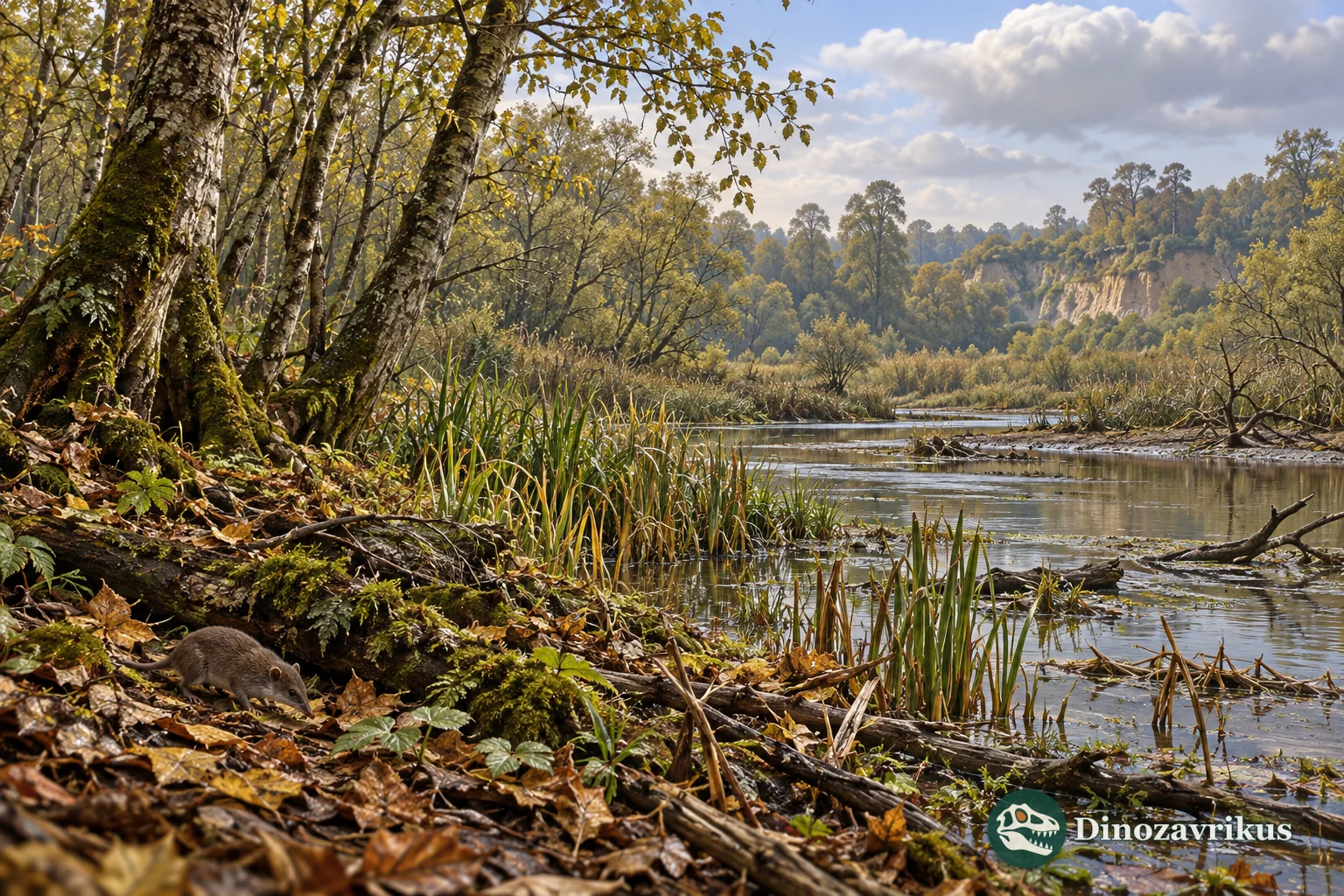
The many savini pieces at West Runton are associated with a river deposit. Their abundance once supported a suggestion of water-associated behavior. Depositional setting cannot distinguish an animal that lived permanently near water from bones transported into a river. The pictured landscape illustrates one possible Quaternary setting, not the range of every species.
Limits of a living reconstruction
Tooth and jaw dimensions can compare fossil populations, but do not directly yield a precise body mass or length for every extinct form. The cited remains do not preserve coat color, litter size or identifiable prey. The island shrew Nesiotites shows another branch of soricid diversity, without implying close kinship to Drepanosorex. The cover is a plausible shrew illustration, not a portrait of a measured D. savini specimen.
Frequently asked questions
Is Drepanosorex a genus or a subgenus?
Both usages occur. Reumer treated it as a genus, while the West Runton study wrote Sorex (Drepanosorex).
What fossils are known?
The main evidence is skull fragments, jaws and teeth. Published element counts from West Runton are not individual counts.
Why is its incisor important?
The split-tipped upper incisor helps when combined with the shape of other teeth and the jaw. It is not unique on its own.
Did it live in water?
River deposits prompted that hypothesis, but a fossil's place of preservation cannot establish the shrew's behavior.