

Ectypodus was a small multituberculate mammal known mainly from isolated teeth and jaw fragments in Paleocene and Eocene North America. A few finds offer a wider view: skull material is known for the early Eocene species E. tardus, while the Arctic species E. arctos was named from a single lower premolar.
Multituberculate teeth carry rows of cusps that preserve useful taxonomic detail. They also create a challenge: wear, tooth position, age and ordinary variation can make specimens look more different or more similar than they are. Ectypodus is included in the ancient mammal catalogue with related multituberculates, but its species boundaries remain an active research question.
Quick facts
| Scientific name | Ectypodus Matthew & Granger, 1921 |
|---|---|
| Group | Multituberculata, family Neoplagiaulacidae |
| Age | Paleocene and Eocene records in North America |
| Range | Western North America and Arctic Canada |
| Common fossils | Isolated teeth and jaw fragments |
| Rare evidence | Skull material of E. tardus; a single premolar holotype for E. arctos |
| Open question | How much tooth variation separates named species |
What can the fossils tell us?
Multituberculate teeth can be compared by crown shape, cusp rows and measurements. An isolated tooth cannot be assigned to a jaw or individual, and position, wear, age and variation affect the features being measured.
Skull material assigned to the early Eocene species E. tardus from Wyoming helps connect dental traits with a broader cranial anatomy. Most records remain fragmentary, so it does not provide a complete picture of every species.
A 2025 conference abstract reports hundreds of Bighorn Basin teeth studied with micro-CT. Its preliminary work evaluates variation in E. powelli and E. tardus; it is not yet a final peer-reviewed taxonomic revision.
The holotype of E. arctos is a fourth lower premolar from Ellesmere Island, Arctic Canada. It extends the known high-latitude record of multituberculates, but one tooth cannot reveal a full skeleton or detailed ecology.
A mammal often found one tooth at a time
William Diller Matthew and Walter Granger named Ectypodus in 1921. The genus belongs to Neoplagiaulacidae, within the extinct order Multituberculata. Its fossils are small, and isolated teeth are far more common than associated skeletons. Screenwashing sediment can recover many such teeth from deposits that otherwise reveal little about small mammals.
The Smithsonian’s record for Ectypodus grangeri, for example, lists a mandible and teeth from the Torrejonian of the Paleocene. The specimen illustrates how a jaw fragment can preserve more context than a loose crown while still leaving much of the body unknown.
Compare Ptilodus and Meniscoessus, two other multituberculates in the catalogue. Their shared order does not mean that their anatomy or ecological roles can be inferred from one another.
What a multituberculate tooth can show
Multituberculate cheek teeth have several rows of cusps, and different tooth positions have distinct shapes. Researchers compare crown outline, cusp number and arrangement, ridges and measurements to identify fossils. These characters are especially valuable when teeth are the only remains available.
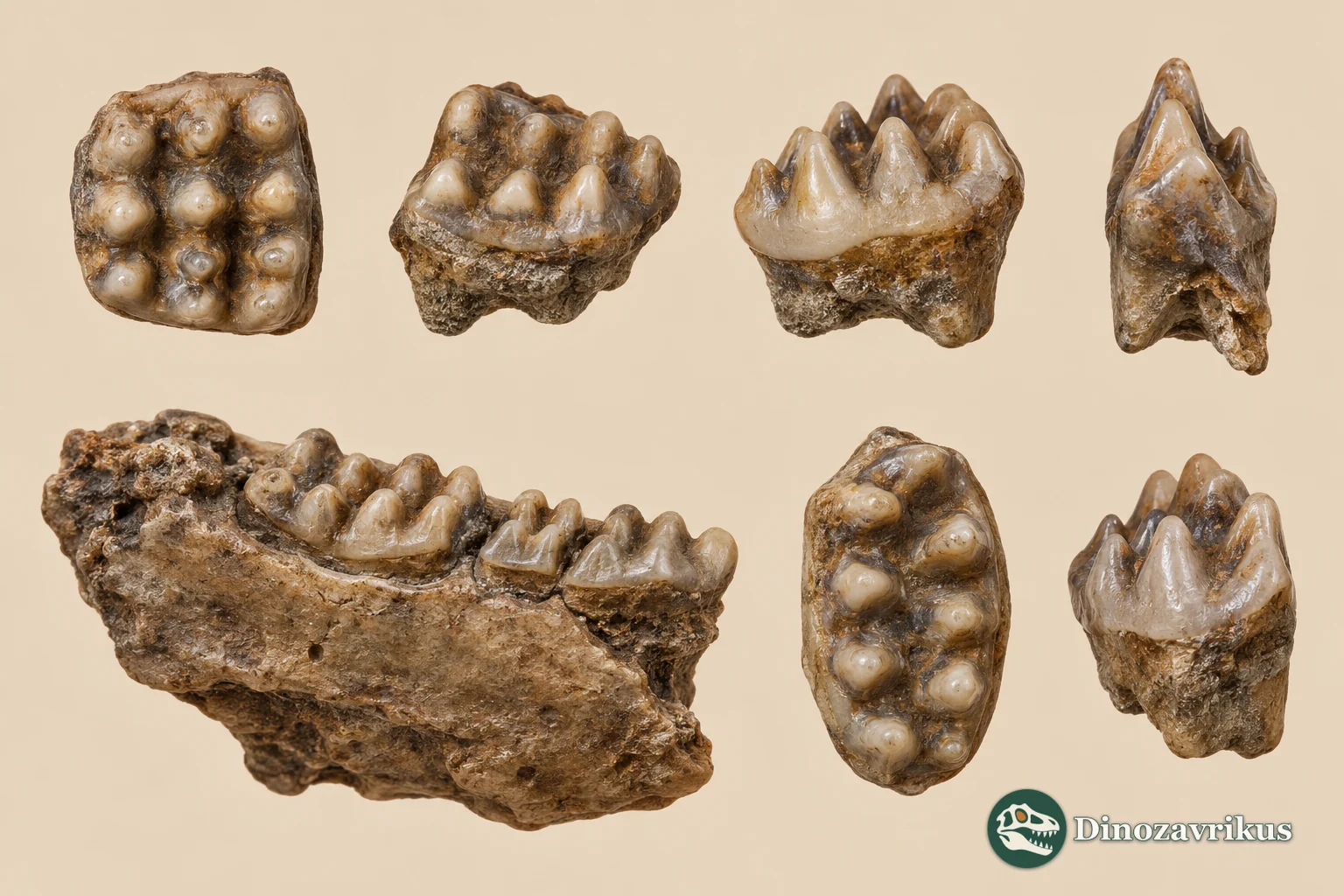
An isolated tooth does not reveal which individual it belonged to, how its jaw moved or what the entire skull looked like. Its shape also reflects its position in the tooth row and the degree of wear. If samples are small, natural variation can be mistaken for a species difference, while distinct species may appear similar in the limited traits that survive.
Gregg Ostrander’s 1984 study described 47 teeth referred to Ectypodus from the Raben Ranch local fauna in Nebraska. He concluded that this local sample represented one species. That conclusion concerns the Raben Ranch teeth and comparisons available in the study; it does not collapse the entire genus into one species.
Rare skull evidence and the Arctic record
Ectypodus tardus from the early Eocene of Wyoming is notable because skull material is rare among small multituberculates. Cranial evidence lets researchers connect dental anatomy with features beyond the tooth crown. It remains one species-level window rather than a complete anatomical record for the genus.
The Arctic species Ectypodus arctos was described from a fourth lower premolar found on Ellesmere Island in northern Canada. Beard and Dawson presented it in 2014 as the northernmost global record of Multituberculata. The fossil establishes that a multituberculate reached a high latitude during the Eocene; a tooth alone cannot tell us how it coped with seasonal darkness or what habitat it preferred.
More fragmentary referrals should be treated with care. A specimen assigned to a named species may contribute to a range map, but the confidence of that assignment depends on how diagnostic its preserved tooth is and how well it can be compared with the holotype.
New scans and a taxonomic question
In a 2025 Geological Society of America conference abstract, researchers reported hundreds of isolated multituberculate teeth from latest Paleocene and earliest Eocene sediments in Wyoming’s Bighorn Basin. They examined first lower molars of Ectypodus with micro-CT, three-dimensional segmentation and landmark-based measurements. The work focuses on how much morphological variation occurs within samples and whether it supports the currently recognised E. powelli and E. tardus.
The authors stress that the named species are based on only a handful of specimens. Their abstract offers a preliminary analysis, not a final peer-reviewed revision. It is nevertheless a useful example of how a larger sample can test old categories rather than simply add names to a list.
Micro-CT allows researchers to capture three-dimensional form without cutting into a fossil. It can improve measurement and comparison, but more precise scans do not by themselves solve taxonomy. The conclusion still depends on sample size, selected landmarks, variation through time and the quality of specimens tied to each name.
What the record cannot yet reconstruct
Teeth can constrain classification and provide clues about how food was processed, but they do not identify an exact diet without additional evidence. The material reviewed here does not establish a universal body-mass value, a typical gait, an arboreal lifestyle or reproductive behaviour for Ectypodus. Those claims would require suitable jaws, skeletons or independent ecological evidence.
The genus is most informative when the evidence is kept at its proper scale: a tooth supports statements about that tooth, a jaw about its preserved row, and a skull about the specimen assigned to it. The broader picture is a diverse, widespread fossil lineage whose details remain unevenly known. That unevenness is part of the scientific story, not a gap to fill with guesswork.
Frequently asked questions
Was Ectypodus a rodent?
No. It was a multituberculate, a member of an extinct mammal lineage distinct from modern rodents.
What fossils are known for Ectypodus?
Most records are isolated teeth and jaw fragments. Skull material is known for the early Eocene species E. tardus.
What does Ectypodus arctos show?
Its holotype is a fourth lower premolar from Ellesmere Island, documenting a high-latitude Eocene occurrence of multituberculates. It does not reveal the full animal’s ecology.
Are all Ectypodus species clearly distinct?
Not yet. A 2025 conference abstract describes preliminary three-dimensional work on tooth variation; the study needs full publication and further testing.