

Edingerella lived in what is now Madagascar during the Early Triassic. Its fossil skulls range from small juveniles to larger individuals. Comparing them helped researchers trace changes in the head as the animal grew and reassess the names given to the fossils.
Quick facts
| Group | Temnospondyls, capitosaurs |
|---|---|
| Age | Early Triassic, Olenekian |
| Region | Africa: northwestern Madagascar |
| Type species | Edingerella madagascariensis |
| Scientific name | Edingerella |
| Diet | Exact prey is unknown |
What can the fossils tell us?
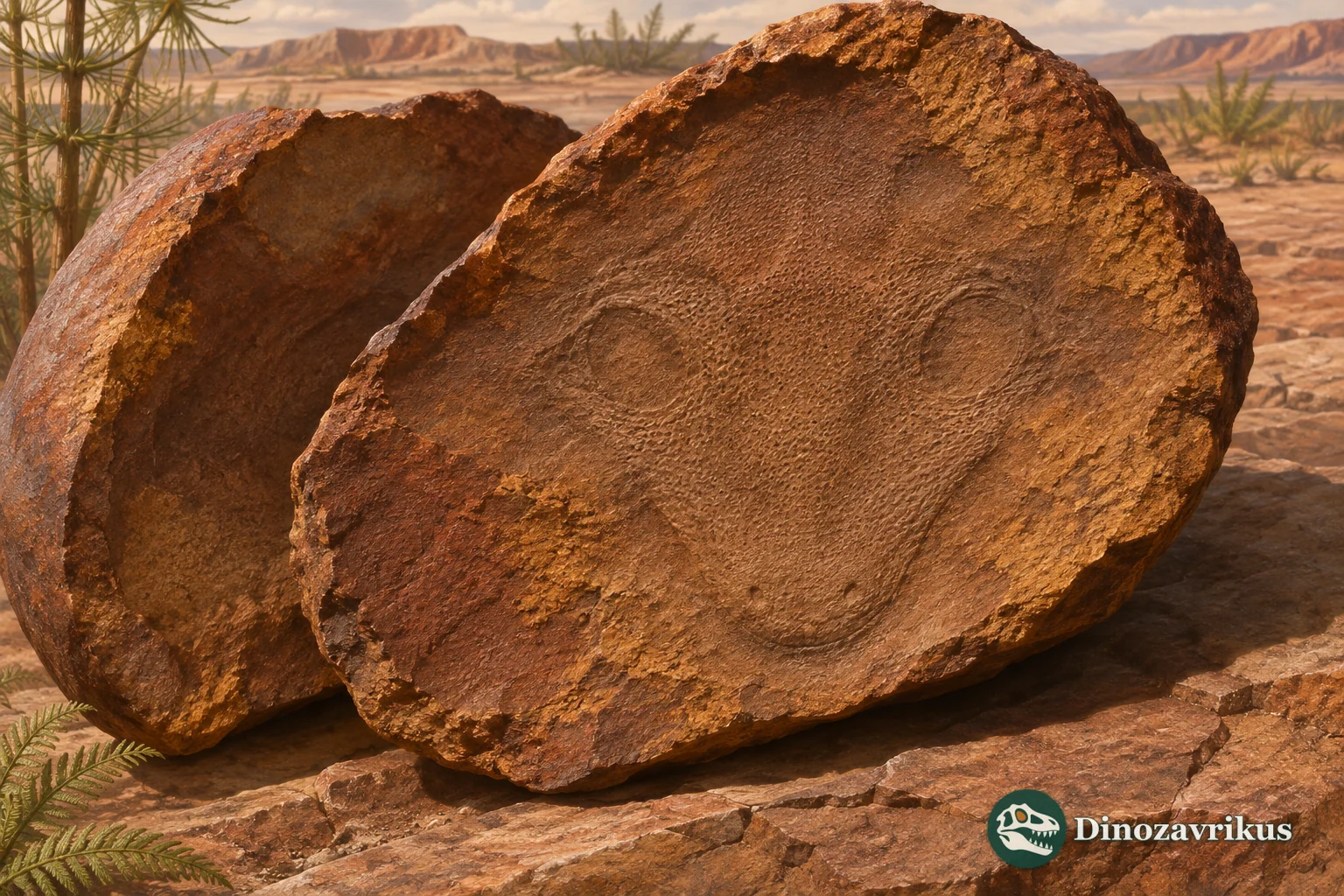
Ironstone nodules preserve natural moulds of skulls. Museum collections contain specimens from juveniles and larger individuals.
The arrangement of teeth on the palate provides points of comparison as the proportions of the skull change.
Simulations show how the skull responds to specified loads. They cannot identify the animals it ate.
Natural moulds in ironstone
Jean-Pierre Lehman described the material from northwestern Madagascar in 1961. The holotype, MNHN MAE 3003, comes from Madiromiary. A small ironstone nodule preserved the impression of a juvenile skull and part of its skeleton. Researchers made casts of these impressions to examine the details from several angles.
Changes in the growing head
Known skulls measure about 4.6 to 14.9 cm long. That range applies to the measured specimens. The region in front of the eyes lengthened during growth, and the eye sockets became relatively smaller. A curved row of teeth across the front of the palate is recognizable in both younger and older individuals.
Several names for one species
The Madagascan skulls were initially divided between Benthosuchus madagascariensis and Wetlugasaurus milloti. Later work united them as a single species, also called Parotosuchus madagascariensis and Watsonisuchus madagascariensis. Rainer Schoch and Andrew Milner proposed Edingerella in 2000. A detailed restudy of the skull in 2009 retained the genus.
What a simulated bite can reveal
A 2016 study tested several loading scenarios on three-dimensional skull models of Edingerella and Stanocephalosaurus. The simulations highlighted areas of stress during a bite on one side and other modelled movements. They give researchers a way to compare skull forms under the same conditions. The animal's actual hunting behaviour remains a matter of interpretation.

Frequently asked questions
Where was Edingerella found?
Its fossils come from northwestern Madagascar. The type specimen is from Madiromiary.
How long were the known skulls?
About 4.6 to 14.9 cm. These measurements describe skulls rather than total body length.
Why did these skulls have several names?
Specimens of different sizes were first assigned to separate species. A comparison of growth stages showed that the fossils belonged to one species.
What did researchers test with computer models?
They tested how different ways of seizing prey would distribute loads across the skull.