

Emarginachelys cretacea lived in western North America near the end of the Cretaceous. Its type specimen preserves skull and shell features that can be compared with two closely related groups of hidden-necked turtles. The initial description placed it near snapping turtles, while several later assessments favoured the kinosternoid stem.
Quick facts
| Group | Turtles, cryptodires (Cryptodira) |
|---|---|
| Age | Late Cretaceous, Maastrichtian |
| Region | North America (Montana, United States) |
| Type species | Emarginachelys cretacea |
| Holotype | KUVP 23488, skull, shell and parts of the skeleton |
| Formation | Hell Creek |
| Scientific name | Emarginachelys |
| Diet | Exact diet unknown |
What can the fossils tell us?
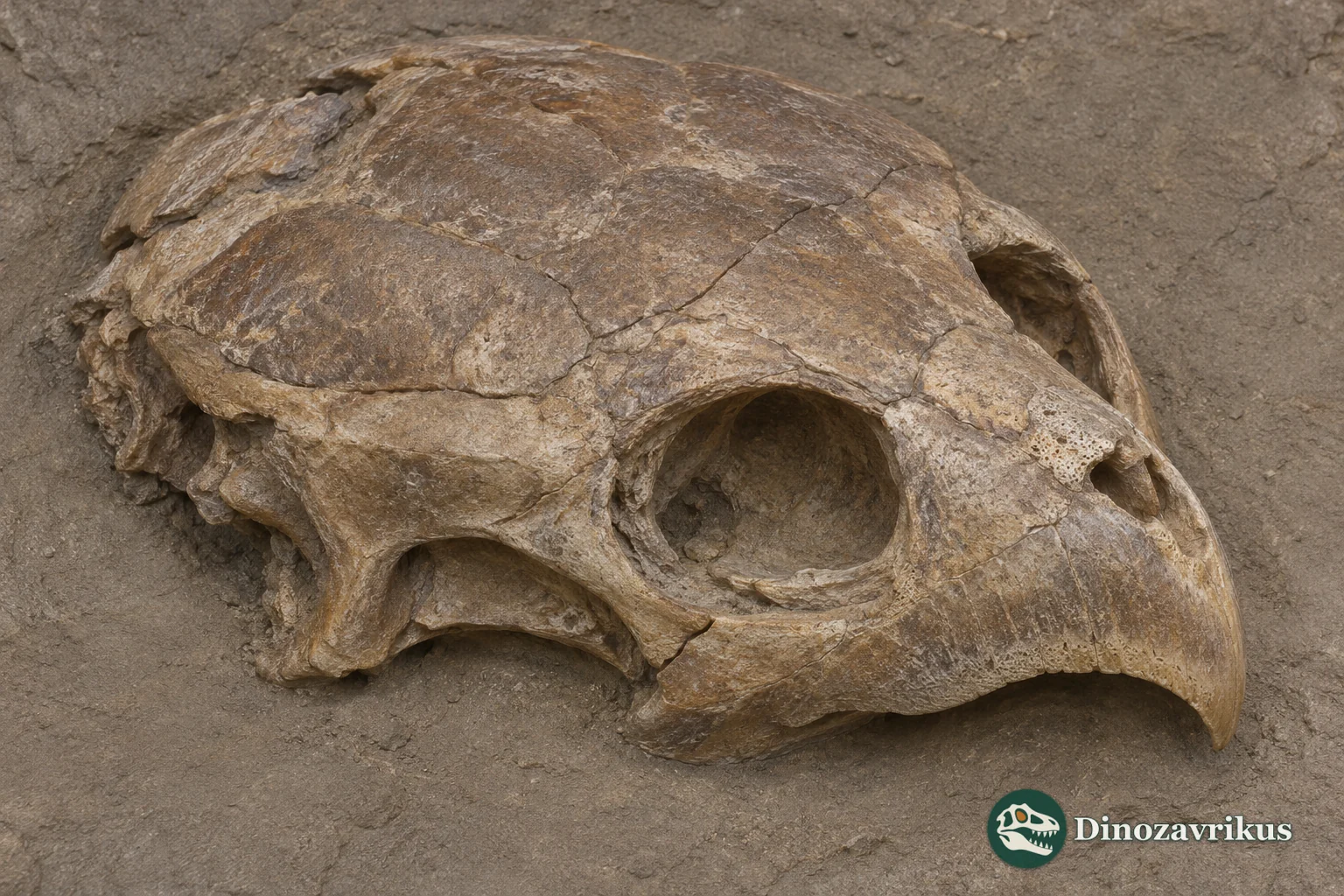
KUVP 23488 includes a skull without the lower jaw, a shell and parts of the limbs. These elements can be compared together because they belong to the same individual.
The lateral process of the nuchal reaches the third peripheral bone. This feature was used to support snapping turtle affinities, but the rest of the skeleton also bears on the analysis.
Some studies placed the genus on the snapping turtle stem. Later analyses recovered it on the kinosternoid stem.
The bones of the holotype
Kenneth Whetstone named the genus and species in 1978. The type, KUVP 23488, was recovered from the Hell Creek Formation of Garfield County, Montana, and is held in the University of Kansas vertebrate palaeontology collection. It preserves the skull without its lower jaw, the upper and lower shell, cervical vertebrae and parts of the limbs and their girdles.
Some of the digits are incomplete. The association of the skull, shell and limbs in one specimen still makes it possible to compare each region of the skeleton directly. Assigning loose material from elsewhere in the formation requires diagnostic features of its own.
Why its position changed
The original description placed the turtle among relatives of snapping turtles. Gregory Knauss and colleagues later supported that interpretation after inspecting the type. They drew attention to the nuchal, at the front of the upper shell. It bears a bony process that reaches sideways to the third peripheral bone, as it does in snapping turtles.
Walter Joyce and Jason Bourque treated it as a stem kinosternoid in 2016. An analysis published with the description of the French species Chelydropsis aubasi recovered that placement as well. Both interpretations concern the early history of closely related groups of cryptodiran turtles.
The Hell Creek setting
The Late Cretaceous rocks of Montana preserve several kinds of turtle in river and floodplain deposits. Gilmoremys from Hell Creek represents a soft-shelled lineage with a different shell construction. Emarginachelys adds a second form to this picture of the region's turtles. Its precise diet remains unknown.
Frequently asked questions
Where was Emarginachelys found?
The type specimen comes from the Hell Creek Formation of Garfield County, Montana.
What does the type specimen preserve?
It includes a skull without the lower jaw, a shell, vertebrae and parts of the limbs and girdles.
Which feature suggests affinities with snapping turtles?
A process from the nuchal bone extends to the third peripheral bone at the edge of the carapace.
Is there a confirmed record after the end of the Cretaceous?
The holotype comes from Maastrichtian strata and establishes the genus in the latest Cretaceous.