

Emeraldella brocki was a long-bodied Middle Cambrian arthropod with a smooth head shield, two fine antennae, many limbs and an elongated posterior spine. The best-known complete specimen, ROM 61148, measures about 202 mm from antennae to telson. That is the length of a fossil outline, not a body-mass estimate or a measurement of the trunk alone.
Charles Doolittle Walcott named Emeraldella in 1912. David Bruton and Harry Whittington published a detailed redescription in 1983, and Martin Stein and Paul Selden revisited its anatomy and relationships in 2012. The ancient arthropod catalogue places Emeraldella among fossils whose classification changes as researchers reinterpret preserved segments and limbs.
Quick facts
| Scientific name | Emeraldella brocki Walcott, 1912 |
|---|---|
| Group | Arthropod; 2012 analysis places it near the base of Artiopoda |
| Age | Middle Cambrian, about 505 million years ago |
| Locality | Walcott Quarry, Burgess Shale, British Columbia |
| Type specimen | Lectotype USNM 57702, Smithsonian National Museum of Natural History |
| Largest complete specimen | ROM 61148, about 202 mm including antennae and telson |
| Notable anatomy | Long antennae, biramous limbs and toothed gnathobases |
What can the fossils tell us?
The holotype USNM 57702 is about 120 mm long; ROM 61148 measures about 202 mm from antennae to telson. These are fossil outlines, not estimates of mass or trunk length alone.
Bruton and Whittington described 13 trunk somites. Stein and Selden later recognised 12 tergite-bearing segments plus a styliform telson, using a different character interpretation.
The 2012 restudy described differentiated endopods and tripartite exopods. Walking, feeding and respiratory functions are inferred from form, not directly observed.
Stein and Selden analysed 20 fossil arthropod taxa using 36 characters and placed Emeraldella near the base of Artiopoda in that analysis. The precise position remains dependent on dataset and anatomical interpretation.
The type specimen and successive studies
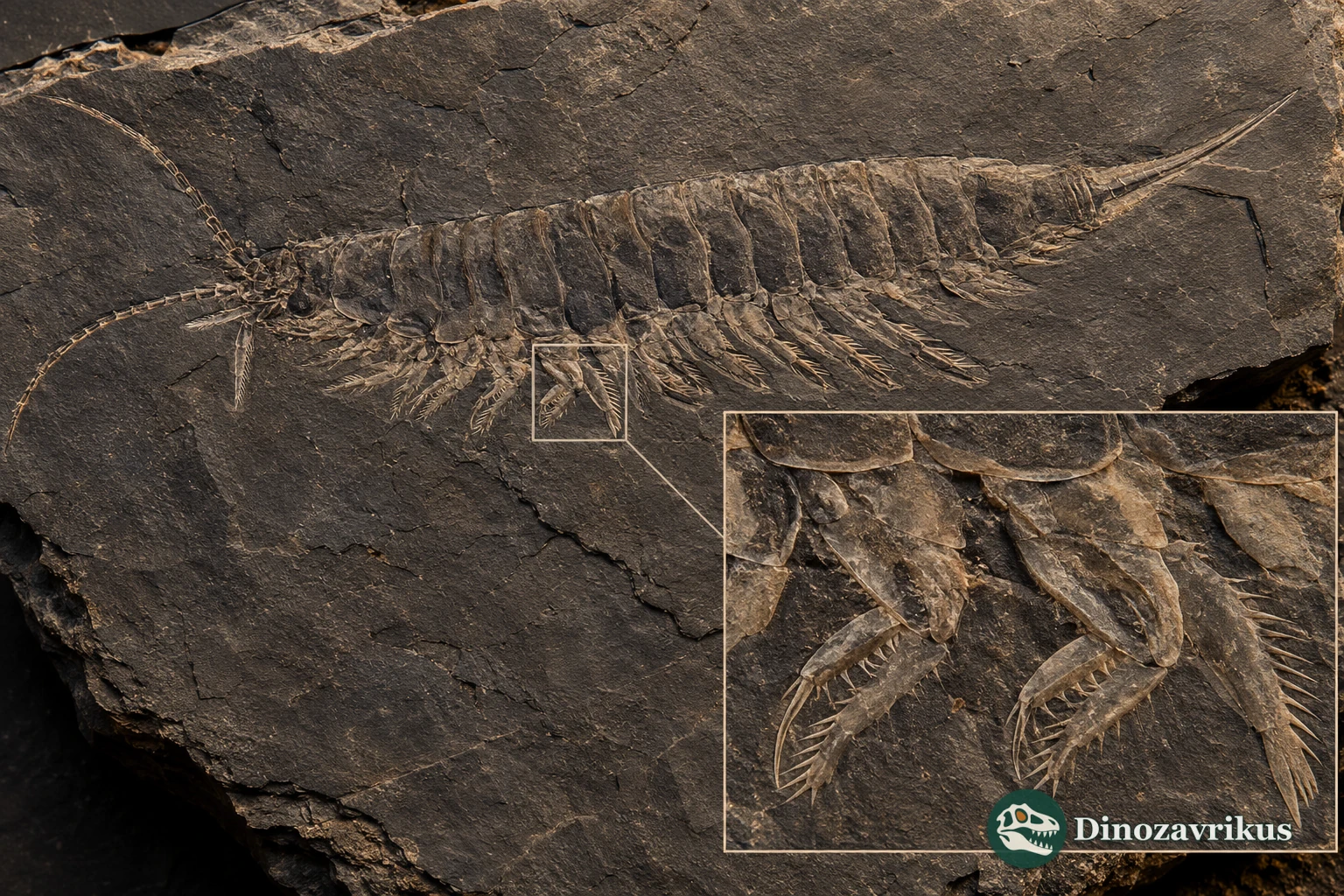
The lectotype USNM 57702 is housed at the Smithsonian National Museum of Natural History. It preserves the antennae, posterior spine and a dark central trace interpreted as the gut. Royal Ontario Museum specimens provide additional views: ROM 61147 is about 175 mm long, while the more complete ROM 61148 is about 202 mm including antennae and spine. These finds come from the Walcott Quarry of the Burgess Shale in British Columbia.
Walcott's 1912 description was followed by Bruton and Whittington's 1983 study of newly prepared material. Their interpretation divided the body into a cephalon and 13 trunk somites, with 11 pleural segments followed by two cylindrical posterior somites. Stein and Selden's 2012 restudy instead counted 12 tergite-bearing segments plus a styliform telson. The difference reflects how each study identifies boundaries in flattened fossils; it should not be erased by quoting a single segment count as uncontested.
Long antennae and a segmented body
The smooth head shield is semicircular, and the long antennae comprise many short articles. No eyes are clearly recorded in the museum's material, but absence from a compressed slab is not proof that the living animal lacked eyes. The trunk narrows toward the rear and carries repeated biramous limbs. Their inner branches consist of differentiated podomeres, while the broad outer branches have several lobes with fine lamellae or filaments.
Some inner limb bases bear robust spines called gnathobases. They are positioned to help process food near the backward-facing ventral mouth, an interpretation supported by anatomy rather than a directly observed feeding event. Outer branches may have served in respiration and perhaps short bouts of swimming, but the fossils do not record exact movement or swimming performance.
What does a length of 202 mm mean?
The 202 mm value for ROM 61148 includes the fine antennae at the front and the tail spine at the rear. ROM 61147 is about 175 mm overall; the lectotype is about 120 mm. The trunk itself is much shorter, and the reported body-only measurements vary according to which segments and preserved extensions are included. This is why an image that compares Emeraldella with a person would exaggerate certainty unless it explicitly used the complete fossil outline.
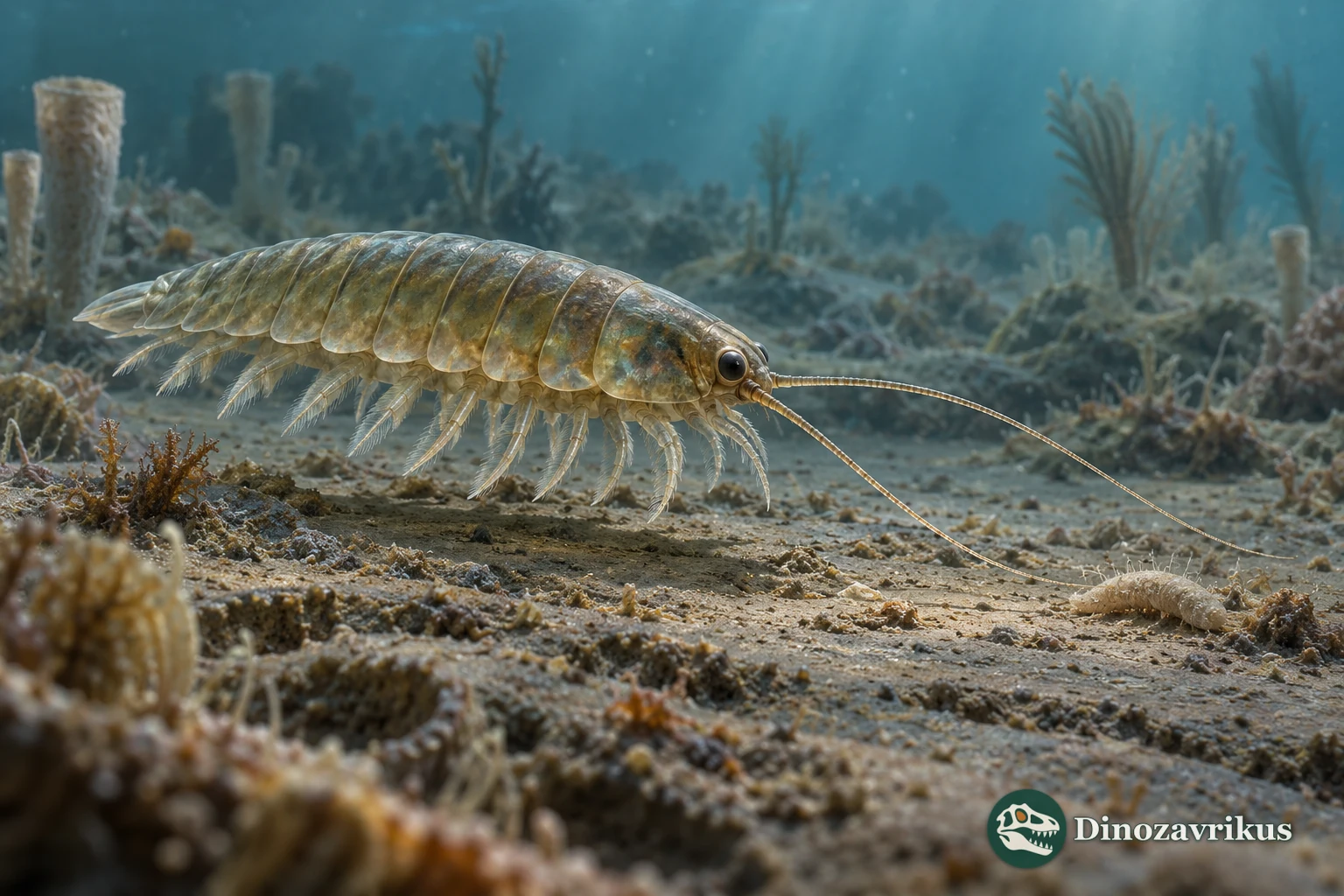
Its long antennae may have swept or sampled the muddy surface, while walking branches kept the body near the bottom. The jointed tail could flex, but the exact posture and swimming role are not directly recorded. The scene below is a reconstruction of a possible seafloor setting, not a claim about a specific encounter or hunting event.
Feeding and ecological interpretation
Spines on the inner limbs and robust gnathobases are consistent with handling or processing animal food. The Royal Ontario Museum characterises Emeraldella as a possible mobile predator, with antennae exploring the sediment and walking limbs drawing food toward the mouth. No specific prey item in the gut identifies its diet, so carnivory remains an anatomical and ecological inference rather than a direct observation.
At the Walcott Quarry, Emeraldella was rare compared with common deposit feeders. Rarity in a burial assemblage does not alone reveal whether the animal was naturally scarce, patchily distributed or less likely to be preserved. The Burgess Shale's extraordinary preservation allows comparison of structures usually lost, but it remains a snapshot filtered by burial and decay.
From arachnomorphs to artiopods?
Earlier studies placed Emeraldella among arachnomorphs, with proposed affinities varying between chelicerates, trilobites and other arthropods. Stein and Selden's 2012 matrix included 20 fossil taxa and 36 characters; it recovered Emeraldella as a basal member of a group containing the sampled artiopods. Artiopods include trilobites and several extinct flattened arthropod lineages.
This result is a phylogenetic hypothesis tied to that dataset, not a final consensus or a claim that Emeraldella was a direct ancestor of trilobites. Interpretation of the head segments and posterior trunk is especially consequential. Similar comparisons with Leanchoilia or Branchiocaris help map Cambrian diversity but do not establish close kinship. These animals inhabited the marine ecosystems of the Cambrian Period, when many arthropod body plans were already distinct.
Evidence, inference and reconstruction
| Direct evidence | Head shield, antennae, segmented trunk, limbs, gut trace and posterior spine across multiple slabs |
| Research inference | Food processing by gnathobases, mobile benthic life and an artiopod affinity in a 2012 analysis |
| Uncertain | Exact diet, swimming performance and segment homology |
| Reconstruction | Colour, soft tissues, exact posture and behaviour |
Frequently asked questions
When did Emeraldella live?
Emeraldella brocki lived in the Middle Cambrian, about 505 million years ago. Its type material comes from the Burgess Shale in British Columbia.
How long was the largest Emeraldella specimen?
ROM 61148 measures about 202 mm including antennae and the posterior spine. The trunk alone was shorter.
How many trunk segments did Emeraldella have?
Bruton and Whittington described 13 trunk somites; Stein and Selden later identified 12 tergite-bearing segments plus a telson. The counts reflect different interpretations of flattened anatomy.
Was Emeraldella a predator?
Spiny limb bases and gnathobases support a possible food-processing or predatory role, but no specific prey is confirmed in the fossils.