

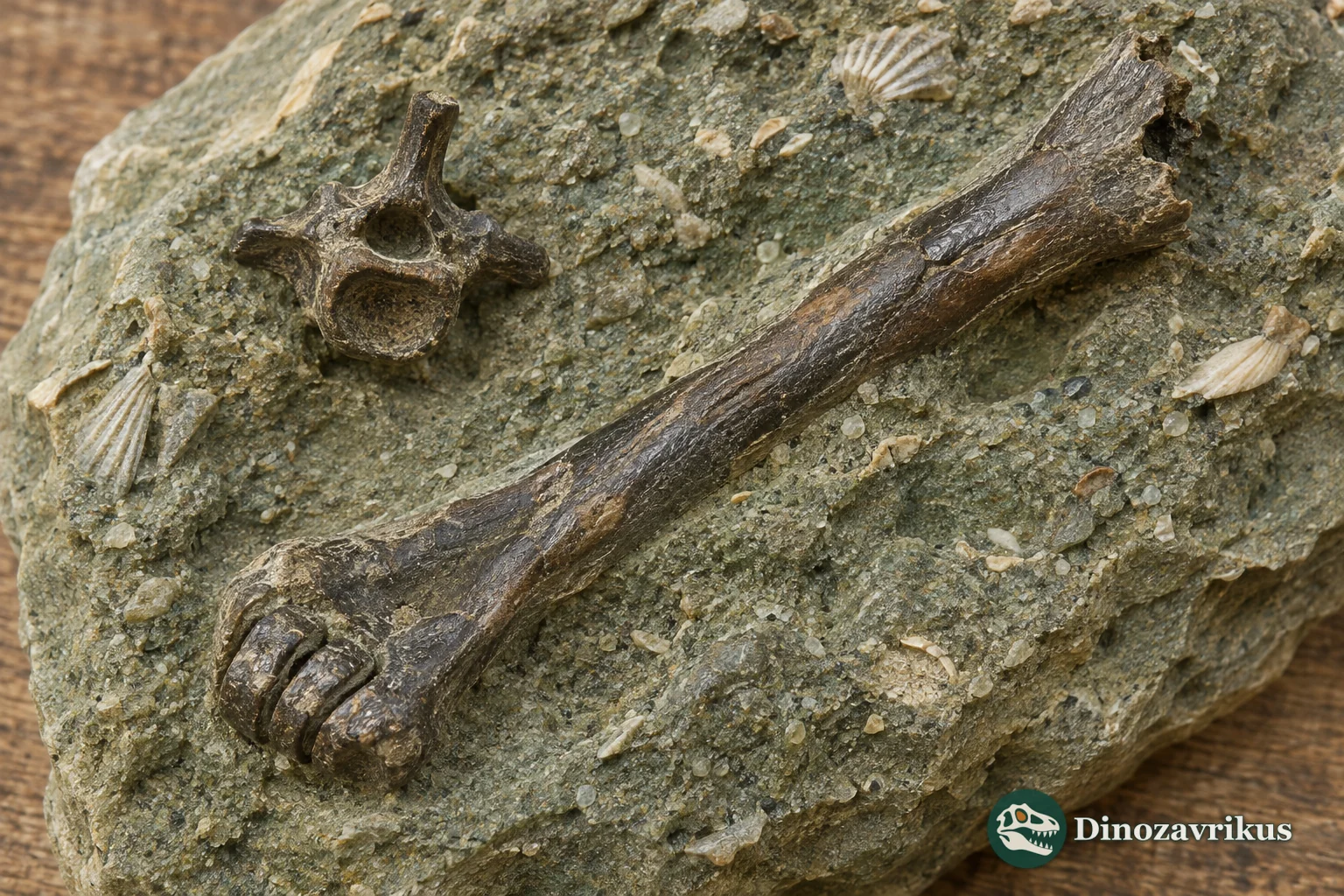
Enaliornis lived near the transition between the Early and Late Cretaceous and is among the earliest known hesperornithiforms. It is known mainly from bones found separately around Cambridge. The feet and other hindlimb bones were well adapted for propulsion underwater.
Quick facts
| Group | Hesperornithiforms (Hesperornithiformes), Enaliornithidae |
|---|---|
| Age | Cretaceous, near the Albian–Cenomanian boundary |
| Region | Europe (Cambridgeshire, England) |
| Diet | Exact diet unknown |
| Type species | Enaliornis barretti |
| Deposits | Cambridge Greensand |
| Known material | Isolated vertebrae, pelvis and leg bones, and referred braincase fragments |
| Locomotion | Foot-propelled diving inferred from joints |
What can the fossils tell us?
The toe joints suggest how the foot worked during propulsion. The presence of swimming lobes is inferred by comparison with other birds.
The Cambridge Greensand is usually assigned to the earliest Cenomanian. Some fossils were reworked into it from older, late Albian sediments.
Leg joint shape and measurements were used to distinguish three forms. The disarticulated fossil material makes some assignments uncertain.
The Cambridge fossils
Harry Seeley described two species in detail in 1876. Enaliornis barretti was the larger and E. sedgwicki the smaller. In a 2002 revision, Peter Galton and Larry Martin identified a third, intermediate-sized form named E. seeleyi. Their analysis considered the shape of the tibiotarsus as well as body size inferred from the separate bones.
Most authors place the Cambridge Greensand at the start of the Cenomanian. Erosion brought material from the older Gault sediments into that deposit, including late Albian fossils. Consequently the age of the sediment around a bone can differ from the age of the animal.
Swimming with the hindlimbs
Parts of the fossils once interpreted as the upper ends of ulnae were reidentified as the upper ends of the tarsometatarsus, the element between the ankle and toes. The shape of the lower joint surfaces led Galton and Martin to suggest that each toe could carry a swimming lobe. The outlines of the actual toes are unknown.
The lower limb and pelvis place Enaliornis on the early branches of Hesperornithiformes. Better-preserved leg bones of Baptornis help show how another member of the group used its feet for underwater propulsion. Morphology in the fragments referred to the braincase of Enaliornis has also been interpreted in the context of diving. Its wings, precise swimming stroke and diet remain poorly known.
Frequently asked questions
Where did the fossils come from?
They came from the Cambridge Greensand in eastern England, near the city of Cambridge.
How did Enaliornis move underwater?
The anatomy of the hindlimbs supports foot-propelled swimming. Details of the feet are inferred from the joints.
Why are two geological stages mentioned?
The greensand is commonly assigned to the earliest Cenomanian and contains material eroded from older Albian rocks.
How many species were distinguished in the revision?
Three species were recognized using dimensions and the form of the leg joints. They include an intermediate form named Enaliornis seeleyi.