

Eohyrax was a genus of South American typotherian notoungulates named by Florentino Ameghino in the early twentieth century. Its fossils are especially useful for studying Eocene land mammals of Patagonia, yet the genus is known mostly from teeth and jaw fragments. That record allows detailed comparisons of tooth crowns but leaves much of the animal's anatomy and life history uncertain.
The genus is included in the ancient mammal catalogue. It can be compared with other typotheres such as Archaeohyrax, while differences in age and anatomy caution against treating them as ecological neighbours.
Quick facts
| Scientific name | Eohyrax Ameghino, 1901 |
|---|---|
| Type species | E. rusticus Ameghino, 1901 |
| Group | Typotherian notoungulate; traditional Archaeohyracidae is heterogeneous |
| Age | Eocene of South America |
| Principal region | Patagonia, Argentina |
| Type of E. rusticus | MACN 10775; primarily dental material |
| Main limitation | Teeth are better represented than the rest of the skeleton |
What can the fossils tell us?
Descriptions compare premolar and molar proportions, crown height and enamel features. These characters help identify specimens but do not supply a complete skeleton or behaviour.
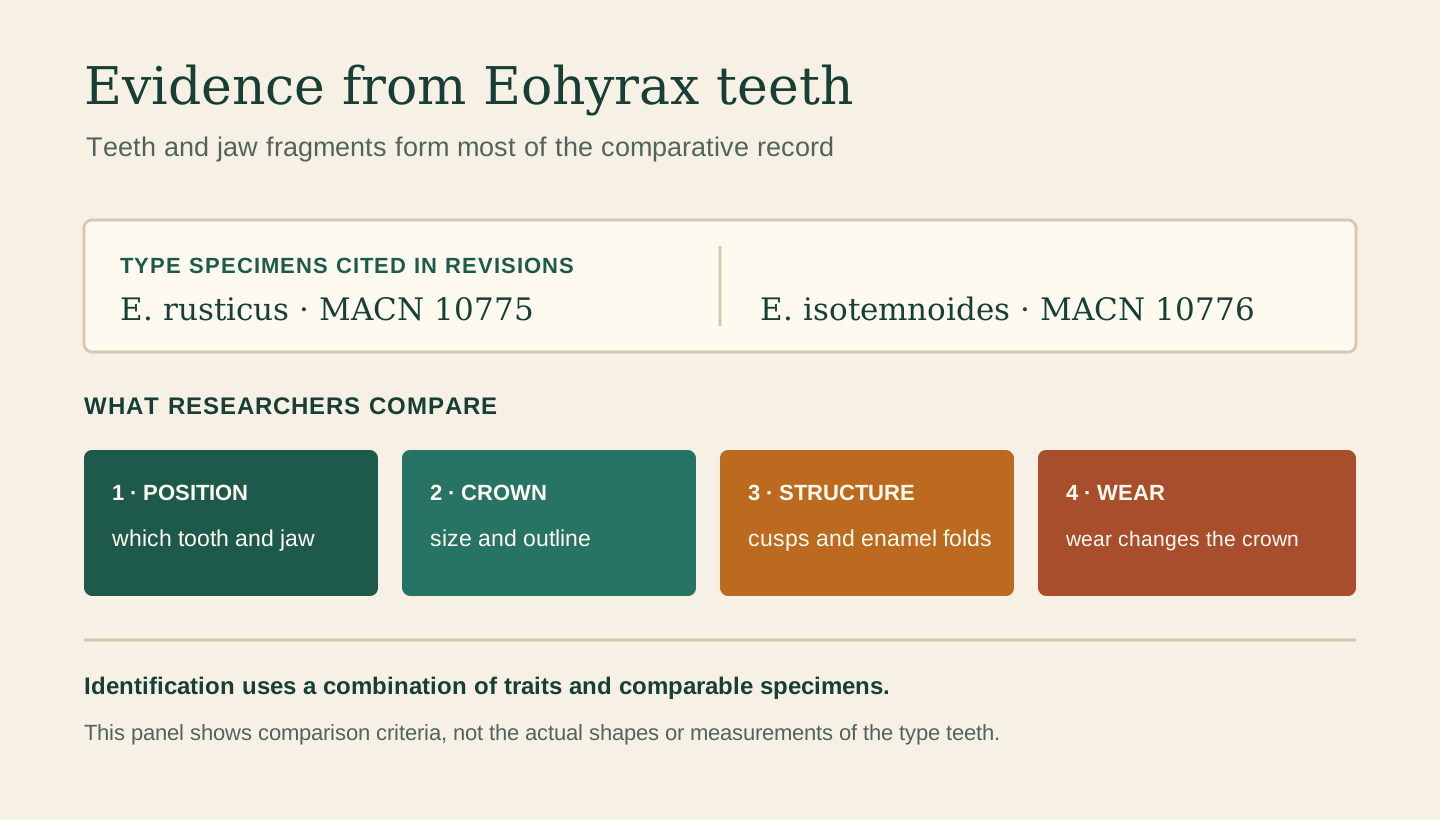
MACN 10775 is cited for E. rusticus and MACN 10776 for E. isotemnoides. Their role is to anchor names; whether other fossils belong to the same species is a separate comparison.
Phylogenetic studies have questioned whether the traditional Archaeohyracidae forms a single natural group. The family-level label should therefore be tied to a stated classification.
Name and species
Ameghino established Eohyrax in 1901, with E. rusticus as the type species. Later workers referred several names to the genus, including E. isotemnoides, E. praerusticus, E. platyodus and E. brachyodus. Their accepted status varies among revisions; proposed synonymies and changed diagnoses mean that a species list should be linked to the study being followed.
Published accounts cite MACN 10775 as the type specimen of E. rusticus and MACN 10776 for E. isotemnoides. The numbers refer to material in Argentina's Museo Argentino de Ciencias Naturales. A type fossil anchors the use of a name, but does not represent every size or anatomical feature of the species.
Teeth and changing classification
Most information about Eohyrax comes from cheek teeth. Researchers compare crown proportions, height and enamel folds, while taking wear into account. As a tooth wears, its exposed pattern changes, so measurements from specimens at different wear stages may not be directly comparable. An isolated tooth can be informative without being sufficient for a confident species identification.
Older works placed the genus in Archaeohyracidae. Later phylogenetic studies questioned whether that traditional assemblage is a natural group: the names often called archaeohyracids may represent several branches of typotheres. Some recent work has treated these names as a paraphyletic grade. It is more cautious to identify Eohyrax as a typotherian notoungulate and state which family-level arrangement a source uses.
Localities and geological age
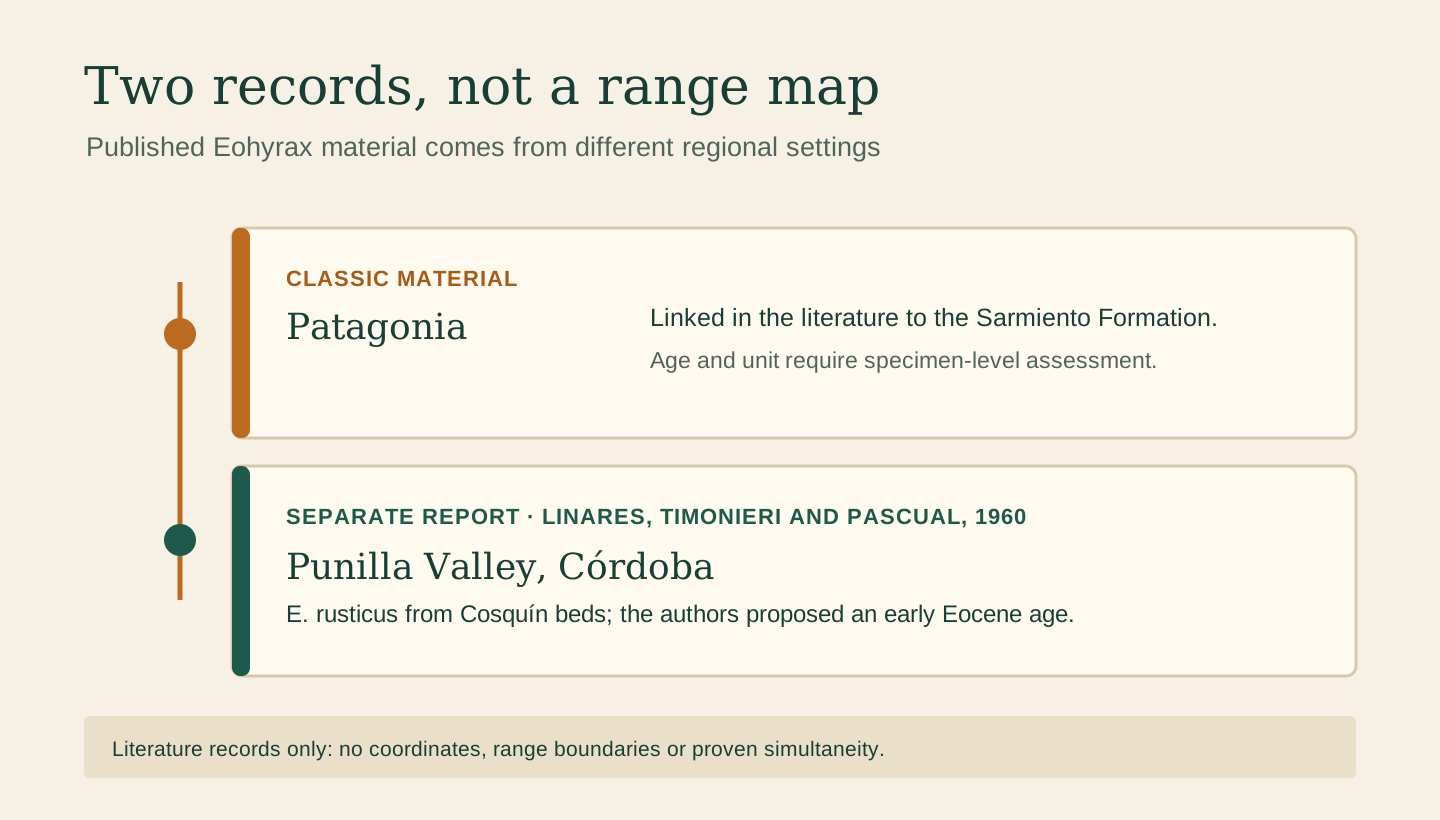
Classic Eohyrax material comes from Patagonia and is associated with the Sarmiento Formation. Different species and specimens have been assigned to separate Eocene intervals and South American Land Mammal Ages, including the Casamayoran and younger records. These regional age units compare mammal assemblages; they are not a direct numerical date for each fossil.
A report of E. rusticus from Punilla Valley in Córdoba Province broadened the geographic record. The authors described fossils from sedimentary beds whose age and correlation were discussed in the geological context of the basin. Such a locality is an important individual record, but it should not be merged uncritically with Patagonian samples or assumed to be exactly contemporaneous.
Body size, diet and life history
Published estimates of body mass are indirect and depend on comparison with better-known mammals. The genus lacks the kind of associated, nearly complete skeleton that would support a direct reconstruction of body proportions. A numerical estimate from dental dimensions should be treated as a model, not as a measured mass for every species.
Typotheres are often interpreted as terrestrial herbivores, but no stomach contents are known for Eohyrax. The teeth provide evidence about chewing surfaces and wear; they do not identify exact plant species, seasonality, social structure or reproductive biology. The available literature does not establish pathologies or a detailed locomotor reconstruction for this genus.
What the record can and cannot show
Eohyrax records help document the diversity of Eocene typotheres in South America and make it possible to compare dental anatomy across genera. Collection numbers, published measurements and locality descriptions connect many claims to particular fossils. Whole-body appearance, coat colour and behaviour depend much more heavily on comparison and artistic reconstruction.
The fossil record is biased toward parts that preserve and are recognised readily. Teeth often outnumber associated skeletons, and small differences can reflect wear, individual variation or taxonomic separation. New finds that connect jaws with postcranial bones would help test both species boundaries and the animal's position among typotheres.
Frequently asked questions
When did Eohyrax live?
The genus is known from Eocene deposits in South America. Different species and records have been assigned to different intervals within the epoch.
Which species is the type species?
Eohyrax rusticus, named by Florentino Ameghino in 1901, is the type species. Later sources cite MACN 10775 for its type material.
Why has the classification changed?
Researchers compare Eohyrax with other typotheres, and the traditional Archaeohyracidae may not represent one natural evolutionary branch. Family-level assignments therefore depend on the classification used.
Can its exact appearance and diet be known?
No. The record is dominated by teeth and jaw fragments. A plant-eating interpretation is plausible for a typothere, but an exact menu and many body details are not directly preserved.