

Eoplinthicus was an Eocene ray known from teeth. The type species was named from Louisiana, and a second species was described from the Dakhla area. The low crowns and root structure contribute to comparisons with early relatives of modern devil rays.
Quick facts
| Group | Myliobatiform rays |
|---|---|
| Type species | Eoplinthicus yazooensis |
| Genus authors | Henri Cappetta and Gary Stringer, 2002 |
| Fossils | Isolated teeth and fragments |
| Type area | Louisiana, United States |
| Age of type record | Priabonian, Late Eocene |
What can the fossils tell us?
Teeth assigned to the same species also occur in older Alabama deposits.
DAK2A-2 anchors comparisons, even though its position in the jaw is unresolved.
The low crown and root are useful for comparison. Body proportions remain unknown.
From Louisiana to Alabama
Henri Cappetta and Gary Stringer named E. yazooensis in 2002 from Late Eocene material in Louisiana. Material assigned to the species was subsequently described from Alabama. A study of the Claiborne Group reported specimens from the Bartonian stage of the Middle Eocene. The Priabonian age of the type material therefore describes one locality rather than the full span of reported occurrences.
A second species from the Dakhla area
The description of E. underwoodi is based on four complete teeth and numerous fragments from site DAK2, south of Dakhla. Holotype DAK2A-2 comes from the Gerran Member of the Samlat Formation, assigned to the late Middle or Late Eocene. The authors left its precise tooth position unresolved. The species honours palaeontologist Charlie Underwood.
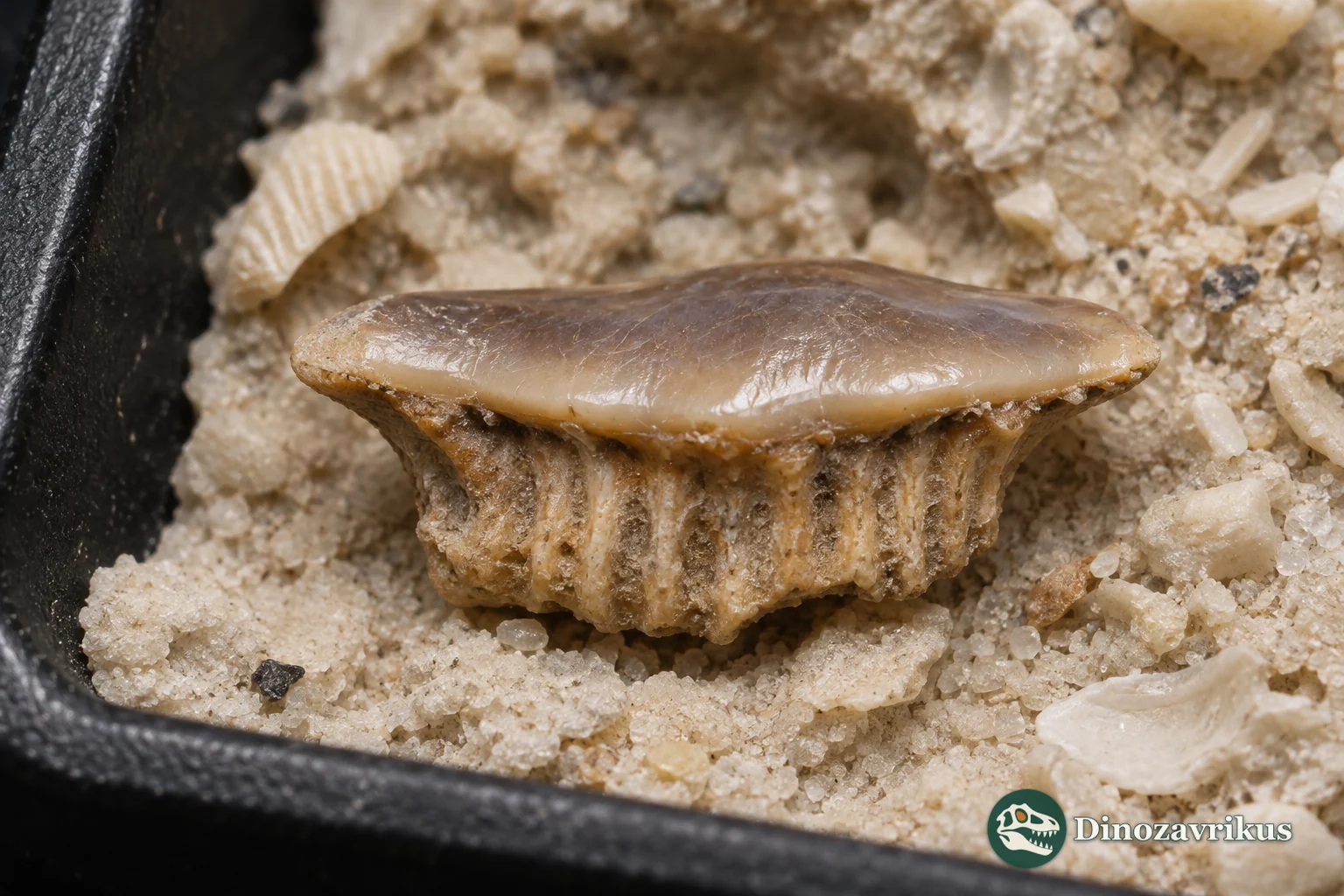
What the teeth can show
Researchers compare the shape and relief of the low crown as well as the structure of the root. Those characters contribute to comparisons with other fossil rays, including Plinthicus. An isolated tooth gives an incomplete view of the dentition and leaves body width, tail length and colour unknown.
Appearance and diet
The two sets of finds on opposite sides of the Atlantic indicate a wide range for the genus. They represent different species, and neither demonstrates a shared range for one species. The teeth leave exact diet and usual swimming depth unresolved. The illustrated outline is hypothetical. The profile of Belemnobatis shows how articulated skeletons can support a more specific reconstruction.
Frequently asked questions
Where was the type species found?
It was named from Late Eocene deposits in Louisiana. Reports from Middle Eocene Alabama also refer teeth to this species.
What fossils represent the Dakhla species?
Four complete teeth and numerous fragments were described as E. underwoodi. The holotype is DAK2A-2.
Was it a modern manta ray?
It was a distinct extinct genus whose teeth inform studies of early devil ray evolution.
Is a complete skeleton known?
The records discussed here consist of isolated teeth and do not establish its exact appearance.