

Eopneumatosuchus colberti lived in what is now Arizona during the Early Jurassic. The rear of one skull is the only securely identified fossil. CT imaging revealed an extensive network of connected air spaces inside its bones.
Quick facts
| Species | Eopneumatosuchus colberti |
|---|---|
| Group | Early crocodyliform |
| Age | Early Jurassic |
| Locality | Seller Spring, Arizona |
| Principal fossil | Rear of the skull, MNA V2460 |
| Rock unit | Kayenta Formation |
What can the fossils tell us?
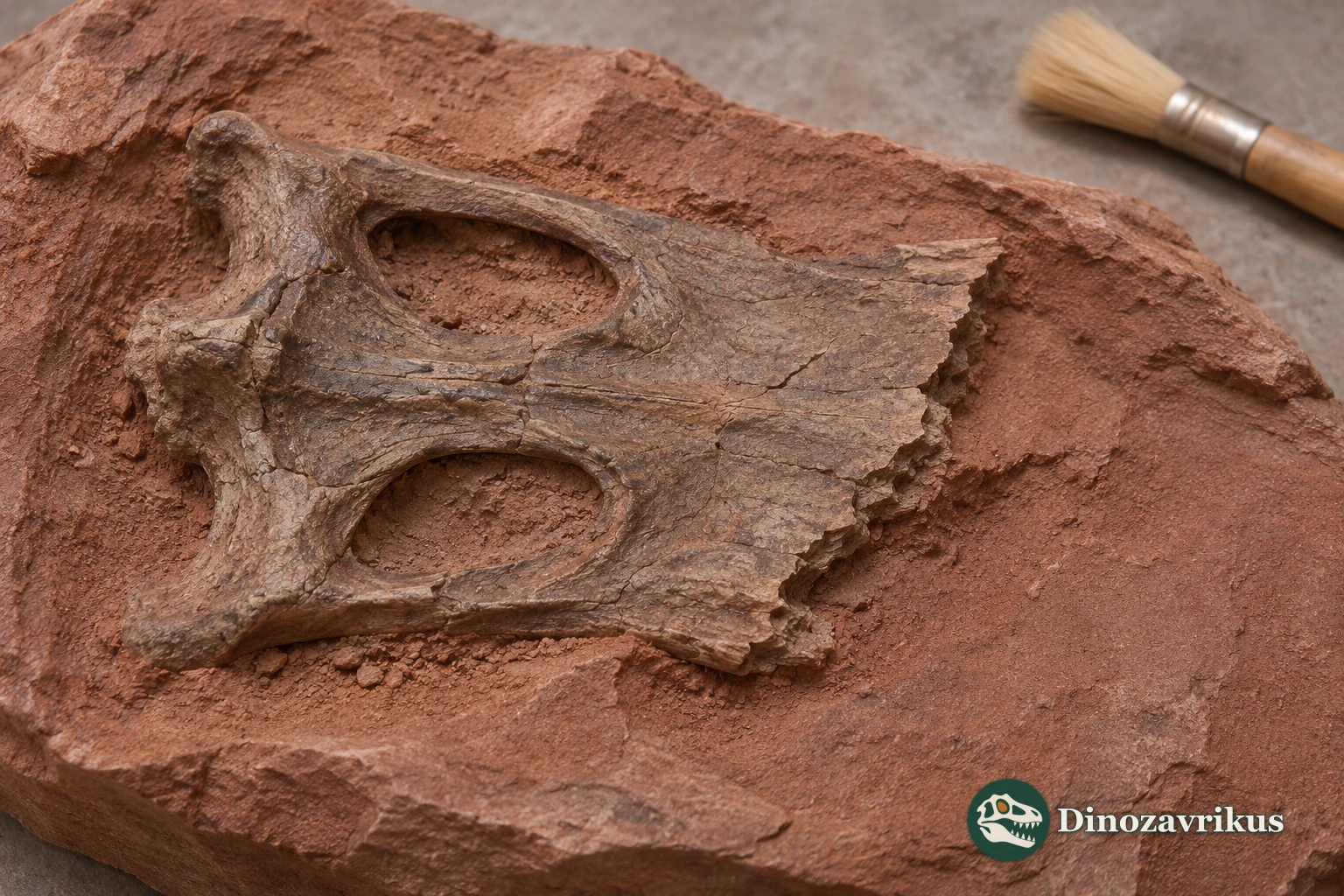
Large openings in the skull roof and bones around the eye sockets survive. The complete muzzle and dentition remain unknown.
The three-dimensional model traces passages within the bones. Only some entrances are visible on the outer surfaces.
The proposed specimens lack directly comparable parts of the type skull. They cannot establish the anatomy of the feet or body armour.
A skull from Seller Spring
Alfred Crompton and K. K. Smith named Eopneumatosuchus in 1980 from MNA V2460, held by the Museum of Northern Arizona. It was found in Coconino County within the Navajo Nation. The outcrop sits in the silty facies of the Kayenta Formation, although published and museum records differ in where they place the exact horizon.
The Kayenta Formation preserves deposits of an ancient river system. A hip bone, isolated armour plates and an ankle bone were later proposed as possible additional material, along with partial skeleton MCZ 8895 from another locality. Those specimens lack parts that can be matched directly to the type skull.
Air spaces inside the skull
The upper temporal openings appear larger than the eye sockets when their outlines are reconstructed from the surviving margins. Micro-CT scans show connected air spaces throughout the braincase bones. Another early crocodyliform, Protosuchus haughtoni, has many similar spaces.
Comparisons of inner-ear shape produced different ecological signals. Some placed the fossil near terrestrial species and others near semiaquatic forms. The river sediments document the setting where the skull was buried. Anatomical evidence for locomotion is limited in the absence of confirmed limb bones.
An early branch of the crocodyliform tree
The large temporal openings recall thalattosuchians, a group that includes many marine crocodylomorphs. An analysis incorporating the new braincase description recovered Eopneumatosuchus next to a clade formed by Protosuchus richardsoni and Orthosuchus. Other analyses have placed it nearer thalattosuchians. A single partial skull limits the characters available to distinguish these alternatives.
Frequently asked questions
Where was Eopneumatosuchus found?
The skull came from Kayenta Formation deposits near Seller Spring in Coconino County, northeastern Arizona.
How were the air spaces detected?
Researchers used micro-CT scans to follow the spaces through the braincase bones and trace their connections.
Can its body length be estimated?
The type cannot give a reliable body length. It lacks the front of the head and the rest of the skeleton.
Did it live in the sea?
The skull was buried in river sediments far from marine deposits. Researchers have discussed terrestrial and semiaquatic habits because comparisons of the inner ear support different possibilities.