

Eotorpedo is among the earliest rays assigned to the electric ray lineage. Fossils date from the Palaeocene and early Eocene. The teeth of Hilgendorf's species have a high, conical cusp that curves into the mouth. Long known from African deposits, the species was also identified from eight teeth found in a South Carolina quarry.
Quick facts
| Group | Electric rays |
|---|---|
| Genus named by | Errol White, 1934 |
| Age | Palaeocene to early Eocene |
| Material | Isolated teeth |
| South Carolina record | Eight teeth from a quarry near Jamestown |
| Body length | Uncertain from the teeth |
What can the fossils tell us?
The tall cusp of Hilgendorf's species rises from a broad crown base and a low root.
African and South Carolina specimens share a distinctive tooth shape. This matches the species without revealing its route of dispersal.
Tooth morphology supports the electric ray assignment. The power or anatomy of an electric organ cannot be read from these crowns.
Names and early discoveries
Otto Jaekel described African teeth as Torpedo hilgendorfi in 1904. Errol White established Eotorpedo in 1934 while studying Nigerian material. The Nigerian species Eotorpedo jaekeli has smaller projections on the outer crown and a narrower notch on the inner side than Hilgendorf's species.
The Lower Palaeocene phosphate deposits of Morocco yielded Eotorpedo zennaroi, whose cusp is flattened from side to side and whose outer crown bears a pronounced transverse ridge. The Lower Eocene Belgian species Eotorpedo nolfi was based on a single tooth estimated to be under 3 mm high. A single position in the jaw cannot show how the crown varied along the rest of the row.
Eight teeth from South Carolina
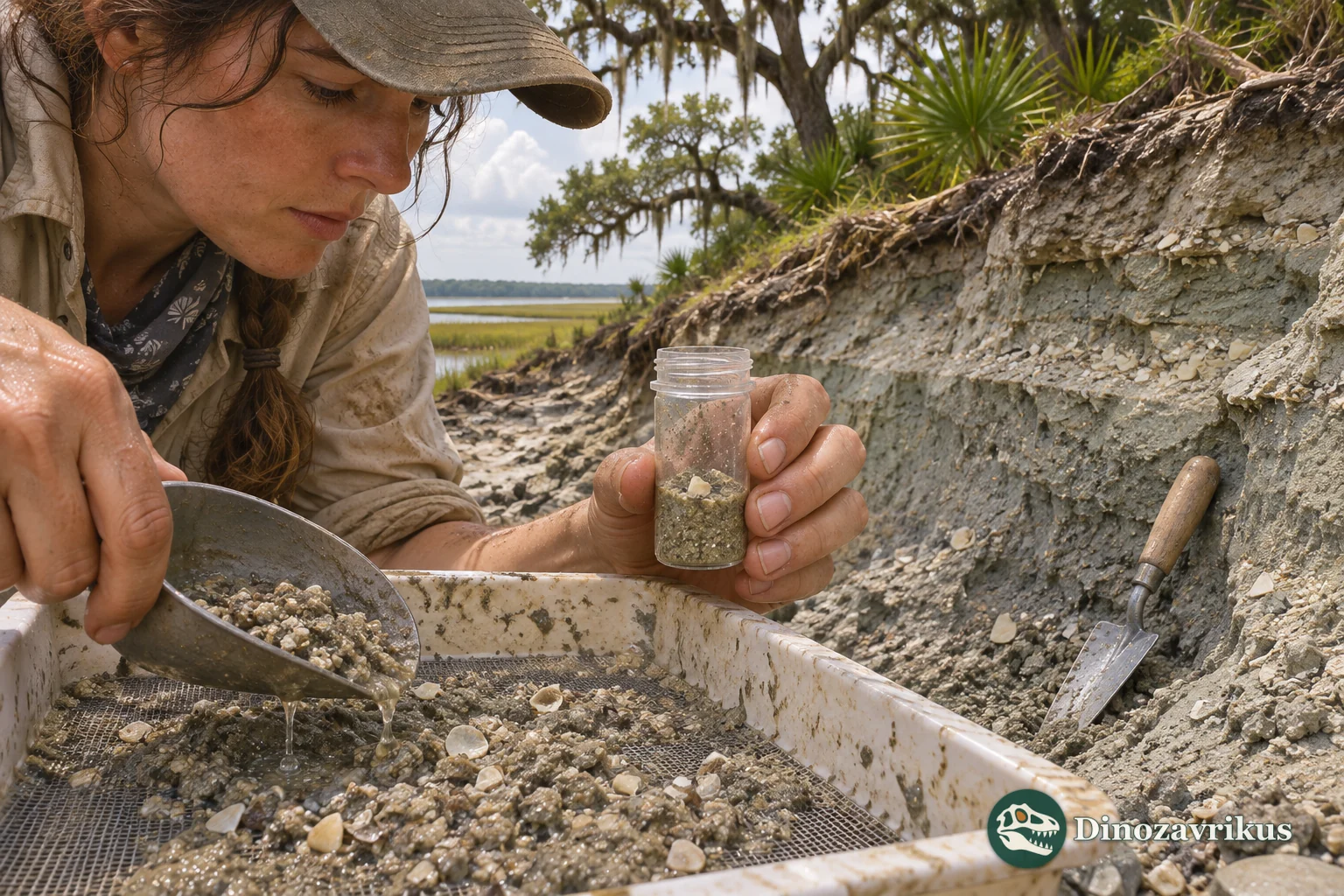
The quarry near Jamestown in Berkeley County yielded eight isolated teeth of Eotorpedo hilgendorfi after hundreds of kilograms of rock were processed. Sharks and rays made up much of the wider assemblage, which the researchers dated to the early Eocene. Before the South Carolina discovery, the species was documented around northern and western Africa and had also been reported from the Arabian Peninsula.
Specimen BCGM 7026 was 6 mm high as preserved. Its cusp is more compressed from side to side than those of most other teeth in the sample. Their cusps have rounder cross-sections, with smooth edges. The authors interpreted these differences as variation within the dentition of one species. The teeth did not preserve their positions in the jaw.
Crown, root and distribution
Viewed from above, the tooth outline has four lobes. Two on the outer face of the crown flare apart near the base. The inner face has a wide notch. The low root extends inwards past the edge of the crown and carries a large opening near the middle of its basal surface.
In Mali, the specimen CNRST-SUNY 415, also registered as AMNH 22046, came from the Mali-17 section. Its identification helped constrain the age of the containing interval to the Late Palaeocene or later. Together with the South Carolina material, it documents the species in separate marine basins around the Atlantic. The available points do not resolve where the lineage originated or how it spread.
Function and the limits of the fossil evidence
A row of high, recurved cusps would have helped grip prey such as fish or crustaceans. No gut contents accompany the teeth discussed here. Jaekel estimated two to three metres of total length from tooth size. A skeleton that could test that historical estimate has yet to be described among these finds.
Living electric rays generate a discharge with paired organs on either side of the head. Eotorpedo was assigned to the lineage by comparing fossil teeth. Its teeth do not show the anatomy or output of those organs. The similar name of Heterotorpedo likewise says nothing by itself about whether that fossil ray could generate a discharge.
Frequently asked questions
When did Eotorpedo live?
The genus has a Palaeocene to early Eocene fossil record. The Moroccan species Eotorpedo zennaroi is from the Lower Palaeocene.
What distinguishes the teeth of Hilgendorf's species?
A tall conical cusp curves into the mouth, with projecting lobes and a broad notch at the crown base.
Where was Eotorpedo found outside Africa?
Eight teeth of Hilgendorf's species were described from a quarry near Jamestown, South Carolina.
Has the electric organ been found?
The material discussed here consists of teeth. These support the relationship to living electric rays but do not preserve an organ.