

Heterotorpedo is an extinct ray genus known from isolated teeth. The first species was described from the Bracklesham Group of southern England, and two more were later named from Moroccan phosphate deposits. The fossils preserve several tooth shapes, but no complete skeleton establishes the animal’s body, swimming style or soft anatomy.
Quick facts
| Group | Extinct ray genus; family-level placement has varied |
|---|---|
| Type species | Heterotorpedo fowleri Ward, 1983 |
| Main evidence | Isolated teeth with diagnostic crowns and bifid roots |
| Age | Late Cretaceous and Paleogene species from separate intervals |
| Geography | England and Moroccan phosphate basins; other reports require taxonomic review |
| Body length | Unknown; no complete skeleton is known |
| Electric organs | Not documented by the known tooth material |
What can the fossils tell us?
David Ward named the genus and type species in 1983 from the Bracklesham Group near Selsey, Sussex. The holotype is catalogued as NHMUK PV P 61157. The original material consists of teeth rather than an articulated skeleton.
The described series includes angular anterior crowns with lateral projections and more oval lateral teeth. Their roots are divided into two lobes. A loose tooth does not always establish its exact position in a jaw.
Noubhani and Cappetta described Heterotorpedo brahimi and H. lyazidii in 1997 from Moroccan phosphate basins. Their species diagnoses rely on dental characters; proposed differences between sexes are interpretations of tooth variation, not direct observations of whole animals.
The first record from Sussex
David Ward described Heterotorpedo fowleri in 1983 as a new batoid ray from the Bracklesham Group near Selsey, in Sussex, southern England. Its name-bearing specimen is now catalogued by London’s Natural History Museum as NHMUK PV P 61157. Ward’s account was based on isolated teeth. It did not include an articulated jaw or a complete skeleton that could show the outline of the animal.
The Bracklesham Group contains Early to Middle Eocene deposits, with marine and marginal-marine layers. Regional geological accounts describe a shallow shelf environment with changing sediments and water conditions. That setting belongs to the formation as a whole. It cannot establish the exact depth, habitat preference or behaviour of the individual ray represented by a particular tooth.
A changing tooth row
Ward distinguished several forms along the tooth row. Anterior teeth have a roughly quadrate outline when viewed from above, with lateral projections on the crown. In side view, the crown is triangular and leans toward the inside of the mouth. Farther back, those projections become weaker or disappear, and the crown outline becomes more oval. The roots are generally divided into two lobes.
This variation matters because a single isolated tooth can be misleading. Position, wear, breakage and individual variation may alter the features visible on a specimen. A series of teeth is more informative than one element, but the exact position of each tooth still depends on comparison with better-documented rows. The named genus is therefore a taxonomic interpretation of dental characters, not a portrait assembled from a whole body.
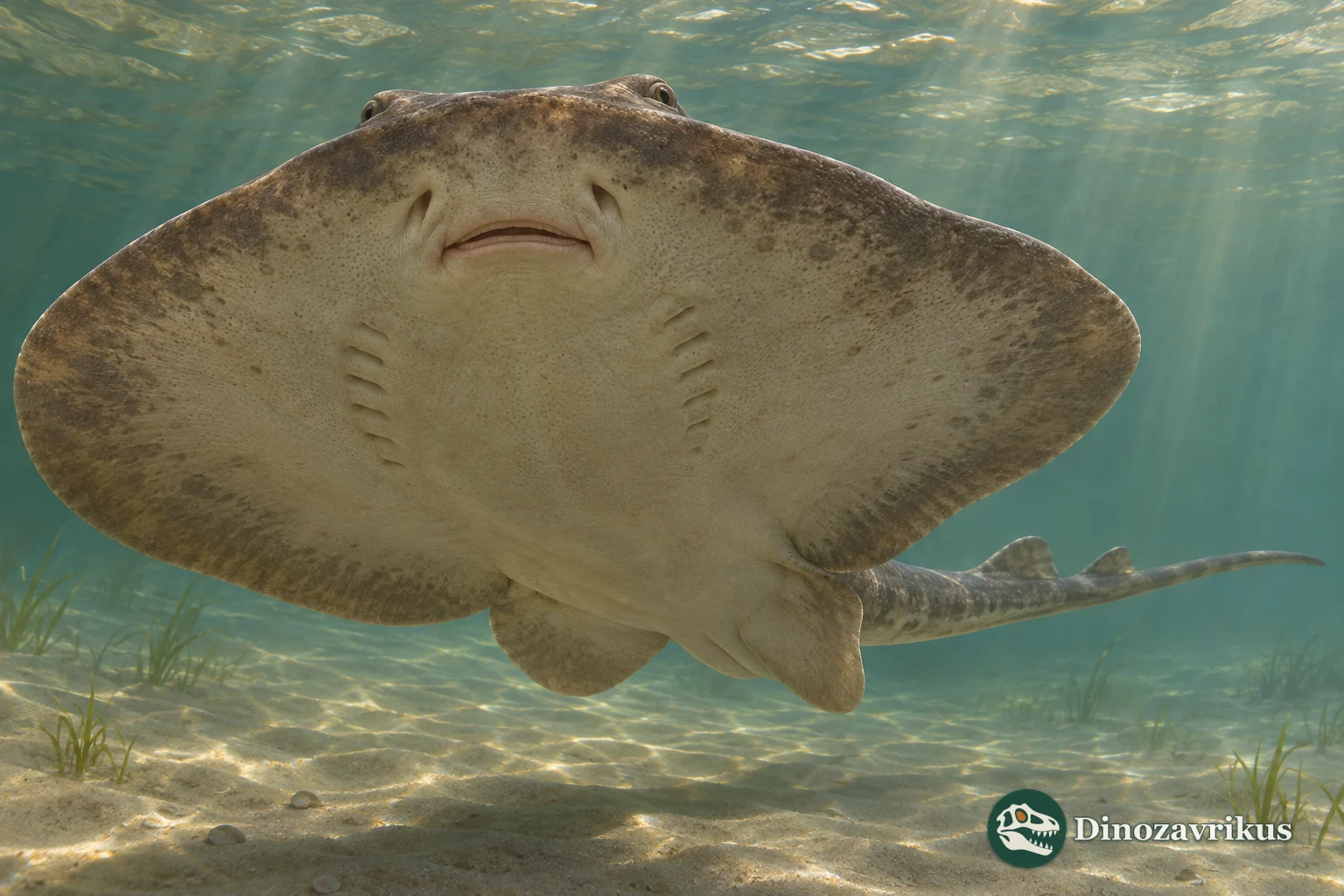
The illustration is intentionally cautious. Other fossil rays, including Schizorhiza, preserve rostral structures that can be studied in connection with one another. A shark such as Crassescyliorhinus offers a separate example of how isolated teeth can carry useful anatomical information. Neither comparison fills in the missing skeleton of Heterotorpedo.
Additional species from Morocco
In 1997, Abdelmajid Noubhani and Henri Cappetta described Heterotorpedo brahimi and H. lyazidii from Moroccan phosphate deposits. Their monograph treats a sequence extending from the Maastrichtian to the basal Lutetian, but the species occur in their own horizons. The full age span of the deposits should not be assigned to every species in the book or to the genus as a single continuous population.
The authors compared the Moroccan species using tooth-crown and root characters. For H. brahimi, they interpreted some differences between tooth forms as associated with males and females. That proposal is based on dental variation; the sex of an animal cannot be observed directly from an isolated tooth. Position in the mouth, wear and differences between individuals are other factors that require consideration.
The named species show how a genus can acquire a wider record as new material is studied. They do not prove that the same form lived unchanged through every intervening interval. Each occurrence needs to be tied to its own specimen, horizon and diagnostic features. Reports identified only at genus level should not automatically be treated as records of H. fowleri or of either Moroccan species.
Classification and limits of reconstruction
Ward originally described the genus as a torpedinid-like ray. Later taxonomic catalogues generally place it among Myliobatiformes and list it with Dasyatidae, but classifications based on isolated dental material can change as researchers compare broader character sets. The name Heterotorpedo does not demonstrate that the animal had electric organs. The known teeth preserve no evidence of such soft anatomy.
No dependable total body length, disk width, tail proportions, skin pattern or colour can be read from the currently described teeth. Nor do the teeth preserve prey or stomach contents that would identify a specific diet. Their crown and root shapes are direct fossil evidence; body shape, locomotion and feeding scenes remain inferences of varying strength. A reconstruction should keep those two kinds of information visibly separate.
Frequently asked questions
Was Heterotorpedo an electric ray?
That is not established. Its name is not anatomical evidence, and the known fossils are teeth that do not preserve electric organs.
Has a complete skeleton been found?
No complete skeleton is known in the descriptions used here. The genus is based mainly on isolated teeth with different crown shapes and divided roots.
When did Heterotorpedo live?
Named species come from separate Late Cretaceous and Paleogene intervals. The Bracklesham type species is Eocene, while Moroccan species occur in distinct phosphate horizons.
What did it eat?
Tooth shapes support comparisons about how the mouth may have worked, but no associated prey or stomach contents establish a specific diet.