

Eowinterbergia was first named from trilobites in early Carboniferous rocks in China. A younger study described a German species from the end of the Devonian. Near that boundary in southern France, separate head and tail shields preserve a third form whose placement in the group remains tentative.
Quick facts
| Group | Proetid trilobites |
|---|---|
| Age | Late Devonian and early Carboniferous |
| Named by | Yuan and Xiang, 1998 |
| Type species | Eowinterbergia transversa |
| Confirmed records | China and Germany |
| Type formation | Wangyou Formation, Guizhou |
What can the fossils tell us?
Yuan and Xiang described a new subgenus from the Wangyou Formation in 1998.
Basse and Lemke described Eowinterbergia effenbergensis from the German Late Devonian.
The cheek was studied alongside separate head and tail pieces. The French species is only tentatively assigned to the group.
From the Wangyou Formation to the Wocklum Limestone
Yuan and Xiang described Winterbergia (Eowinterbergia) transversa from the Wangyou Formation of Guizhou in 1998. Eowinterbergia first denoted a subgenus of Winterbergia. It has since also been treated as a genus, with E. transversa as its type species.
Martin Basse and Ulrich Lemke named E. effenbergensis in 2020. This was the first German Late Devonian record of Eowinterbergia. The Wocklum Limestone fauna lived in the final part of the Famennian, before the Hangenberg crisis reshaped marine communities.
What the French fossils show
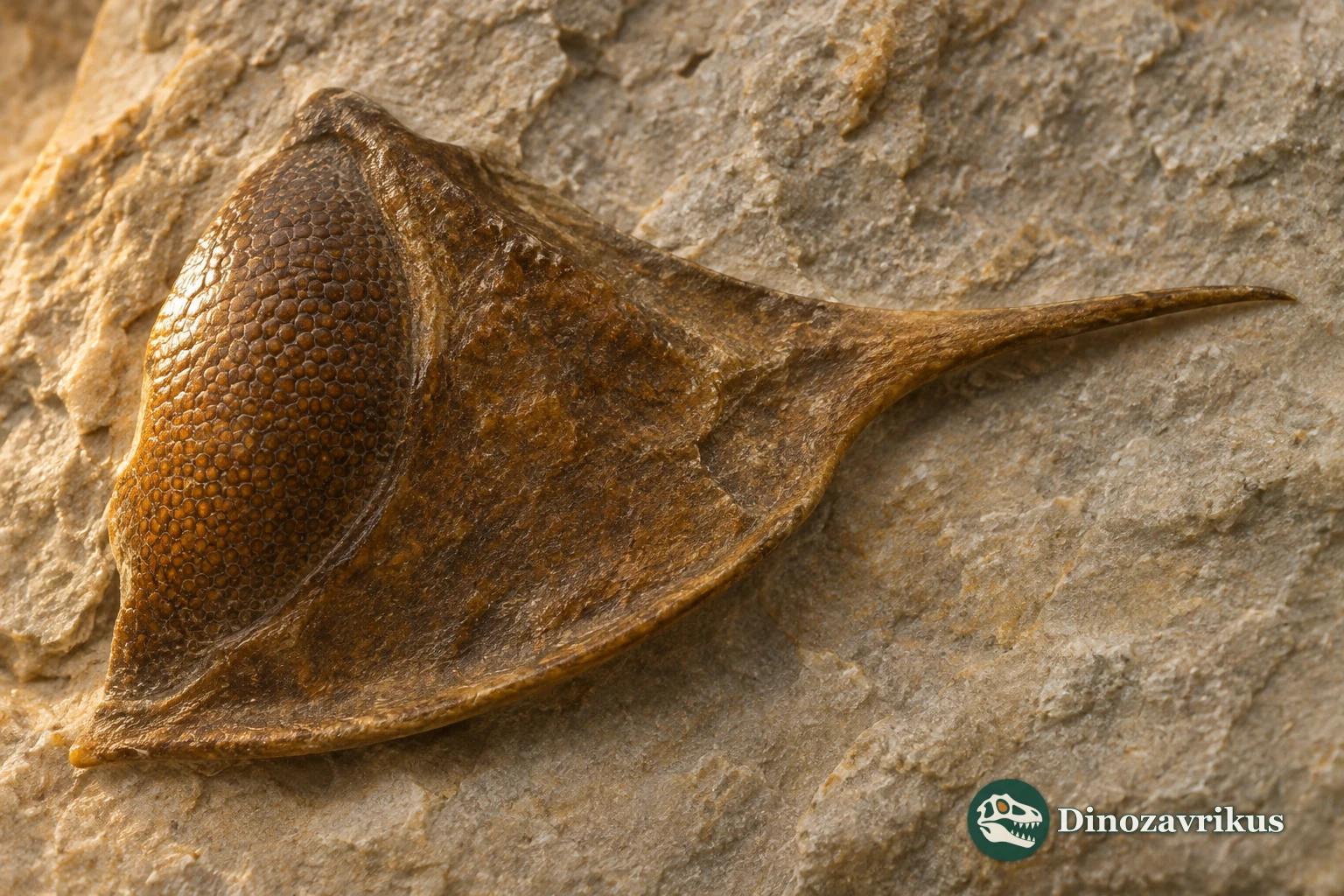
A free cheek of funirepa from the Montagne Noire preserves a large eye and a long cheek spine. Other pieces include a cranidium with a long, convex central lobe and a separate tail shield. Each piece gives researchers features to compare with other proetids.
The French study illustrates these specimens under the name Winterbergia (?Eowinterbergia) funirepa. The question mark flags an uncertain assignment. The large eye belongs to that particular fossil and cannot establish what the Chinese type species could see.
Frequently asked questions
Where was the type species found?
It was described from the Wangyou Formation of Guizhou, China.
When did Eowinterbergia live?
The German species comes from the end of the Devonian. The Chinese type species comes from the early Carboniferous.
Is Eowinterbergia a subgenus of Winterbergia?
Yuan and Xiang introduced it as a subgenus. Later authors have also used it as a genus in its own right.
Which fossil preserves the large eye?
The detached cheek of the French species funirepa, whose assignment to Eowinterbergia is tentative.