

A fossil cheek of the Early Carboniferous trilobite Winterbergia from the Carnic Alps preserves a protruding eye about 2 mm long. Its many tiny lenses are still visible. Separate head and tail fragments from the same locality show how the shell was put together.
Quick facts
| Group | Proetida |
|---|---|
| Age | Early Carboniferous |
| Named by | Gerhard Hahn and Carsten Brauckmann, 1975 |
| Type species | Winterbergia hercynica |
| Localities | Germany and northern Italy |
| Italian eye | About 800 lenses |
What can the fossils tell us?
The lenses are arranged in slanted rows. About 800 were estimated in this eye.
The cranidium forms the centre of the head. An isolated cheek shows the shape of its outer corner.
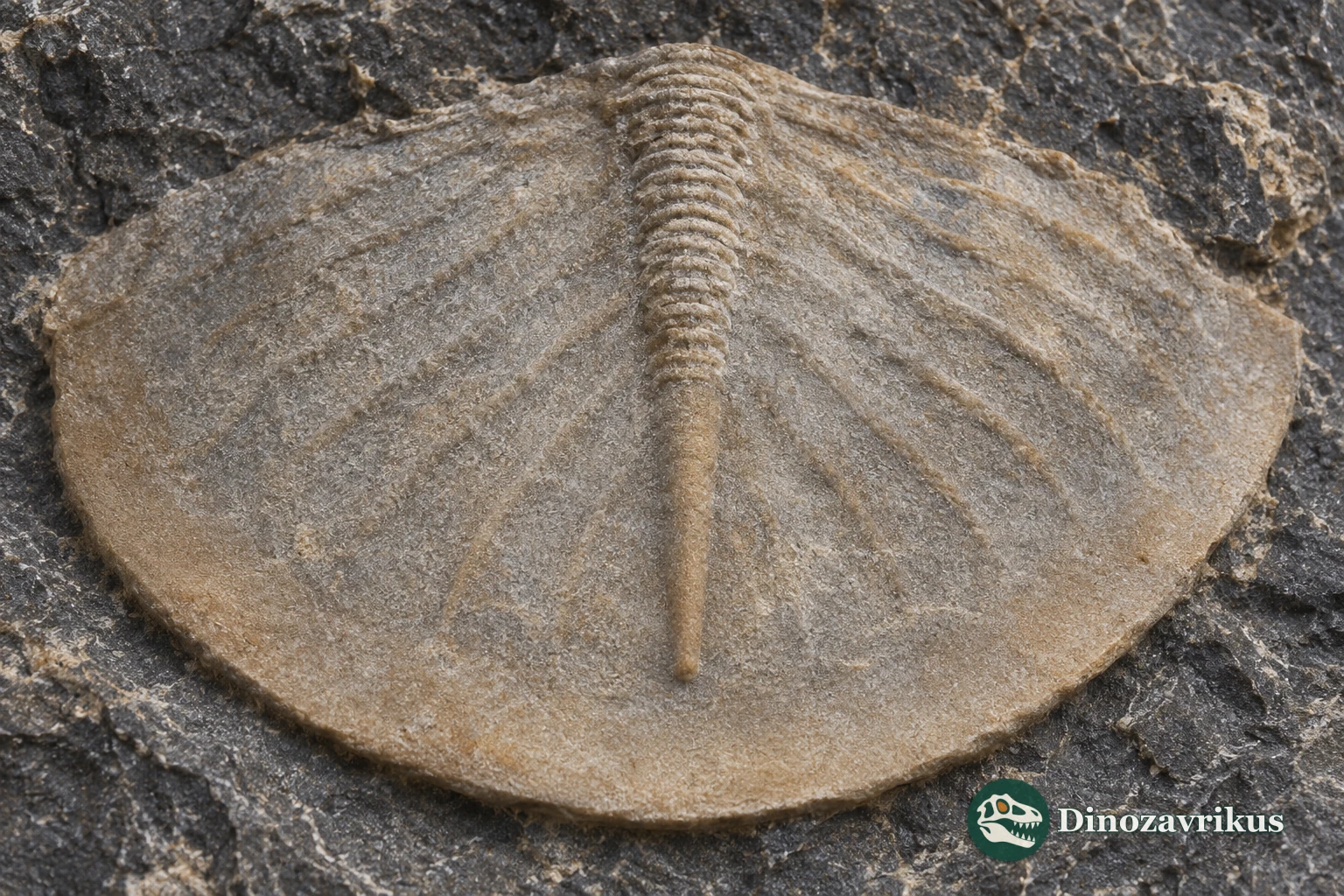
A faint eighth pair lies close to the rear axial ridge. A wide strip of shell folds inward beneath the rim.
From the Harz to the Carnic Alps
Hahn and Brauckmann established Winterbergia in 1975. Its type species is Carbonocoryphe hercynica, named by Hahn in 1967 from German material. Some authors placed Winterbergia within Carbonocoryphe as a subgenus, while later systematic work uses it at genus rank.
Early Carboniferous limestone at Cima di Plotta, northern Italy, yielded the closely related species W. suprahercynica. Its holotype, cranidium B 2000/1/57, is 4.4 mm long. A free cheek and two tail shields were assigned to the same species by comparison with other species of the group. Liobolina is another trilobite recorded from Early Carboniferous limestones in the same area.

What the eye reveals
The cranidium preserves the glabella, or raised central part of the head, and the grooves along its sides. A separate cheek bears a 2 mm eye that rose well above the surrounding shell. About 40 slanting rows hold an average of 20 lenses each. The rear corner of the cheek is rounded and lacks a spine.
From the position of the eye, the authors inferred a field of view extending forwards, sideways, backwards and upwards. They suggested the trilobite lived on a well-lit part of the seabed. The eye alone cannot specify a water depth.
Rings, ribs and the rim
In the best-described tail shield of W. suprahercynica, the narrow axis runs for about two-thirds of the shield’s length and preserves ten rings. A ridge continues towards the rear edge. Seven pairs of ribs are clear on either side of the axis, with traces of an eighth pair.
The shell curves inward under the tail rim to form a wide doublure, which carries about fifteen fine ridges. The dimensions of the isolated tail and head shields do not give the total length of the animal.
Frequently asked questions
Where were Winterbergia fossils found?
The type species was described from Germany. Well-studied shields of another species come from Cima di Plotta in the Italian Carnic Alps.
How many lenses did the eye have?
The eye on one fossil cheek of the Italian species was estimated to have about 800 lenses.
How many rings are visible on the tail shield?
The axial lobe of the best-described Italian tail shield preserves ten rings. Seven pairs of ribs are clearly visible beside it.
Did the Italian species have cheek spines?
The preserved free cheek has a rounded rear corner without a projecting spine.