

Liobolina occurs in rocks deposited around the Devonian–Carboniferous boundary. At Drewer in Germany, paleontologists identified its type species from the relief on tiny tail shields. Head fragments from the Carnic Alps show that at least one species retained eyes.
Quick facts
| Group | Proetida |
|---|---|
| Named by | Rudolf and Emma Richter, 1951 |
| Type species | Liobolina nebulosa |
| Type species age | Early Tournaisian |
| Key sections | Drewer and Grüne Schneid |
| Juvenile tail | 5 mm long at Drewer |
What can the fossils tell us?
Three ribs are distinct near the front of the side field. The tail shield is 5 mm long.
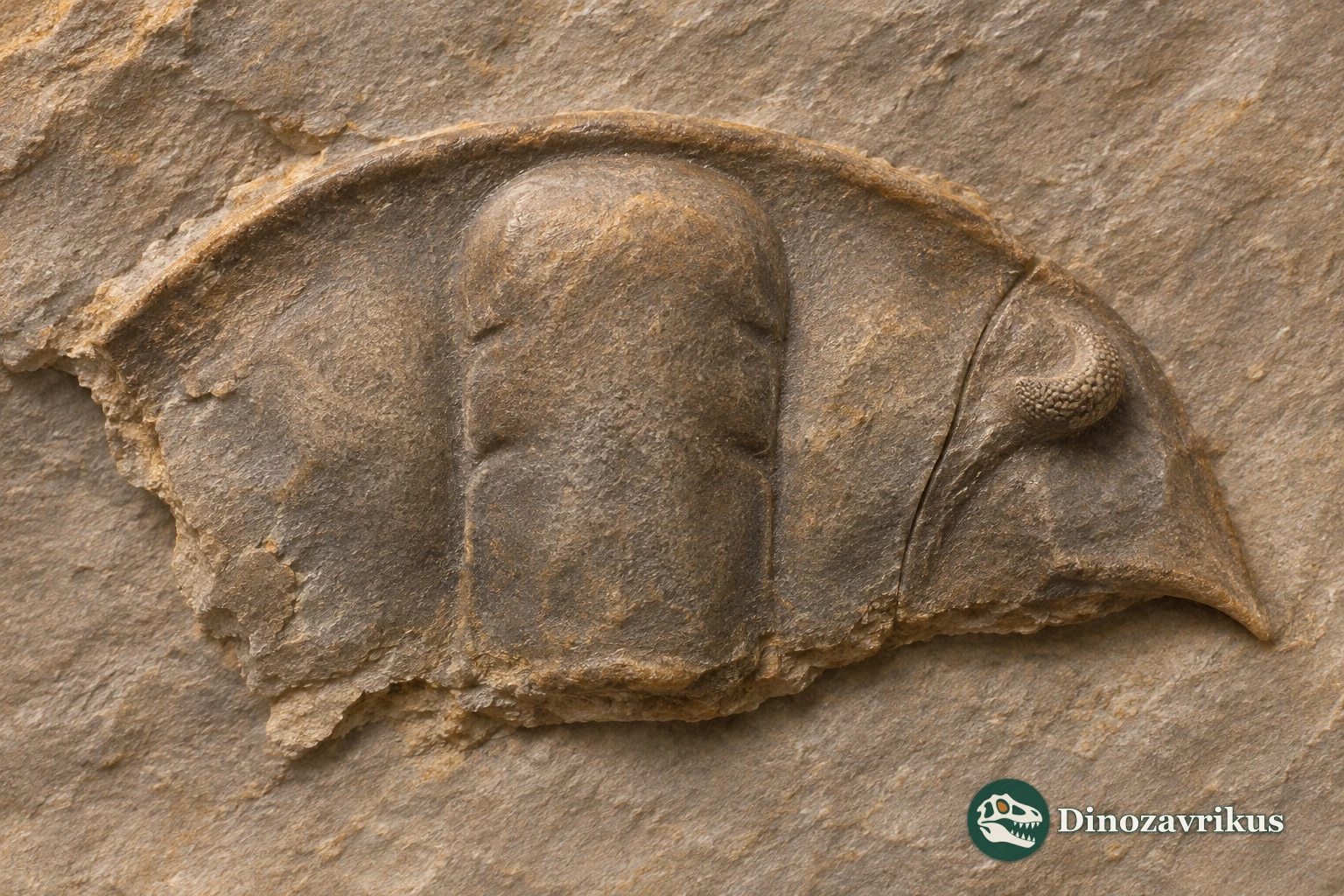
The fragment shows where the eye sat. The type fossil of the same species is an isolated tail shield.
The Drewer tail shields and the Alpine type come from separate Early Carboniferous zones.
Tail shields from Drewer
Rudolf and Emma Richter established Liobolina in 1951. Its type species, L. nebulosa, is known from Early Tournaisian strata in Germany, Austria and England. Taxonomic revisions place the genus in Cummingellinae with Cummingella.
At Drewer in Germany’s Sauerland, specimens from beds 9–11 fall in the sandbergi conodont Zone. One juvenile tail shield, WMfN P 17565, is an internal mould 5 mm long and about 7.5 mm wide. Its 4.2 mm axis shows ten rings, while three ribs stand out near the front of the side field.
Another shield is preserved as a negative impression. It retains eight closely spaced terrace lines on the cuticle that folds under the tail margin. Its shape and relief are close to those of a tail shield assigned to the type series.

An eyed species from the Carnic Alps
L. crestaverdensis takes its name from the Grüne Schneid ridge. Holotype GEOLBA 1989–3–48 is a tail shield from light-grey limestone in bed 6D, assigned to the basal Carboniferous sulcata conodont Zone. Head fragments were described with the tail material.
The head has a crescent-shaped palpebral lobe and an eye platform, and the rear corner of the free cheek extends into a short spine. The narrow tail axis is bounded by deep grooves. The combination distinguishes the Alpine species from other members of the genus.
Records near the boundary
Tail shields referred to Liobolina without a species name occur in the latest Devonian part of the Drewer section. Another tail from the boundary beds was tentatively compared with L. submonstrans. Its ribs still project, but deformation has changed the overall outline. The fossils help track the fauna around the boundary, with identification limited by what survives on each shield.
Frequently asked questions
Which species anchors the genus Liobolina?
Liobolina nebulosa, named by Rudolf and Emma Richter in 1951.
How long is the axis on the juvenile tail from Drewer?
It is 4.2 mm long on a shield that measures 5 mm from front to rear.
Did Liobolina have eyes?
The species from Grüne Schneid preserves crescent-shaped palpebral lobes and an eye platform.
How was the Alpine holotype dated?
Its limestone bed was assigned to the basal Carboniferous sulcata conodont Zone.