

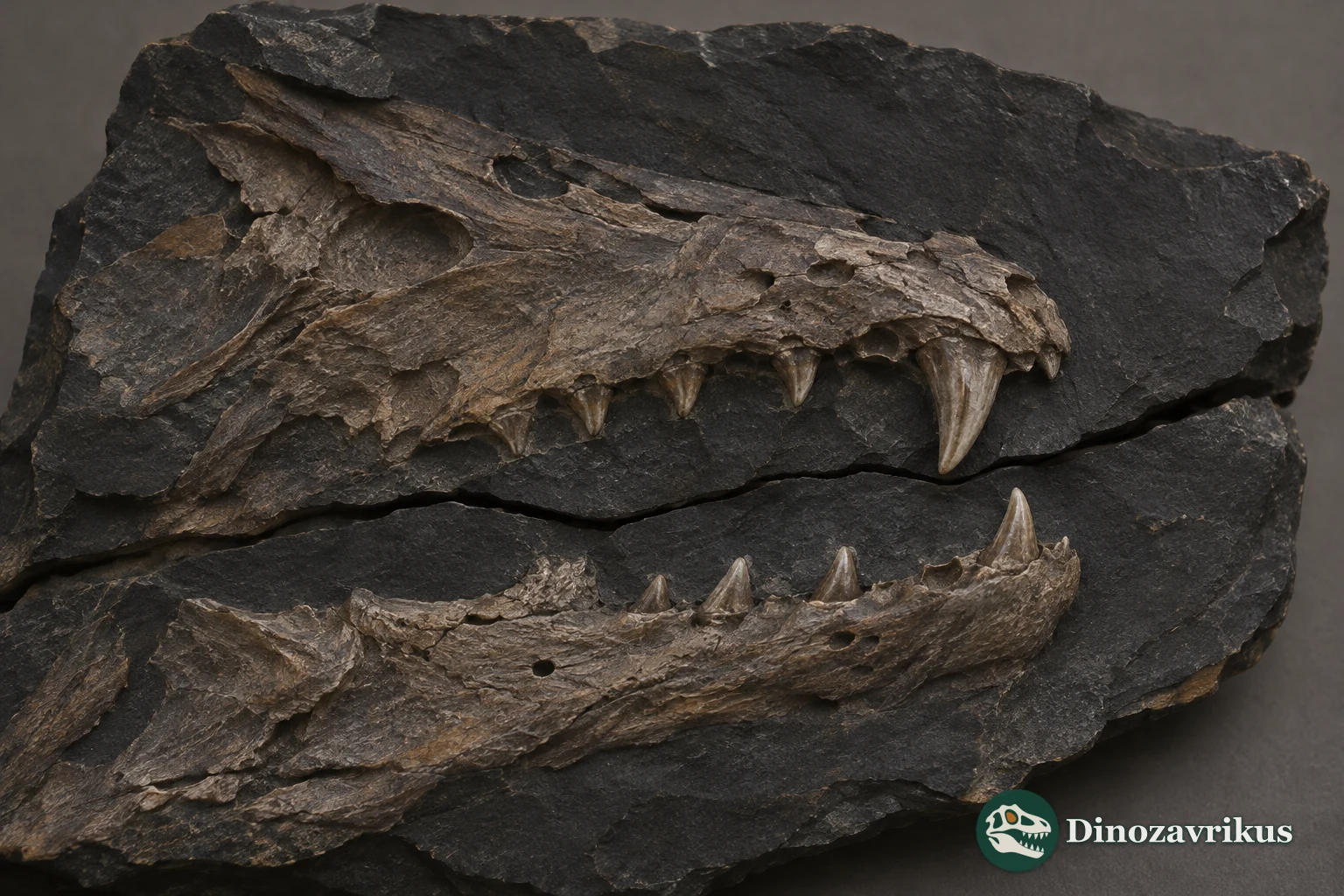
Erpetosaurus was a temnospondyl from the Carboniferous of Ohio. When it shut its mouth, some of its larger teeth fitted into pits in the opposite jaw. The inner side of the lower jaw also carried small, almost square skin bones.
Quick facts
| Group | Temnospondyls, dvinosaurs |
|---|---|
| Age | Late Carboniferous, Middle Pennsylvanian |
| Region | North America, USA (Ohio) |
| Type species | Erpetosaurus radiatus |
| Scientific name | Erpetosaurus |
| Diet | Exact prey is unknown |
What can the fossils tell us?
The front of the jaw preserves large teeth and opposing pits. Some skin bones and parts of the trunk are also known.
A comparison of features in the skull and trunk placed Erpetosaurus close to more specialised dvinosaurs.
The jaws show how the teeth met. That mechanism gives limited evidence about what Erpetosaurus caught.
The coal beds of Linton
Edward Cope named the type species Tuditanus radiatus in 1874. It was later assigned to its own genus, Erpetosaurus. Confirmed material of the type species comes from the Upper Freeport Coal at Linton, Ohio. That vertebrate assemblage also includes other temnospondyls, such as Platyrhinops.
Fangs, pits and small bones
At the front of the mouth, large teeth in the upper and lower jaws fitted into corresponding pits as the jaws shut. Along the inner underside of the lower jaw, researchers found flat bony scales with roughly square outlines and rounded corners. Modified scales also occur behind the interclavicle, a bone between the shoulders. Both sets of scales provide clues to identification in incomplete fossils.
Its place among the dvinosaurs
The 2011 redescription compared the jaws, palate, shoulder girdle and pelvis. The back of the parasphenoid, a bone in the floor of the skull, formed a long tubular section. This feature and the postcranial bones helped place Erpetosaurus close to the dvinosauroids. It retained an otic notch at the back of the skull, a feature lost in more specialised members of that branch.
Frequently asked questions
When did Erpetosaurus live?
Its fossils date to the Middle Pennsylvanian, in the later part of the Carboniferous.
Where was the type species found?
It comes from the Upper Freeport Coal at Linton, Ohio, USA.
What were the pits in its jaws for?
They accommodated large teeth from the opposite jaw when the mouth closed.
What group did Erpetosaurus belong to?
It was a dvinosaur, a member of one of the branches of temnospondyl amphibians.