

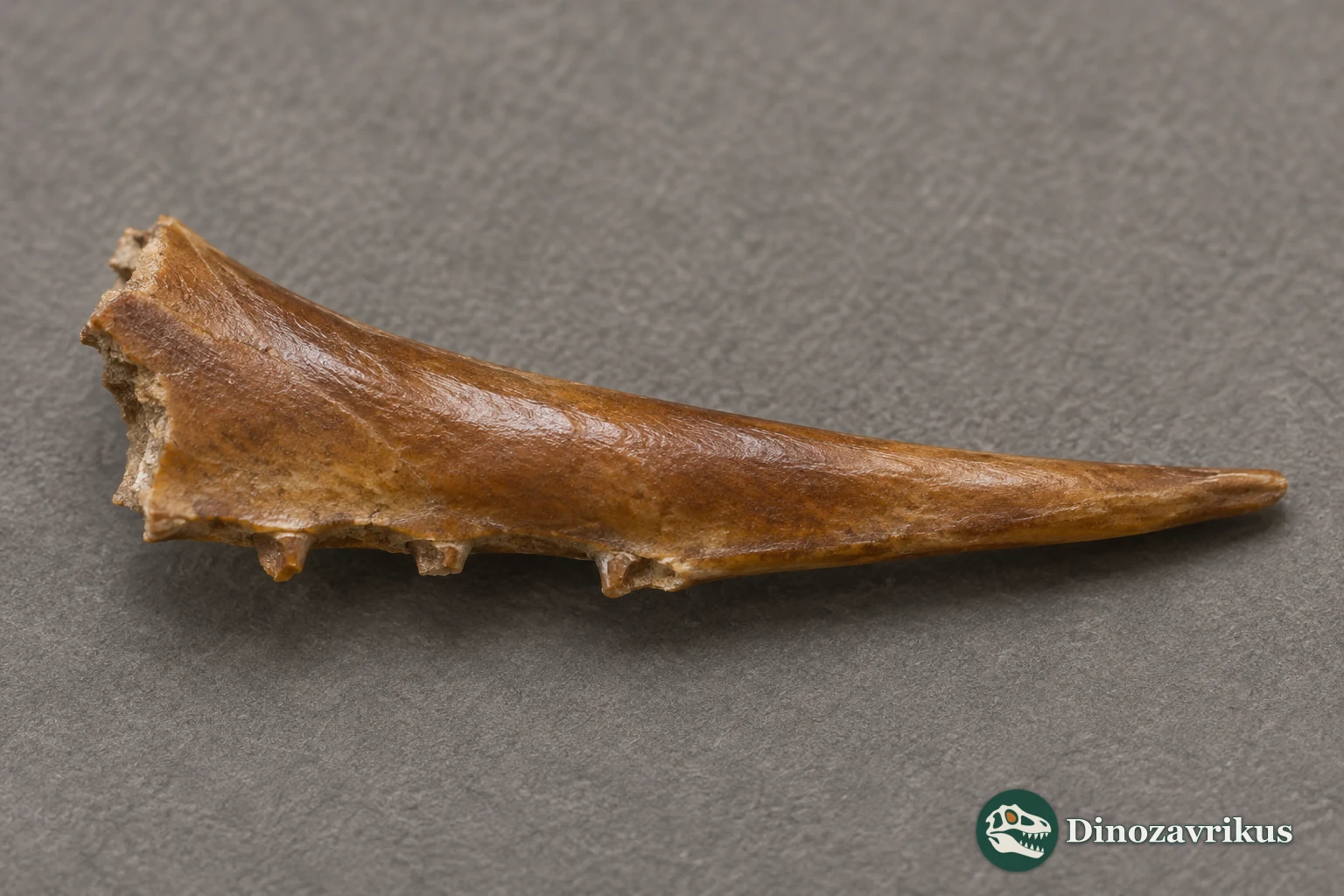
Estesina elegans was a frog from Late Cretaceous Uzbekistan. Its fossils are pieces of the maxilla, a tooth-bearing bone of the upper jaw. They preserve subtle differences from other frogs of the Kyzylkum, but give little indication of the animal’s overall size or proportions.
Quick facts
| Group | Frogs |
|---|---|
| Age | Late Cretaceous |
| Region | Asia, Uzbekistan, central Kyzylkum |
| Type species | Estesina elegans |
| Scientific name | Estesina |
| Diet | Exact prey is unknown |
What can the fossils tell us?
The type specimen, LU-N5/172, is the rear part of the right maxilla. It preserves a tooth-bearing edge and an internal shelf of bone.
Comparison with other smooth-sided maxillae depends on details such as the outline of the shelf and how far the tooth row extends.
One referred fragment differs in the size of a projection and the position of a recess. The original authors questioned whether it belonged to the same species.
The type locality and its age
Zbyněk Roček and Lev Nessov named Estesina in 1993 from a fossil collected at the CBI-4b site near Dzharakuduk. It came from the middle part of the Bissekty Formation. The original study dated this part of the succession to the Coniacian. More recent work uses marine beds above and below the continental sediments to support a Turonian age.
What distinguishes the jaw
The bone is smooth on the outside. A shelf on its inner face has a rounded free edge towards the front and becomes thin and extended towards the back. The tooth row continues beyond the shelf. Specimen LU-N5/98 resembles the type in the shape of the shelf and the size of the bone. Another specimen, LU-N6/335, is more difficult to match. Kizylkuma, from Cretaceous deposits in the same region, also has a smooth outer surface on its maxilla. Identifying either frog takes a closer look at the shape of the bone.
Why the fossils are isolated
The Bissekty Formation preserves remains of freshwater and marine animals. Sand and silt accumulated in channels across a coastal plain, where separate bones could be buried together. The sediments tell us about the setting of burial. They leave the living frog’s preferred water conditions and diet unresolved.
Frequently asked questions
Which bone was used to name Estesina?
The type is the back portion of a right maxilla, an upper jaw bone from the Bissekty Formation.
Did the upper jaw bear teeth?
Yes. The tooth row extends farther back than the bony shelf on the inner face.
Who was the genus named after?
It honours Richard Estes, who studied fossil amphibians and reptiles. The species name elegans refers to the form of the upper jaw bone.
Can the bones give a body length?
There is no reliable body length. That would require a more complete skeleton or a closer anatomical comparison than the fragments permit.