

Euceratherium, the extinct shrub-ox, was a bovid related to musk oxen without being the living musk ox itself. Skulls from northern Californian caves show its elevated horn cores. At dry sites on the Colorado Plateau, a distinctive dung assemblage has supplied unusually direct clues to what a local population ate.
For most of its research history the genus seemed North American. Early Pleistocene fossils reported from northern China in 2024 changed that picture. The Chinese material includes a specimen identified only as Euceratherium sp., so a wider range does not imply one unchanged species across two continents.
Quick facts
| Family | Bovidae |
|---|---|
| Lineage | Ovibovines, relatives of musk oxen |
| Type species | Euceratherium collinum |
| Named | Edward L. Furlong and William J. Sinclair, 1904 |
| Type locality | Samwel Cave, Shasta County, California |
| Evidence | Skulls, horn cores, teeth, limb bones and inferred fossil dung |
What can the fossils tell us?
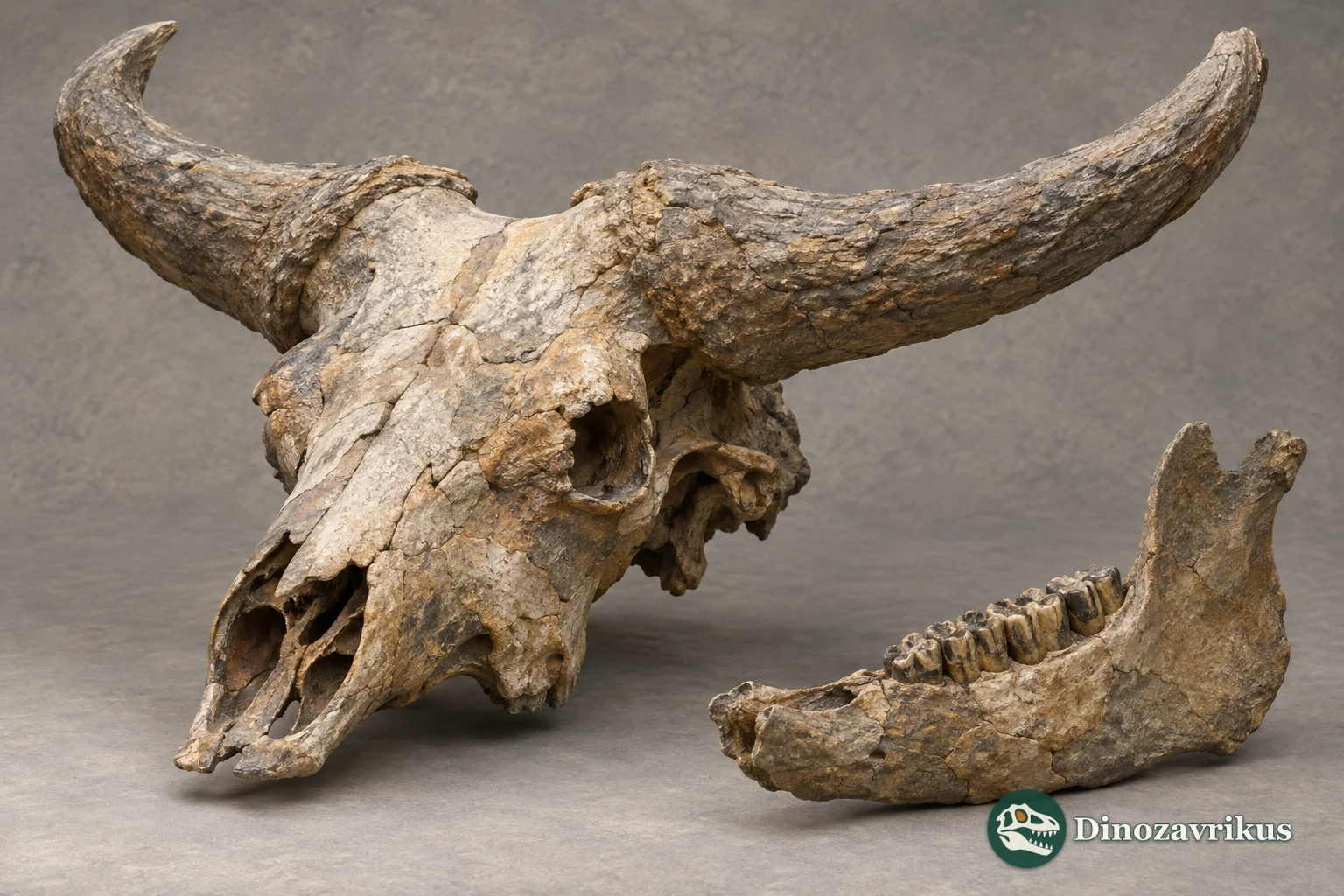
The Samwel Cave skull and later cranial finds show the bony cores rising and curving outward and forward. The full keratin sheath, coat and colour are not preserved by those bones.
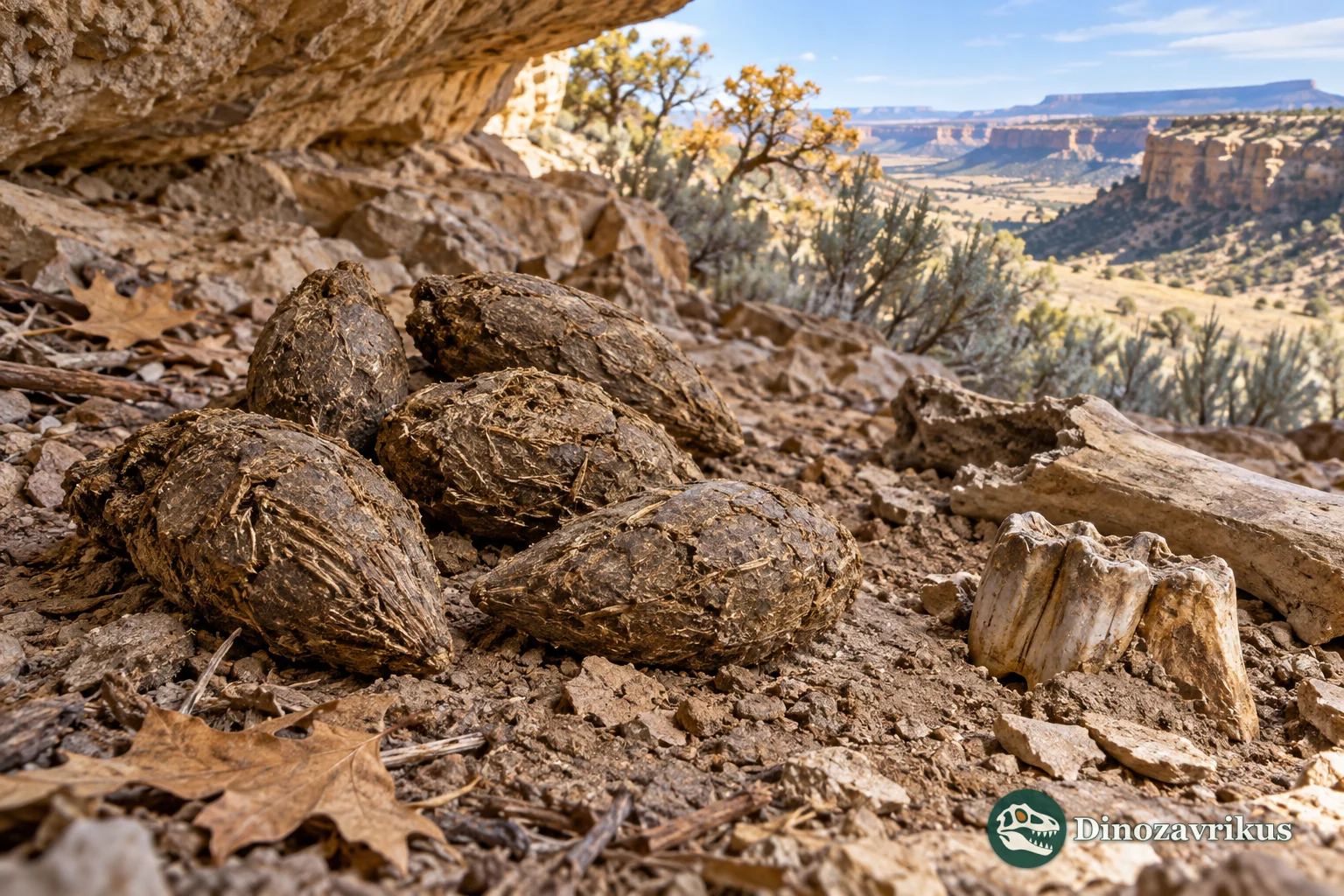
Distinctive dry pellets on the Colorado Plateau contain mostly woody plants. Their attribution to Euceratherium rests on pellet form and size, associated teeth and bone, and craniodental comparisons rather than direct observation of the producer.
Early Pleistocene teeth and limb bones described from northern China were assigned to Euceratherium. An East Asian origin is an inference from age and anatomy, not a continuous fossil trail across Beringia.
A skull from Samwel Cave
Edward Furlong discovered a cranium without its lower jaw in Samwel Cave, Shasta County, California. William Sinclair published a preliminary description of the new genus and species in 1904 and stated that a fuller study was being prepared with Furlong. The name was anchored by cranial material, rather than by a single isolated tooth. Samwel and nearby Potter Creek caves yielded related fossil assemblages, but their finds cannot automatically be placed in one identical layer.
The English common name includes 'ox', although this was not a member of the living cattle genus Bos. Its position among ovibovines is supported by skull and horn anatomy. Bootherium is a useful comparison because both were heavy-headed bovids, yet their horn shapes and cranial details differ.
Horn cores and the limits of the coat
The bony cores arose toward the rear of the frontal bones, rose above the skull, diverged and swept forward. A separate keratin covering would have changed their visible outline in life, but its exact extent is uncertain. The skull does not justify simply giving the animal a bison's hump or a modern musk ox's horns.
Limb remains indicate a sturdy four-legged herbivore. A single precise body mass for all populations would require choosing specimens and a scaling model. Neither hair colour nor a seasonal coat has been directly preserved. The cover is an artistic reconstruction built around the supported cranial outline.
Dry pellets and the browse they contained
Large tapered dung pellets survived in dry alcoves of the Escalante River Basin, Utah. At Bechan Cave they occur in an assemblage with an E. collinum tooth and a foot-bone fragment. Researchers compared their shape and size with those of other ruminants, and used the animal's teeth to strengthen the identification. The argument combines several lines of evidence; it is not a genetic identification of every pellet.
Microscopic plant remains in the studied pellets were more than 95 per cent tree and shrub material. Sagebrush, oak, acacia and other woody plants were identified. This describes the sampled Colorado Plateau assemblages, not every individual that lived in China or North America. Spring and autumn pollen is compatible with the animal's presence in different seasons but cannot trace a migration route.
Earlier fossils in China
A 2024 description of teeth and limb bones from northern China provided the first confirmed Euceratherium record outside North America. Those Early Pleistocene finds are older than part of the North American record. The authors proposed an East Asian origin and later dispersal into North America, while comparative analysis also placed the genus near the living musk ox.
The dates and morphology make movement across northern regions plausible. They do not form a complete chain of fossil sites from China to California. A late cave deposit should likewise not be turned into the exact extinction date of the whole genus without directly dated specimens.
Frequently asked questions
Was the shrub-ox the same animal as a modern musk ox?
No. Euceratherium was a separate extinct bovid genus among ovibovines, a group that also includes relatives of the living musk ox.
How can fossil dung be linked to Euceratherium?
Researchers compared pellet form and size with those of other ruminants, examined plant remains and considered teeth and a foot bone from the same late Pleistocene assemblage.
Does the Chinese record prove where the genus evolved?
No. Older Chinese fossils support an East Asian origin hypothesis, but a continuous migration sequence has not been recovered.
Do fossils preserve its coat colour?
No. Bones constrain parts of the skull and body, whereas coat colour and exact hair length in the illustrations are reconstructions.