

Euclastes was an extinct sea turtle with a broad bony palate and a stout lower jaw. For decades, researchers used different names for skulls and shells from the same beds in New Jersey. A fossil with both parts preserved together showed how those bones fitted into a single animal.
Quick facts
| Group | Turtles, sea turtles of the euclastid lineage |
|---|---|
| Age | Late Cretaceous, Paleocene and Eocene |
| Region | North America, South America, Europe and Africa |
| Type species | Euclastes platyops |
| Scientific name | Euclastes |
| Diet | Hard prey inferred from jaw shape |
What can the fossils tell us?
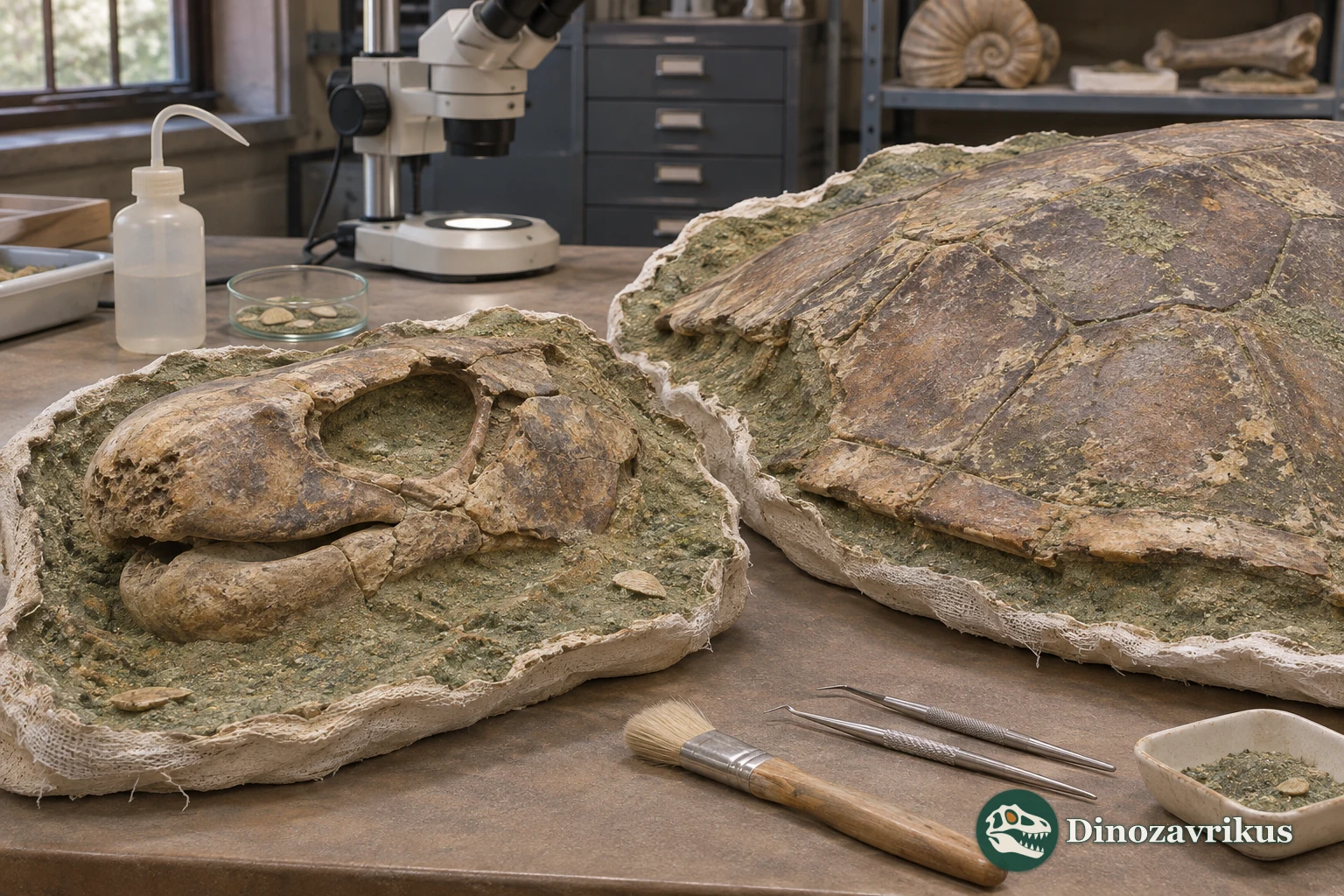
In RU-EFP-00004, the jaw traits of Euclastes occur with features of the shell previously assigned to Catapleura.
The palate and lower jaw formed wide surfaces capable of crushing hard food. Those bones leave the identity of its prey open.
French and Moroccan fossils complement the North American record. A Cretaceous skull from Chile has been assigned to the genus without a species identification.
Why the turtle had several names
Edward Drinker Cope named Euclastes in 1867 from part of a skull from New Jersey. Its type species is E. platyops. Cope named a separate turtle, Catapleura, from shell material. In 2021 Paul Ullmann and Eric Carr described RU-EFP-00004 from the Main Fossiliferous Layer of the Hornerstown Formation. It preserves the snout, lower jaw, carapace and plastron. The elongate junction between the two dentaries matches material described as E. wielandi. At the back of the shell, the second suprapygal fails to contact the eleventh peripheral, a feature associated with Catapleura repanda.
Sorting out the older identifications
Ullmann and Carr treated Catapleura as a junior synonym of Euclastes and proposed E. repandus for the species that includes the material of E. wielandi. The 2025 revision uses E. wielandi for comparable remains. Some skulls once attributed to Osteopygis also belong to Euclastes. The shell material of the type species of Osteopygis belongs to a different turtle lineage. Likewise, the Miocene species once named Euclastes hutchisoni is now assigned to Pacifichelys.
What the jaws could do
An expanded secondary palate formed a broad working surface inside the upper jaw. A matching area lay on the lower jaw. Together they could have crushed hard food such as shelled invertebrates. This interpretation is based on bone shape. The jaws leave the actual prey and its contribution to the diet unknown. Some species had different proportions. The Moroccan E. acutirostris, for example, had a relatively narrower snout than the broad-snouted New Jersey material.
From Chile to the Paris Basin
The Maastrichtian Quiriquina Formation in Chile yielded skull SGO.PV.6504, referred to Euclastes without a species name. The genus is especially well documented in the Paleocene. A skull from Morocco records E. acutirostris. In the Paris Basin, a lower jaw from Laversines dates to the early Paleocene. A younger jaw from Therdonne is the basis of E. montenati, named in 2025. Both French specimens come from coastal deposits. In South Carolina, researchers identified the fused dentaries CCNHM 552 as Euclastes from their shape, extending its record into the late Eocene.
Across the Cretaceous–Palaeogene boundary
The fossil record places this marine turtle lineage on both sides of the end-Cretaceous mass extinction. Yaminuechelys, a long-necked freshwater turtle from Patagonia, also occurs in deposits on both sides. The two genera document turtle survival in different environments.
Frequently asked questions
Why is Euclastes considered a sea turtle?
Its skull and shell place it on the sea turtle lineage. Several specimens come from shallow marine and coastal deposits.
Why does the name Catapleura appear in older publications?
Catapleura was named for shell bones. The New Jersey skeleton linked such a shell with the jaws of Euclastes, which has priority as the older genus name.
What did Euclastes eat?
Its jaws could have crushed hard food. The exact composition of its diet remains unknown.
What fossil extends the record into the Eocene?
CCNHM 552 is a pair of fused dentaries from South Carolina. The broad, rounded front and crushing surface support referral to Euclastes.