

Eurazhdarcho langendorfensis was named for associated neck and wing bones from Transylvania. The specimen is more informative than isolated fragments, yet it lacks a skull and a complete wing. Its proposed three-metre wingspan is an estimate, and the diagnostic value of the genus remains disputed.
Quick facts
| Scientific name | Eurazhdarcho langendorfensis, Vremir and colleagues, 2013 |
|---|---|
| Holotype | EME VP 312, associated cervical vertebrae and right wing bones |
| Locality | Lancrăm near Sebeş, Transylvania, Romania |
| Rock and age | Sebeş Formation, early Maastrichtian |
| Wingspan | Up to about 3 m by comparison, not a direct measurement |
| Placement | Azhdarchid; status as a separate genus disputed |
| Skull and food | Skull absent; particular diet unknown |
What can the fossils tell us?
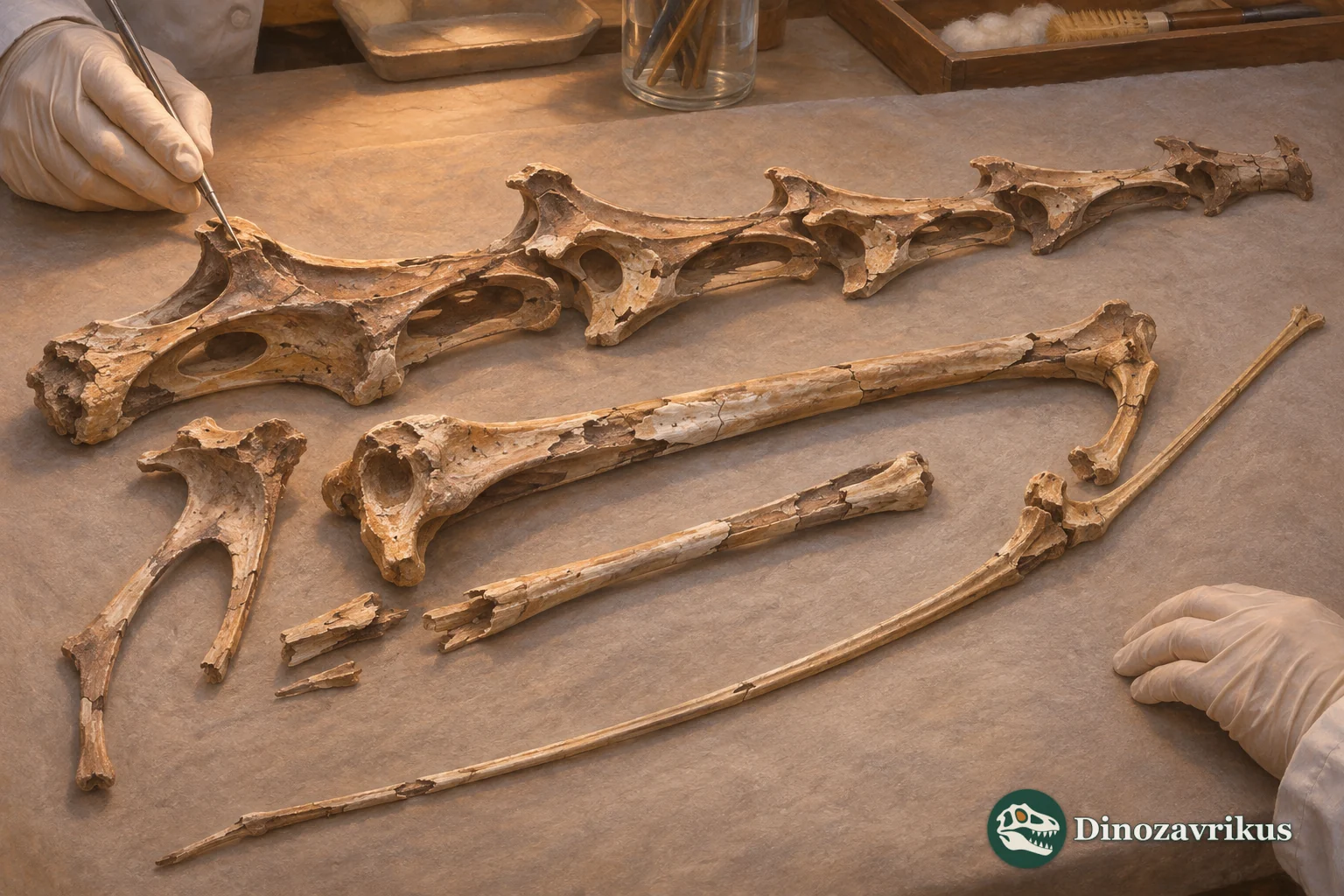
EME VP 312 preserves several neck vertebrae and fragments of the right wing from one accumulation. Neither a complete skeleton nor a skull is known.
The fourth metacarpal was reconstructed at about 250 mm. Comparison with another azhdarchid suggested a wingspan no greater than 3 m, but the entire wing is absent.
The bones came from early Maastrichtian strata of the Sebeş Formation. This dates their geological setting, not the bone directly.
The 2013 description proposed a distinct genus. A 2014 review challenged its diagnostic characters and suggested possible synonymy with Hatzegopteryx, an interpretation of incomplete material.
An associated find near Sebeş
Mátyás Vremir discovered and excavated the remains in 2009 at Sebeş-Glod, near Lancrăm. In 2013 he named Eurazhdarcho langendorfensis with Alexander Kellner, Darren Naish and Gareth Dyke. The genus name combines Europe with Azhdarcho; the species recalls Langendorf, the German name of Lancrăm. Most of the material entered the Transylvanian Museum Society in Cluj-Napoca, while some later finds are held by Babeş-Bolyai University.
Holotype EME VP 312 includes cervical vertebrae, the fourth metacarpal of the right wing, part of the third metacarpal and wing phalanges. Several bones lay close together and retained some of their original relationships. That association is useful, although jaws, the skull and much of the limbs are missing. Elongate, tubular neck vertebrae support an azhdarchid identification. Mistralazhdarcho provides a comparison from another European deposit.
A wingspan inferred from a metacarpal
No preserved wing bone provides a direct measurement of the full wingspan. The original authors reconstructed the fourth metacarpal to about 250 mm because its proximal joint end was missing. Comparing its proportions with the better known Asian azhdarchid Zhejiangopterus suggested a span no greater than roughly three metres. Missing phalanges and uncertain proportions limit that number.
The authors considered the holotype potentially mature based on the proximal end of a wing phalanx. Damage makes that feature difficult to interpret. The modest size alone cannot establish a juvenile of a larger Romanian species, nor can that contested feature prove adulthood or a separate genus.
Why the genus is debated
The 2013 diagnosis relied on a combination of cervical features, including relative vertebral lengths and articular processes. Alexander Averianov reviewed those characters in 2014 and judged them insufficiently distinctive. Some differences may reflect damage or preservation. He proposed that Eurazhdarcho could be a junior subjective synonym of the larger Romanian Hatzegopteryx.
That proposal concerns how the bones should be classified; it does not erase the holotype. The original authors noted that the then-known diagnostic parts of Hatzegopteryx did not overlap with EME VP 312. Direct identity therefore was not demonstrated. More comparable material would help test the suggestion.
Floodplain setting and artistic limits
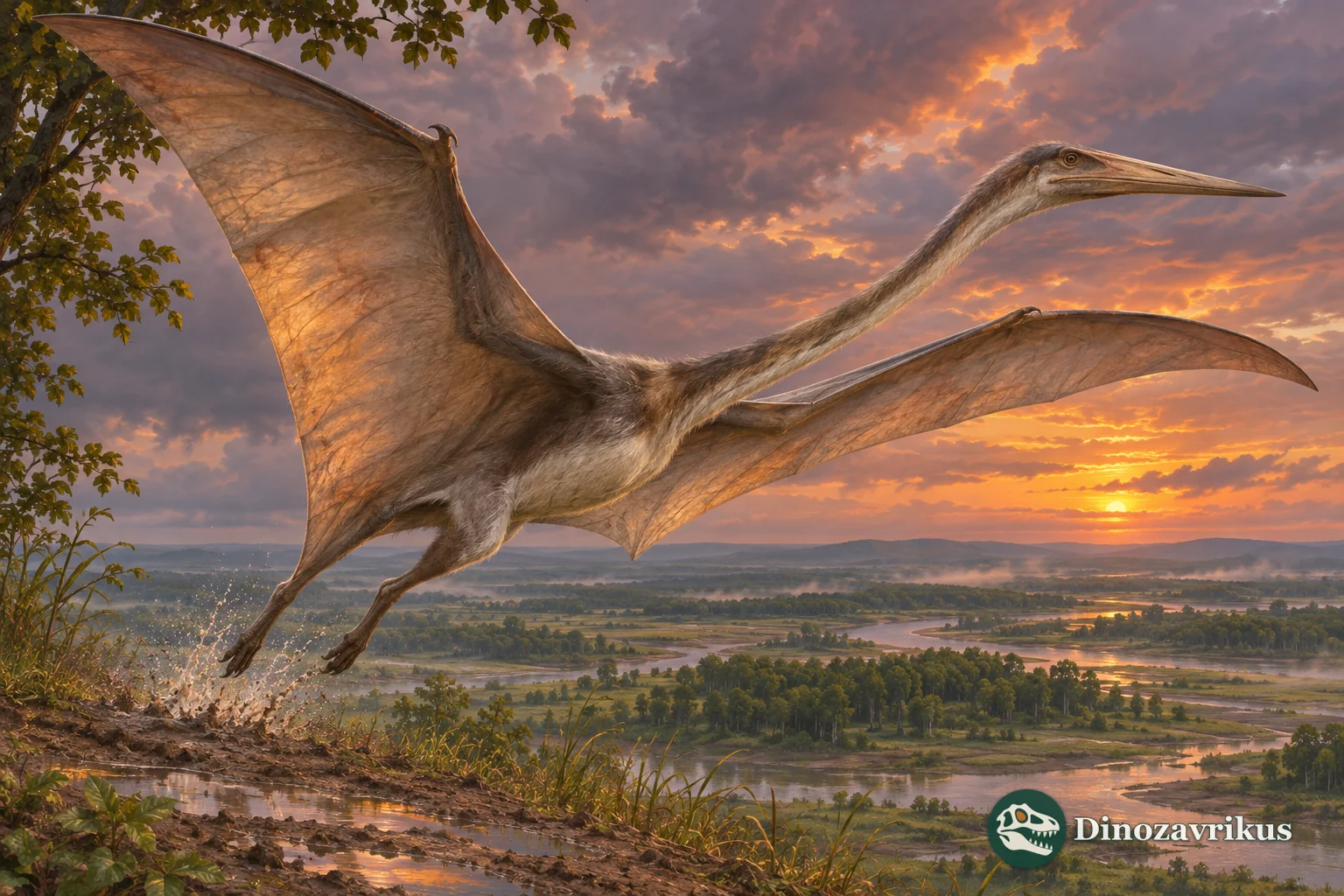
The Sebeş Formation includes river-channel, lake and floodplain sediments. The arrangement of associated but damaged bones led the describers to suggest transport by a weak current as a flood subsided. This is a taphonomic interpretation, not a witnessed event. Punctures on some bones may reflect scavenging, but the animal responsible is unidentified.
No skull, teeth or stomach contents establish what Eurazhdarcho ate. A flight scene over the floodplain illustrates a possible environment, not observed behaviour. Eoazhdarcho broadens the comparison among Late Cretaceous azhdarchids without filling gaps in the Romanian skeleton.
Frequently asked questions
Where was Eurazhdarcho found?
The holotype came from near Lancrăm and Sebeş in Transylvania, Romania, in early Maastrichtian continental strata of the Sebeş Formation.
Which parts of its skeleton survive?
EME VP 312 contains several cervical vertebrae and parts of the right wing, including metacarpals and phalanges. It has no skull.
Was its three-metre wingspan measured?
No. It is a comparative estimate based on a reconstructed fourth metacarpal and the proportions of another azhdarchid.
Is Eurazhdarcho a valid separate genus?
It was named as one in 2013. A 2014 revision challenged the distinguishing characters and proposed possible synonymy with Hatzegopteryx; incomplete comparable bones leave the issue debated.