

Eurhinosaurus lived in European seas during the Toarcian stage of the Early Jurassic. Its toothed upper jaw extended far beyond the mandible. The arrangement is preserved in fossils, but any specific hunting technique inferred from it remains untested.
English type material, German skeletons and other European discoveries now provide more than a single striking skull. A 2025 study named a new Bavarian species and made clear how incomplete measurements should be interpreted.
Quick facts
| Type species | Eurhinosaurus longirostris (Mantell, 1851) |
|---|---|
| Genus named | Othenio Abel, 1909 |
| Group | Ichthyosauria, Parvipelvia |
| Age | Toarcian, Early Jurassic |
| Type specimen | NHMUK PV OR 14566, Whitby area |
| New species | E. mistelgauensis, described in 2025 |
| Bavarian material | Two nearly complete skeletons and a partial snout |
What can the fossils tell us?
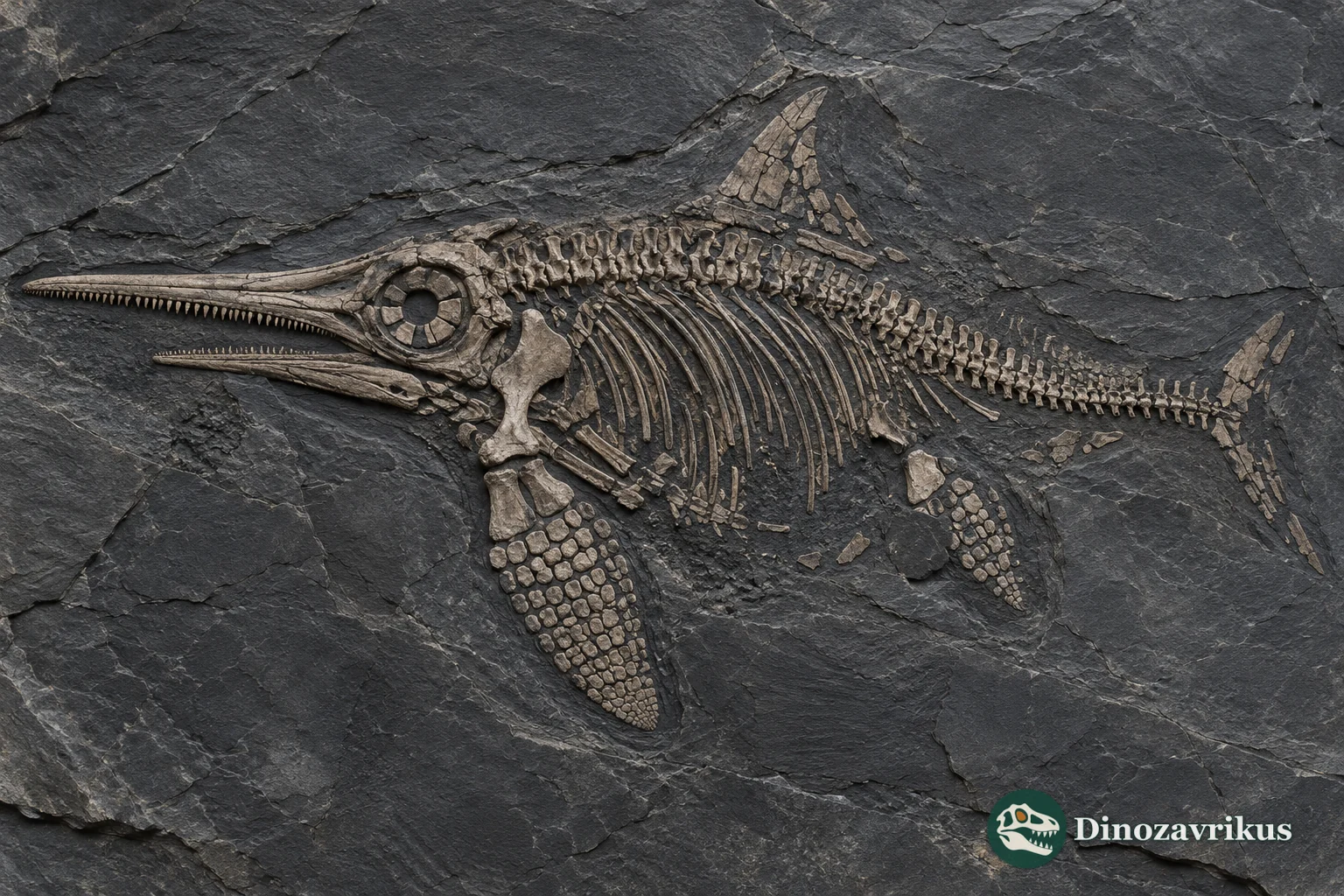
NHMUK PV OR 14566 preserves a skull, partial vertebral column and forefin. Preparation exposed a short lower jaw beneath the long rostrum, confirming the genus without supplying a full body outline.
Two nearly complete skeletons and a snout from Mistelgau show distinctive occipital and rib anatomy. Some humeral differences may reflect pathology rather than another taxon.
The two Bavarian skeletons preserve 419 and 355 cm respectively. Both lack sections; humerus-based regressions provide estimates with meaningful uncertainty.
The name and its English type
Gideon Mantell described the Whitby-area fossil as Ichthyosaurus longirostris in 1851. Othenio Abel established Eurhinosaurus in 1909. The type, NHMUK PV OR 14566, includes a skull, some vertebrae and part of a forefin; much of the jaw remained embedded until later preparation.
Christopher McGowan's 1994 work exposed a lower-jaw section about 172 mm long beneath a skull about 860 mm long. This directly confirmed that the specimen was a eurhinosaur. It also secured the use of the older species name longirostris amid competing historical assignments.
Anatomy beyond the snout
The revised genus diagnosis places the mandible below 60 percent of skull length and notes large orbits, long slender fins and features of the skull base, ribs and pelvis. Notches in fin elements vary too much among specimens to serve as a secure genus marker on their own.
Comparison with Ophthalmosaurus and other ichthyosaurs helps situate the animal, but their shared aquatic outline does not make them the same species. The long rostrum may have aided prey capture; no preserved stomach content or decisive impact trace proves a particular method.

The Mistelgau species and its limits
Spicher and colleagues named E. mistelgauensis in 2025. Holotype UMO BT 011 221.00 and paratype UMO BT 011 235.00 are nearly complete but imperfect skeletons. UMO BT 011 240.00 preserves part of the snout with teeth. All come from Upper Toarcian Jurensismergel beds at Mistelgau, from two ammonite subzones.
The new species combines an unusual basioccipital with robust rounded ribs. A pitted humeral joint surface in the holotype may be pathological, a possibility rather than proof of an illness or diving depth. The paratype preserves 419 cm and the holotype 355 cm, yet each lacks a major section. Humerus-based calculations of roughly 423 and 465 cm illustrate uncertainty, especially where the estimate scarcely exceeds the preserved fossil. The comparative sample of more complete Eurhinosaurus skeletons spans about 3.85–7.12 m, not a demonstrated biological maximum. The later Acamptonectes belongs to Early Cretaceous deposits, far younger than these Toarcian animals.
Frequently asked questions
Was its upper jaw really longer than the lower jaw?
Yes. The prepared type and other specimens show a strongly shortened mandible, less than 60 percent of skull length in the genus diagnosis.
Where is the type specimen from?
The type of E. longirostris came from the Whitby area of Yorkshire and is held by London's Natural History Museum as NHMUK PV OR 14566.
What did the 2025 Bavarian study add?
It named E. mistelgauensis from Mistelgau skeletons and refined the genus diagnosis using skull and rib anatomy.
Do fossils show how it hunted?
No particular hunting motion is directly demonstrated. Ideas about using the long snout remain functional hypotheses.