

Euroemys is a genus name proposed for Eocene freshwater turtles from Western Europe. A German species from Messel anchors the name. A French shell became the type of a second species after comparison of bones and scute grooves on its underside.
Quick facts
| Group | Turtles, geoemydids (Geoemydidae) |
|---|---|
| Age | Middle Eocene (Lutetian) |
| Region | Europe (Germany and France) |
| Type species | Euroemys kehreri |
| Type material | Part of SMF-Me-R109, shell fragment |
| Scientific name | Euroemys |
| Diet | Exact diet unknown |
What can the fossils tell us?
The type was selected from the material catalogued as SMF-Me-R109. Several other fragments under that number were subsequently excluded from the species.
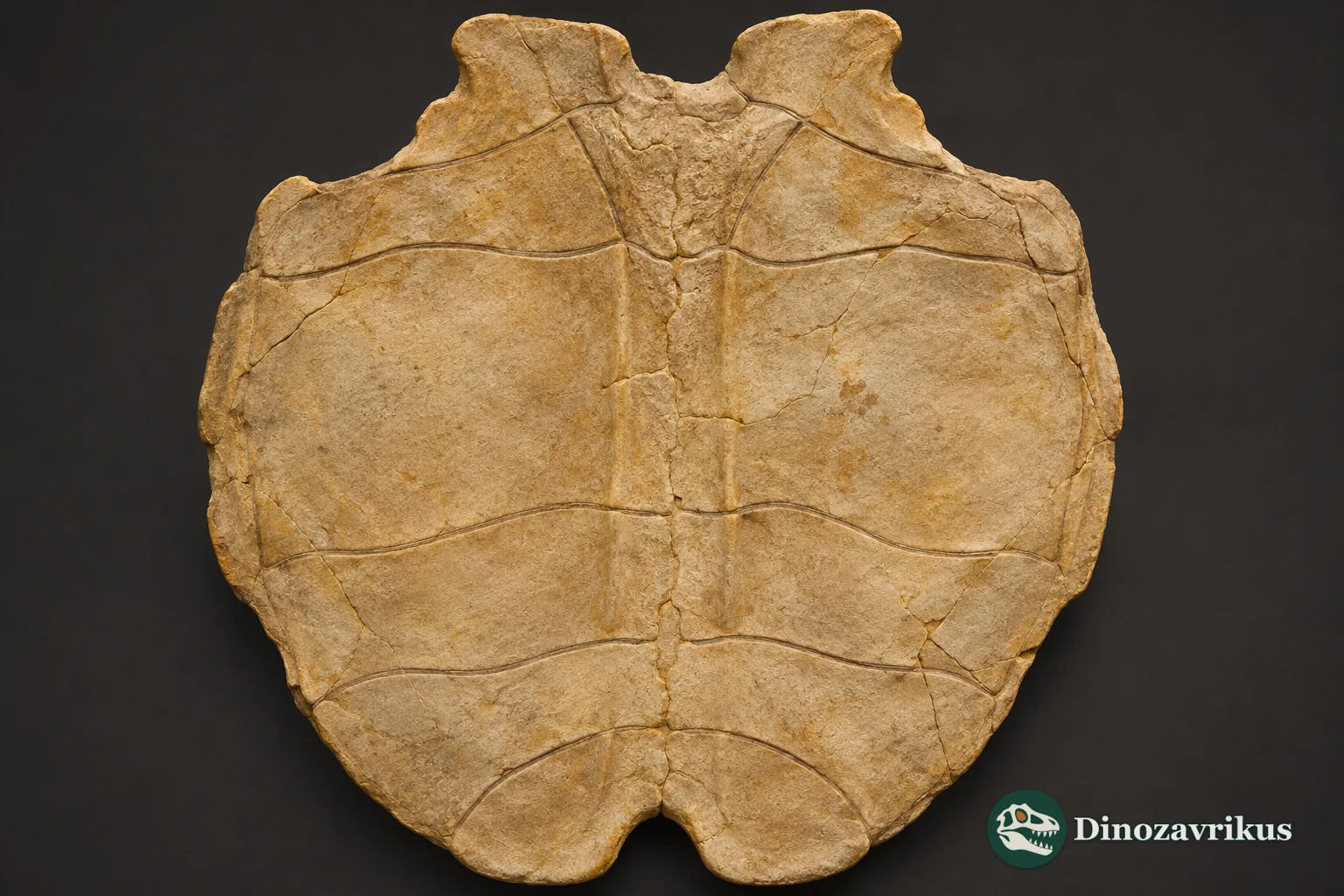
MNHN.F.EBA510 includes a carapace and plastron. The central bone at the front of the plastron is smaller than in the Messel form.
Analyses in 2021 placed the Messel forms in different positions depending on the selection and treatment of characters.
A new name for a German species
Karl Staesche named Ocadia kehreri in 1928 from Messel. Sophie Hervet made it the type species of Euroemys in 2004. The name-bearing specimen is a piece of SMF-Me-R109 singled out in the caption of Staesche’s second plate. Hervet excluded several poorly preserved fragments from the same collection lot.
The Messel form, from the earliest Middle Eocene, has a relatively large entoplastron in the front lobe of the lower shell. The groove between the humeral and pectoral scutes tends to lie close to the rear boundary of that bone. Scute grooves can still mark their former positions after the outer covering is gone.
A separate species in southern France
Dominique Vidalenc found MNHN.F.EBA510 at Trotte-Cos near Pépieux in the Aude department. Hervet named it Euroemys vidalenci. The Lutetian specimen preserves the upper and lower parts of the shell.
Its entoplastron is smaller than in the German form and the humeral–pectoral groove lies farther behind it. Lower shell features therefore provide a basis for comparing the two localities. Another European geoemydid, Cuvierichelys, has also been studied using variation in the distribution of marks left by scutes.
Why the Messel names are still discussed
Researchers have treated the kehreri and messeliana forms as separate genera or grouped them together under Palaeoemys. The 2021 reassessment tested several ways of comparing shell anatomy and proportions with those in living geoemydids. Alternative analyses produced different placements.
Possible Early Eocene Euroemys remains from the Marne are much more fragmentary. Hervet noted that other geoemydid assignments were possible for that material. The better-supported German and French specimens are Middle Eocene.
Frequently asked questions
Which species anchors Euroemys?
Euroemys kehreri, which was originally named Ocadia kehreri.
Where was the French holotype collected?
At Trotte-Cos near Pépieux in southern France. It is held at the natural history museum in Paris.
How are the shells of the two named species distinguished?
The distinction includes the size of a central bone near the front of the plastron and the position of the groove between the humeral and pectoral scutes.
Do the fossils tell us what Euroemys ate?
Direct evidence of diet is lacking. The principal diagnostic characters concern the shell.