

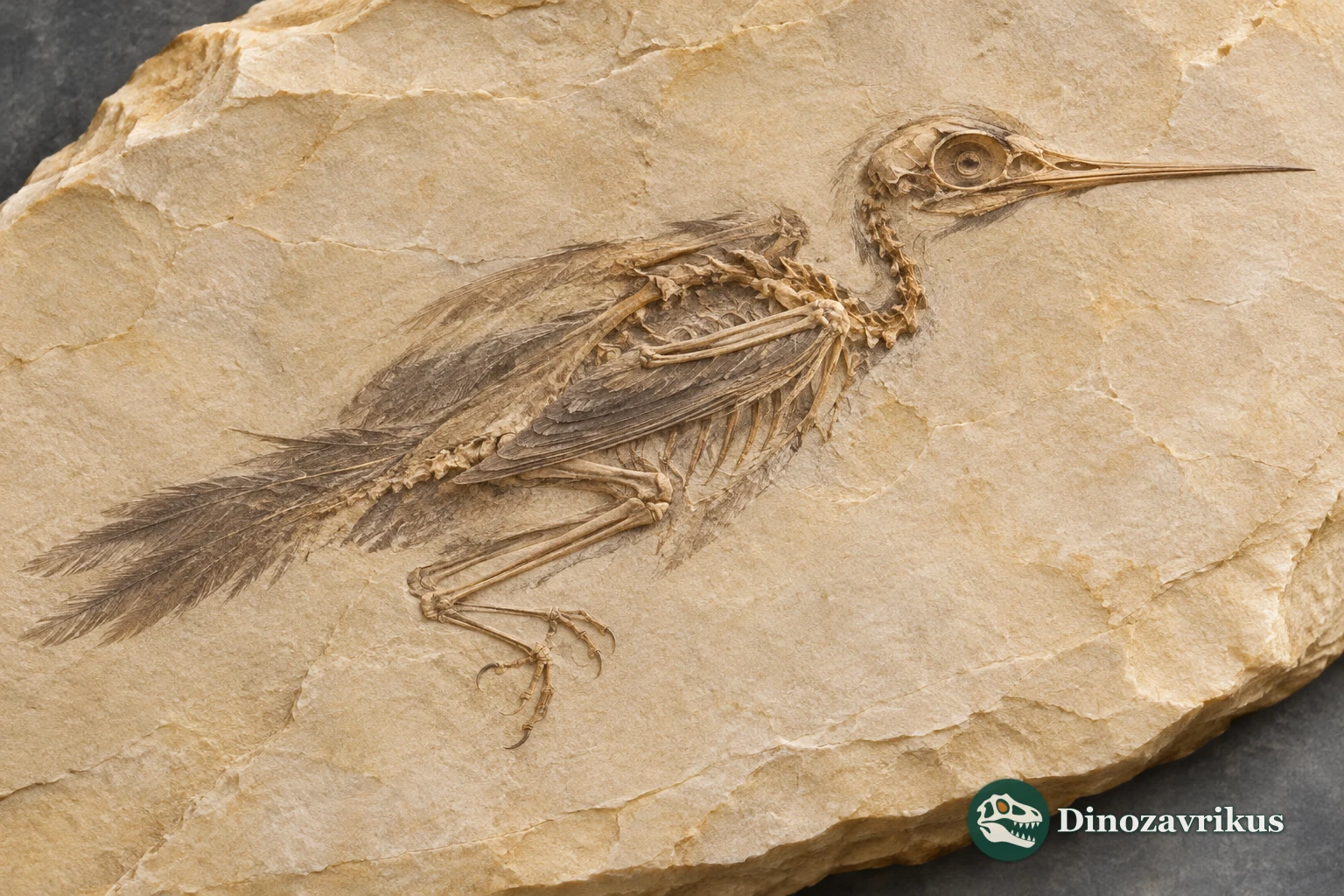
Wild hummingbirds today live in the Americas. Their close relatives had a wider distribution in the early Oligocene. European fossils of Eurotrochilus preserve a long slender bill and compact wing bones suited to hovering. A French slab even retains the outlines of the folded wings and tail.
Quick facts
| Group | Stem hummingbird |
|---|---|
| Age | Early Oligocene, Rupelian |
| Localities | Germany, Poland and France |
| Holotype of type species | SMNS 80739/4, partial skeleton |
| Genus described | Gerald Mayr, 2004 |
| Type species | Eurotrochilus inexpectatus |
| Holotype humerus | 6.0 mm long |
| Feeding | Nectar feeding inferred from bill and hyoid |
What can the fossils tell us?
In modern hummingbirds a comparable projection is associated with wing rotation. Fossil bones are evidence for a hovering ability without revealing the wingbeat rate.
The French hyoid bones supported the tongue. Their size, together with the bill shape, indicates a tongue adapted to taking nectar.
A dark film traces the folded wings and tail. No original plumage colour was identified from the film.
Two birds from a German clay pit
Gerald Mayr described Eurotrochilus inexpectatus in 2004 from two skeletons from the Unterfeld pit at Wiesloch-Frauenweiler, Germany. The holotype, SMNS 80739/4, is a partial skeleton at the State Museum of Natural History in Stuttgart. It preserves parts of the skull and bill, shoulder girdle, wings and legs. SMNS 80739/3 represents a separate individual.
The type humerus is 6.0 mm long, the ulna an estimated 7.8 mm and the tarsometatarsus 6.5 mm. Even with its tip incomplete, the narrow bill is noticeably longer than the cranium. Later specimens from the same site provided additional detail on the wing and shoulder bones.
Hovering and reaching nectar
The humerus and ulna are short and stout. A distinctive projection on the humeral head corresponds to a feature involved in wing rotation in living hummingbirds. Mayr used this and the wing proportions to infer that Eurotrochilus could hover.
The slender bill would have given the bird access to nectar. Large hyoid bones in a French specimen point to an extensible tongue, as in living nectar-feeding hummingbirds. Bill and hyoid anatomy support that interpretation. The flowers it visited and the proportion of insects in its diet remain unknown.
A Polish species and French plumage
Zygmunt and Zbigniew Bochenski described a nearly complete, partly articulated skeleton from the menilite shales at Winnica in the Polish Carpathians as Eurotrochilus noniewiczi. They estimated the deposit at about 31 million years old. The bill and short, sturdy wing bones are hummingbird-like. A shoulder bone, the coracoid, retains a resemblance to that of swifts.
The specimen NT-LBR-040 from near Oppedette in the French Luberon is a nearly complete skeleton in finely layered limestone. Its authors assigned it to the genus without naming a species. A thin dark film preserves the outlines of the folded wings and tail. The bill was estimated at about 20 mm from the nasofrontal hinge to the tip, out of about 32 mm for the skull including the bill.
Burial sites and evolutionary relationships
The French authors interpreted the sediment as the product of a calm fresh or slightly brackish setting. The articulated bones and trace of the feathers suggest little transport and rapid burial. The German fossils occur in deposits near an ancient shoreline. These settings describe how the fossils accumulated. The birds’ daily movements remain unknown.
Details of the wrist and hand distinguish Eurotrochilus from the group formed by living hummingbirds and their most recent common ancestor. Several analyses place it on the hummingbird stem. The profile of Archaeotrogon explores another fossil branch of the wider Strisores. The European hummingbird fossils establish an early Old World presence. They leave the geographic origin of the whole group open.

Frequently asked questions
Where was Eurotrochilus found?
Its fossils come from early Oligocene deposits in Germany, Poland and France. Living wild hummingbirds are confined to the Americas.
Could it hover?
Probably. The short, stout wing bones and a specialised projection on the humerus are consistent with hovering.
How do we know it fed on nectar?
The long, thin bill and large hyoid bones support that inference. There is no direct fossil evidence of the plants it fed from.
Do the fossils show what colour it was?
The French specimen preserves the shape of the tail and folded wings. Its original feather colours were not determined.