

Forfexopterus jeholensis is known from Early Cretaceous deposits in western Liaoning. Its first skeleton preserves an unusual ordering of wing-phalanx lengths and a substantial sternum. Later finds helped compare individual sizes and reveal tooth replacement. Its diet remains an inference from jaw anatomy rather than a direct food find.
Quick facts
| Scientific name | Forfexopterus jeholensis, Jiang and colleagues, 2016 |
|---|---|
| Holotype | HM V20, incomplete skeleton |
| Locality | Lamadong area, Jianchang County, Liaoning, China |
| Rock and age | Jiufotang Formation, Early Cretaceous |
| Wing | First wing phalanx shorter than second but longer than third |
| Wingspan | About 2.37 m and 1.78 m for two specimens, both estimates |
| Food | Filter feeding proposed; actual food not preserved |
What can the fossils tell us?
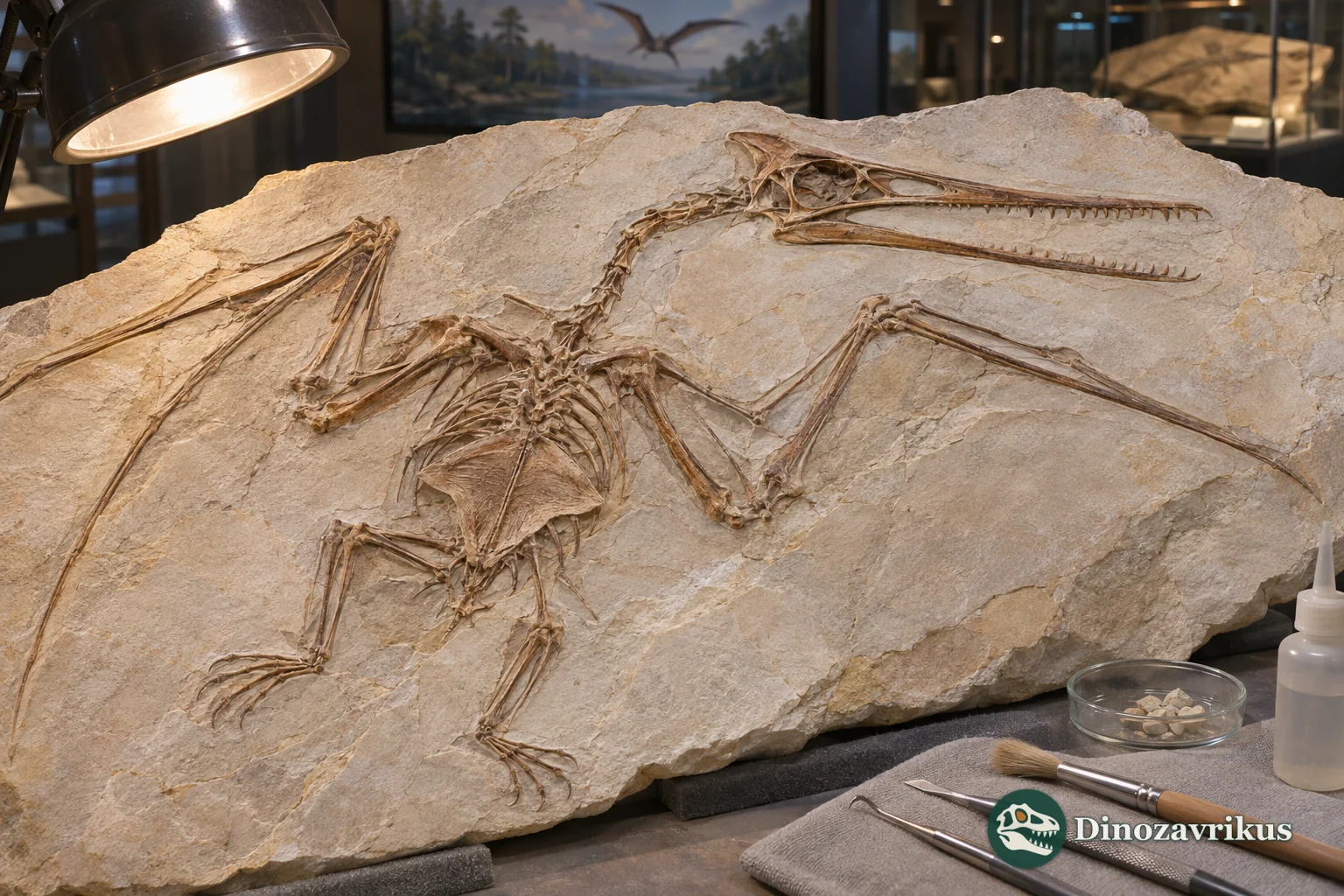
HM V20 preserves elements of the wing and a near-complete sternum, permitting comparison of phalanx lengths and shoulder articulation.
Published comparative span estimates are about 2.37 m for HM V20 and 1.78 m for SDUST-V1003. Their size difference alone does not establish sex or a growth sequence.
CT scanning of separate jaw SDUST-V1007 revealed replacement tooth germs and wear on functioning teeth, direct evidence of dental anatomy rather than food.
Jaw similarities to some filtering pterosaurs prompted discussion of that feeding method. Stomach contents of Forfexopterus are unknown.
The Jiufotang holotype
Jiang Shunxing and colleagues described Forfexopterus jeholensis in 2016 from specimen HM V20. It was found near Lamadong in Jianchang County, within the Early Cretaceous Jiufotang Formation. The skeleton is incomplete, but it retains wing elements and a near-complete sternum. Researchers could therefore compare its flight apparatus as well as its jaws.
The Jiufotang Formation is part of the fossil-rich Jehol deposits. Shared geological age does not make every pterosaur from the area ecologically identical. Eosipterus offers a comparison with another Early Cretaceous Chinese pterosaur.
Wing phalanges and size estimates
In the holotype, the first phalanx of the long fourth wing finger is shorter than the second but longer than the third. This unusual ordering contributed to the species diagnosis. The near-complete sternum also shows positions of the coracoid joints. Bone proportions are better evidence than an artist's freehand wing membrane.
A second wing, SDUST-V1003, was reported in 2020. It came from an individual with skeletal maturity indicators but was smaller than the holotype. By doubling the right forelimb, the authors estimated a span of roughly 1.78 m; about 2.37 m was given for HM V20. These are models from bones, not measurements of wings held open. A smaller mature specimen and larger less mature holotype do not establish their sex or a simple growth curve.
Replacement teeth in another jaw
Researchers later examined a separate lower jaw, SDUST-V1007, assigned to Forfexopterus. CT scans revealed developing replacement teeth behind the functional row and an alternating replacement pattern. Functioning teeth also showed wear. These are observations about a particular fossil's dental anatomy, extending the evidence beyond the original skeleton.
The researchers discussed filtering small food items from water by analogy with the dental arrangements of related forms. No food particles or stomach contents are preserved. Pterodaustro illustrates diversity in pterosaur tooth arrays, but a similar proposed feeding mode cannot prove an identical diet.
Lakeside context and life art
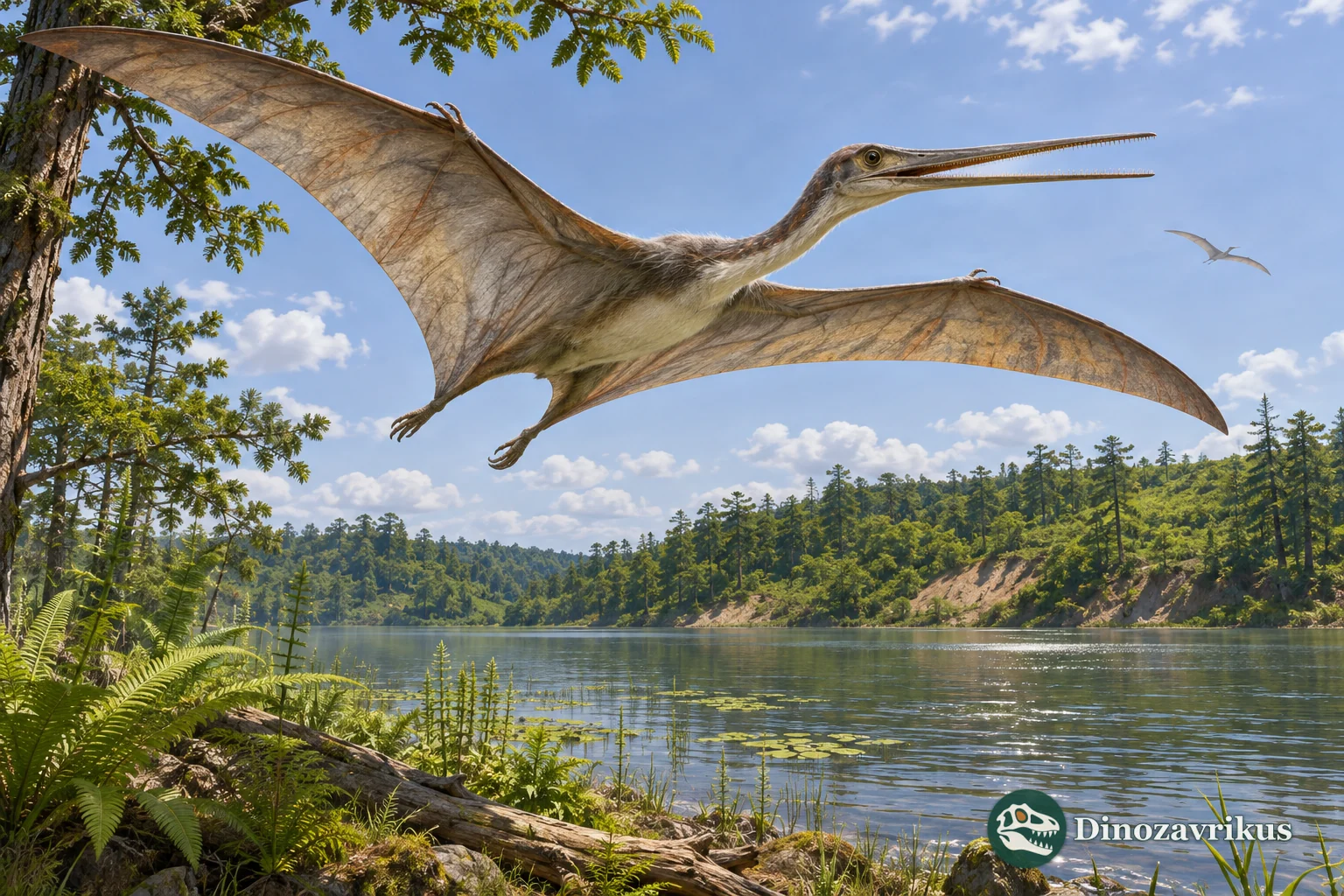
Jehol deposits record ancient lakes and their surroundings. Burial in these rocks cannot show how long Forfexopterus spent beside water or exactly how it caught food. The fossils are bones and teeth, not a record of a flight or feeding event.
The cover and scene over water imagine a live pterosaur with long jaws. Soft tissues, colour, precise wing movement and behaviour are artistic interpretations. Multiple specimens still leave these details unknown.
Frequently asked questions
Where was Forfexopterus found?
Holotype HM V20 came from the Jiufotang Formation near Lamadong in Jianchang County, Liaoning, China.
What is unusual about its wing?
The first wing phalanx is shorter than the second but longer than the third. A near-complete sternum adds information on shoulder joints.
Why are two wingspans cited?
About 2.37 m was estimated for the holotype and 1.78 m for smaller SDUST-V1003. They are separate individuals and comparative estimates.
Is filter feeding proven?
No. Tooth anatomy supports discussion of the idea, but no actual food remains have been identified for Forfexopterus.