

Thin layers of sediment can preserve thousands of microscopic plant remains. By identifying pollen grains and spores and counting their relative abundance, researchers can track how vegetation changed through time. The record is not a ready-made map of an ancient forest: wind and water move pollen, plants produce it in different quantities, and burial changes what survives.
Pollen and spores belong to a wider group of microscopic organic remains called palynomorphs. Their resistant outer walls often survive after leaves and wood have disappeared. They occur in lake and marine sediment, peat and coal, making them useful across archives with very different histories.
What survives in the sediment
Pollen carries the male reproductive cells of seed plants. Spores are produced by mosses, ferns and other groups. Many pollen and spore walls contain sporopollenin, a durable material that can preserve shape and surface ornament. A prepared sample may also contain algal cysts, fungal remains and other organic particles. These are not all pollen, even when palynological preparation concentrates them together.
Under a microscope, palynologists compare size, outline, openings and surface pattern with reference collections and published descriptions. Some forms can be assigned to a family or genus; many cannot be identified confidently to species. A fossil pollen type does not always map one-to-one onto a living plant genus, and separate fossil organs may never have been found attached to the same plant. A single grain is therefore rarely a complete botanical identification.
From a sediment sample to a microscope slide
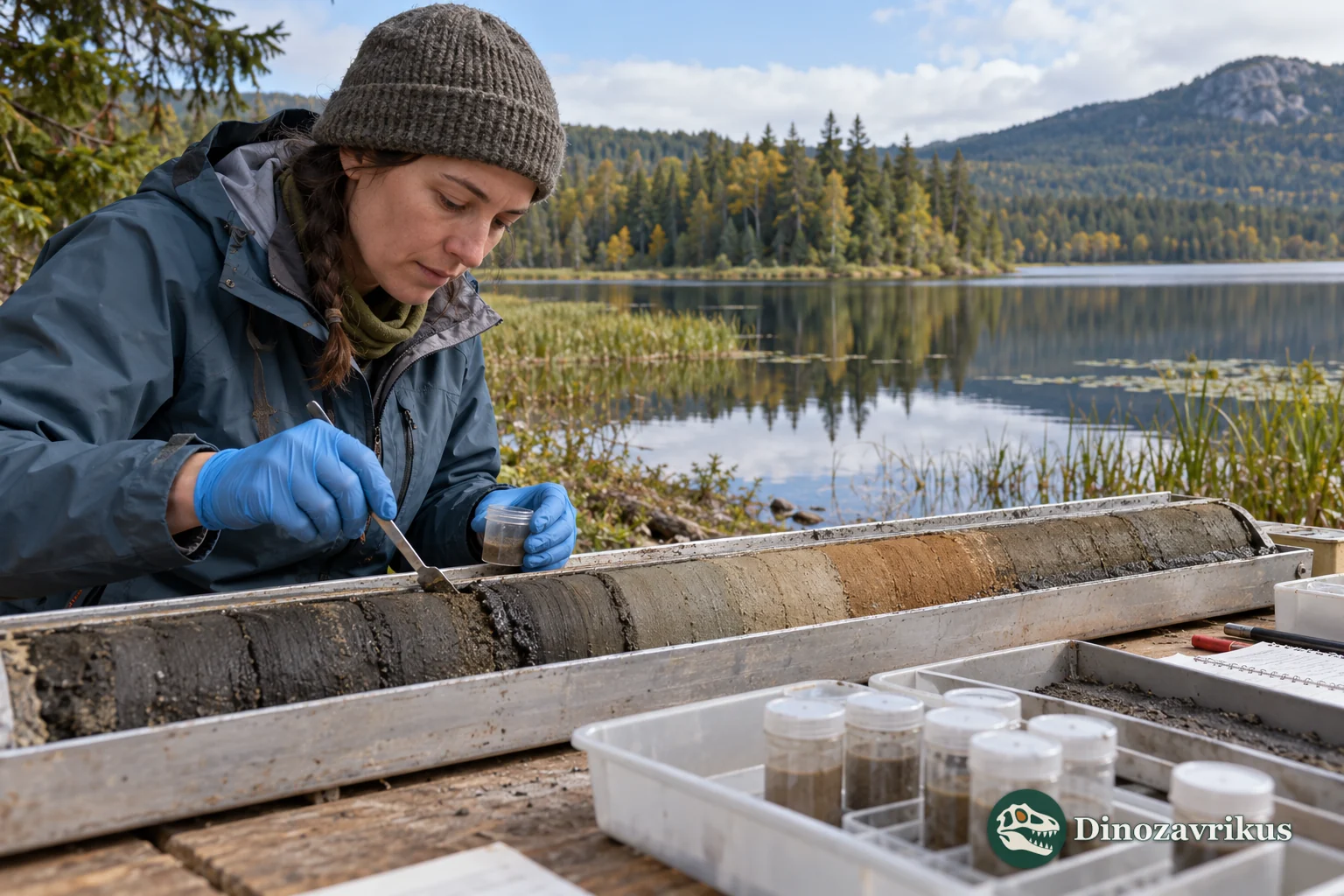
Researchers first record where each sample came from in a measured section or sediment core. Its position gives a relative order; independent dating can connect the layers to a time interval. Pollen itself usually does not supply a precise numerical age.
In the laboratory, a small amount of sediment is processed to separate organic walls from the mineral matrix. The method depends on the rock and on the organisms being studied. Some samples respond to physical separation, while others require controlled chemical steps. Concentrated particles are mounted on slides and examined with transmitted-light or scanning electron microscopy. Clean handling matters: modern airborne pollen or material transferred between samples can create a false signal.
For counts to represent a sample reliably, researchers need enough grains to reduce the chance of missing uncommon forms. Even a large count does not turn pollen percentages into a direct estimate of forest cover. Some wind-pollinated trees release enormous quantities of pollen; other plants produce much less. Counts describe the mixture in the slide, not the number of plants per hectare.
Why the source area matters
A pollen assemblage combines material from different distances. Lightweight grains may travel far in the wind; rivers can carry pollen from an entire drainage basin. A small pond often receives a stronger signal from its immediate surroundings than a large lake or a marine basin. The shape of the depositional site and the size of its catchment affect the area represented by a sample.
Researchers therefore compare pollen with plant tissues, charcoal, sedimentary structures and other evidence. Pollen from a land plant in a marine layer proves that the grain reached the seafloor, not that its parent tree grew on the nearby coast. Older grains can also be eroded from ancient rocks and redeposited into younger sediment, so preservation and stratigraphic context need to be checked together.
Reading vegetation change without overreading it
A sequence of samples can show how the relative abundance of plant groups changed through time. A shift may reflect vegetation moving as climate changed, but it can also follow a change in water level, erosion or sediment source. Climate estimates based on pollen are strongest when modern calibration data, plant ecology and independent proxies support the same interpretation. If an ancient plant community has no close modern analogue, a statistical temperature estimate may be less secure.
Changes in spores or pollen may also record ecological succession or the spread of a plant group. Yet a changing depositional environment can produce a similar pattern. A rise in fern spores, for instance, is compatible with nearby damp habitats but does not by itself prove regional warming. The history of seed plants is a related but distinct question; the overview of how seed plants evolved from spores to seeds follows that evolutionary transition, while palynology reconstructs the material carried into sediment.
Direct evidence and interpretation
The direct evidence is the preserved grain, its morphology and its position in the sediment. Statements about surrounding vegetation depend on identification, counts, transport and burial. A climate reconstruction adds another inferential step and needs calibration and independent checks. Those levels should not be collapsed into the claim that “pollen shows exactly which forest grew here.”
Palynology is especially valuable where plant macrofossils are scarce and sediment accumulated in a sequence. Its sensitivity depends on preservation, contamination, the groups represented and the size of the source area. Laboratory methods must fit the sample, just as the procedures used to recover microscopic fossils from rock vary with the matrix. For the broader context of how palaeontologists study fossils, each method answers a different question and preserves a different fraction of past life.
Frequently asked questions
How are pollen and spores different?
Seed plants produce pollen; mosses, ferns and other groups produce spores. Their resistant walls can be studied with similar methods, but they are not interchangeable evidence for vegetation.
Can one fossil pollen grain identify a plant species?
Usually not. Its shape may identify a broader group, but related plants can produce similar grains and the fossil pollen type may not correspond to a single living species.
Does pollen in marine sediment prove a plant grew on the coast?
No. Wind and rivers can carry pollen far from its source. A marine sample shows that grains reached the sediment; their source is inferred from the whole assemblage and its setting.
Can fossil pollen reveal ancient temperature?
Sometimes pollen assemblages are used in models calibrated against modern observations. Reliability depends on sample size, transport, preservation and whether ancient vegetation has a useful modern analogue.