

Fruitachampsa callisoni was a small crocodyliform from the Late Jurassic Morrison Formation of Colorado. It had a short, relatively deep snout and slender lower legs. Its palate and vertebrae show how features familiar from later crocodyliforms appeared in different combinations early in the group’s history.
Quick facts
| Species | Fruitachampsa callisoni |
|---|---|
| Family | Shartegosuchidae |
| Age | Late Jurassic |
| Locality | Fruita area, Colorado, USA |
| Holotype | LACM 120455a, partial skull and four anterior neck vertebrae |
| Largest skull | About 9 cm long |
What can the fossils tell us?
The skull and the four anterior neck vertebrae were articulated. The surrounding blocks also held bones from a smaller individual.
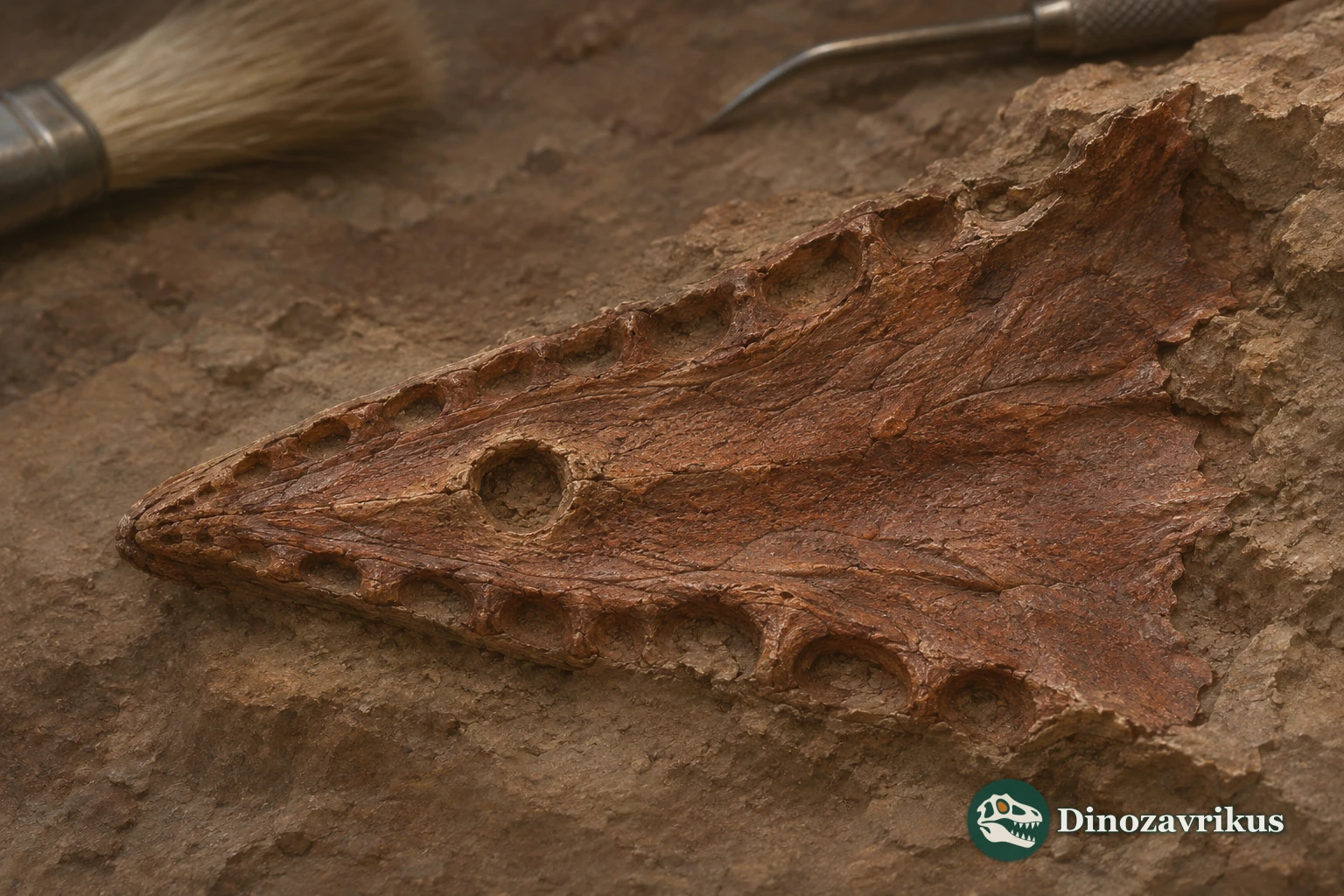
The round palatal opening lay in front of the choana, which led from the nasal passage into the mouth.
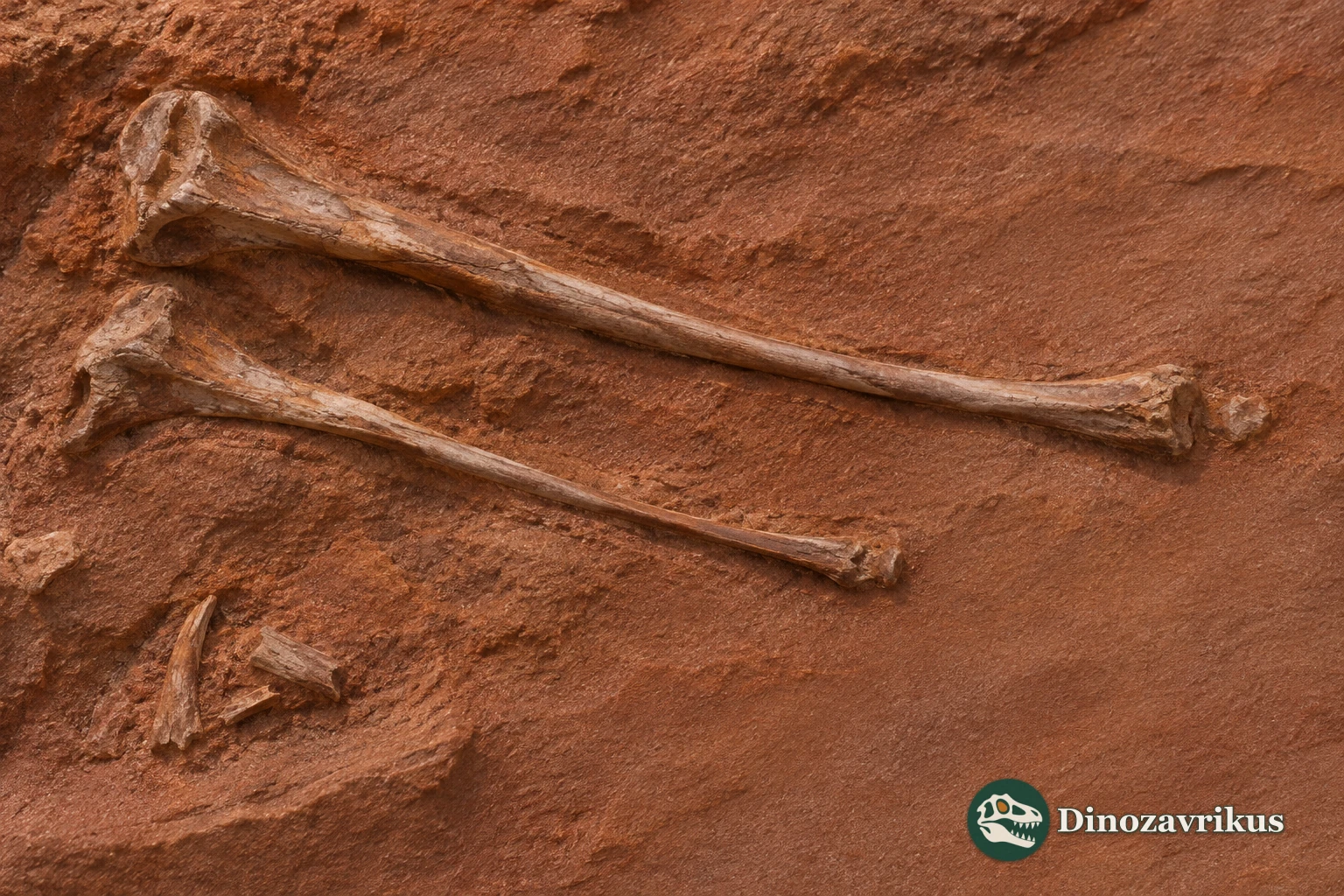
The tibia of LACM 120492 is 59 mm long. Its proportions are evidence for movement on land but provide no direct measure of running speed.
Several individuals from one quarry
James Clark described Fruitachampsa in 2011. The name refers to Fruita, the nearest town, and the species honours George Callison, who led the expedition that discovered the locality. The holotype, LACM 120455a, comes from Quarry 4 in the Fruita Paleontological Area.
The skull and first four neck vertebrae were found in articulation. The same blocks also hold bones of a smaller individual, LACM 120492. Clark limited the holotype to the connected bones because the remaining pieces were intermixed. Other individuals preserve parts of the palate, lower jaws and limbs.
A short snout and two separate openings
The snout occupies around a third of the skull length. In a view from below, a round opening is bounded by the maxillae at the front and sides and by the palatines behind. The choana, where the nasal passage opens into the mouth, lies farther back. Fruitachampsa and its Asian relatives preserve several configurations of these openings and the surrounding bones.
Behind the first neck vertebra, the vertebral bodies generally have a concave front and a convex rear. The palate and vertebrae let researchers compare early crocodyliforms by specific features, including among superficially similar small species.
Slender limbs and Asian relatives
Skull lengths reach about 9 cm. The smaller specimen LACM 120492 preserves a tibia 59 mm long and 2.8 mm across in Clark’s measurements. The slender limb bones are consistent with locomotion on land. The European Atoposaurus provides a separate small Jurassic crocodylomorph with measurable skeletal proportions.
Studies place Fruitachampsa in Shartegosuchidae, together with Late Jurassic forms from Asia. Clark interpreted that distribution as evidence of dispersal from Asia to North America. The fossils document the family on both continents, while the route remains inferred.
Frequently asked questions
What belongs to the holotype?
A partial skull and the four front neck vertebrae preserved in articulation with it.
How large was the skull?
The largest described skull is about 9 cm long.
What is distinctive about the palate?
A round opening in the front of the palate is separate from the internal nostril farther back.
Did Fruitachampsa have Asian relatives?
Yes. Several Late Jurassic crocodyliforms from Asia are classified with it in Shartegosuchidae.