

Gallogoral meneghinii is an extinct European bovid from Villafranchian deposits. Its species name began as Palaeoryx meneghinii in 1878. Claude Guérin established Gallogoral in 1965 after comparing skulls, teeth and skeletons, especially the rich collection from Senèze in France. Similarities to living gorals and serows help frame the comparison, but the fossil has its own combination of traits.
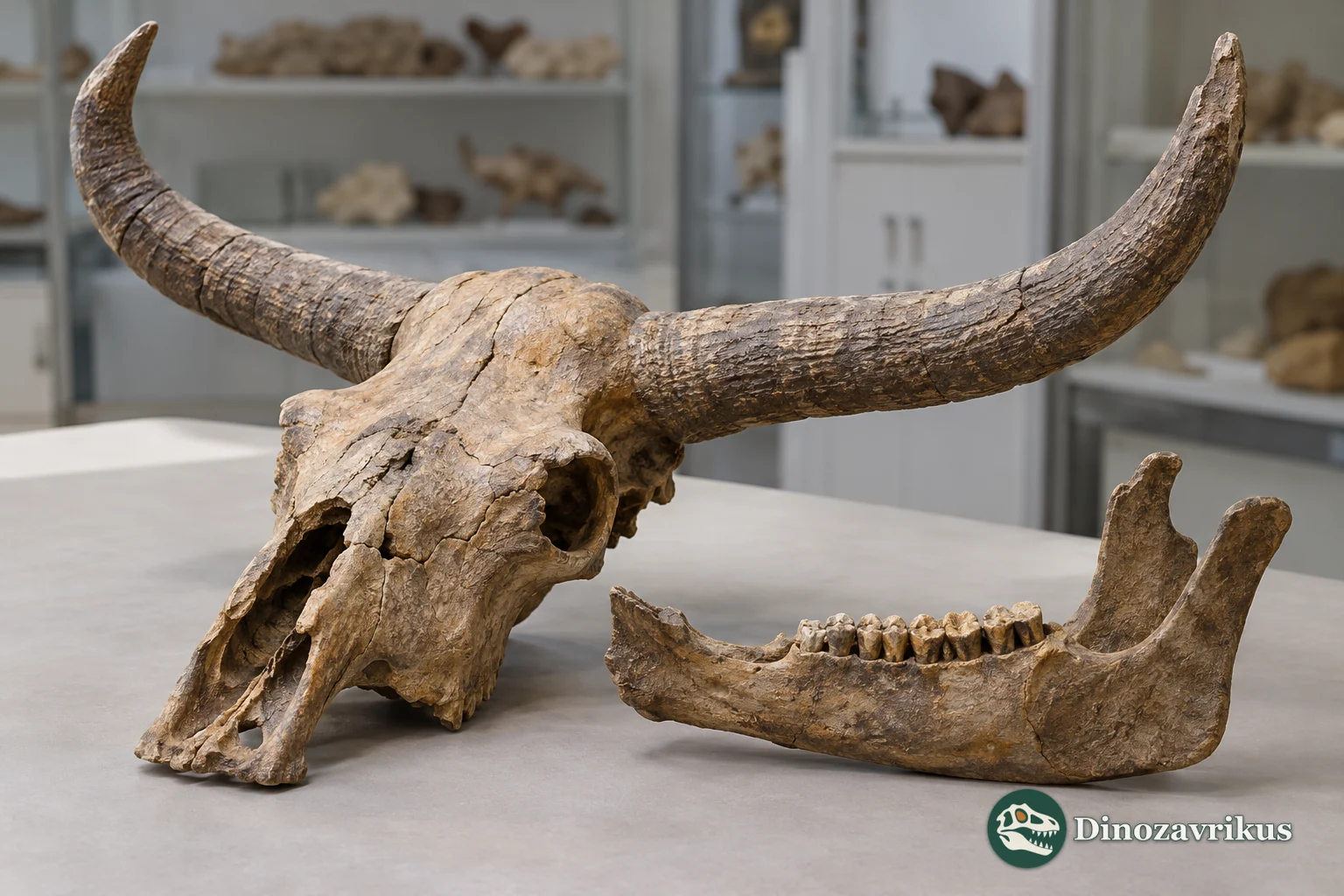
The cover conveys a plausible large bovid. Bone records the horn cores; fur and keratin sheath colors remain artistic choices.
Quick facts
| Species | Gallogoral meneghinii |
|---|---|
| Genus named | Guérin, 1965 |
| Older combination | Palaeoryx meneghinii, 1878 |
| Group | Bovidae |
| Key collection | Senèze, Haute-Loire, France |
| Material | Skulls, jaws, teeth and skeletons |
| Time | Villafranchian, Pliocene to Early Pleistocene |
What can the fossils tell us?
Senèze fossils preserve large divergent horn cores and skull details unlike those of living gorals and serows. Horn sheath color is unknown.
Guérin described several adult skeletons and newborn remains. His revision corrected a distorted earlier assembly of skull 5008.
Molar wear from Coste San Giacomo suggests mixed feeding for that sampled assemblage, not an exact diet for every individual or season.
The Senèze collection
Senèze fossils came mainly from excavations in 1909–1914 and 1919–1921. Guérin documented three relatively complete adult skeletons, newborn remains and isolated bones. This material permits comparison of the skull, vertebrae and limbs. Yet burial distorted some bones: the old assembly of Lyon specimen 5008's skull had to be dismantled and corrected after preparation exposed displaced pieces.
Its long, strong, divergent horn cores, skull base, dental rows and robust limb elements differ from those of living gorals and serows. These differences supported a separate genus. Historical names including Nemorhaedus philisi belong to the taxonomic history of the fossil material, not to living animals at Senèze.
A western European record
The monograph also discussed finds from Chilhac in France, Olivola in Italy and Puebla de Valverde in Spain. Their preservation and certainty differ; scattered bones cannot be treated as equivalent to Senèze's skeletons. At Coste San Giacomo in central Italy, G. meneghinii occurs in an Early Pleistocene assemblage dated to around 2.1 million years ago. That dates a locality, not the lifetime of the whole genus.
The assemblage also includes Gazellospira and Leptobos. Their co-occurrence permits ecological comparisons without proving identical diets. The younger records fall within the Quaternary.
Food and reconstruction limits
A study of Coste San Giacomo molars compared cusp shape and relief with living ungulates. It interpreted the sampled Gallogoral as a mixed feeder, between more selective browsers and chiefly grazing neighbors. Wear integrates food and abrasive particles over time; it does not reveal the exact plants of a meal.
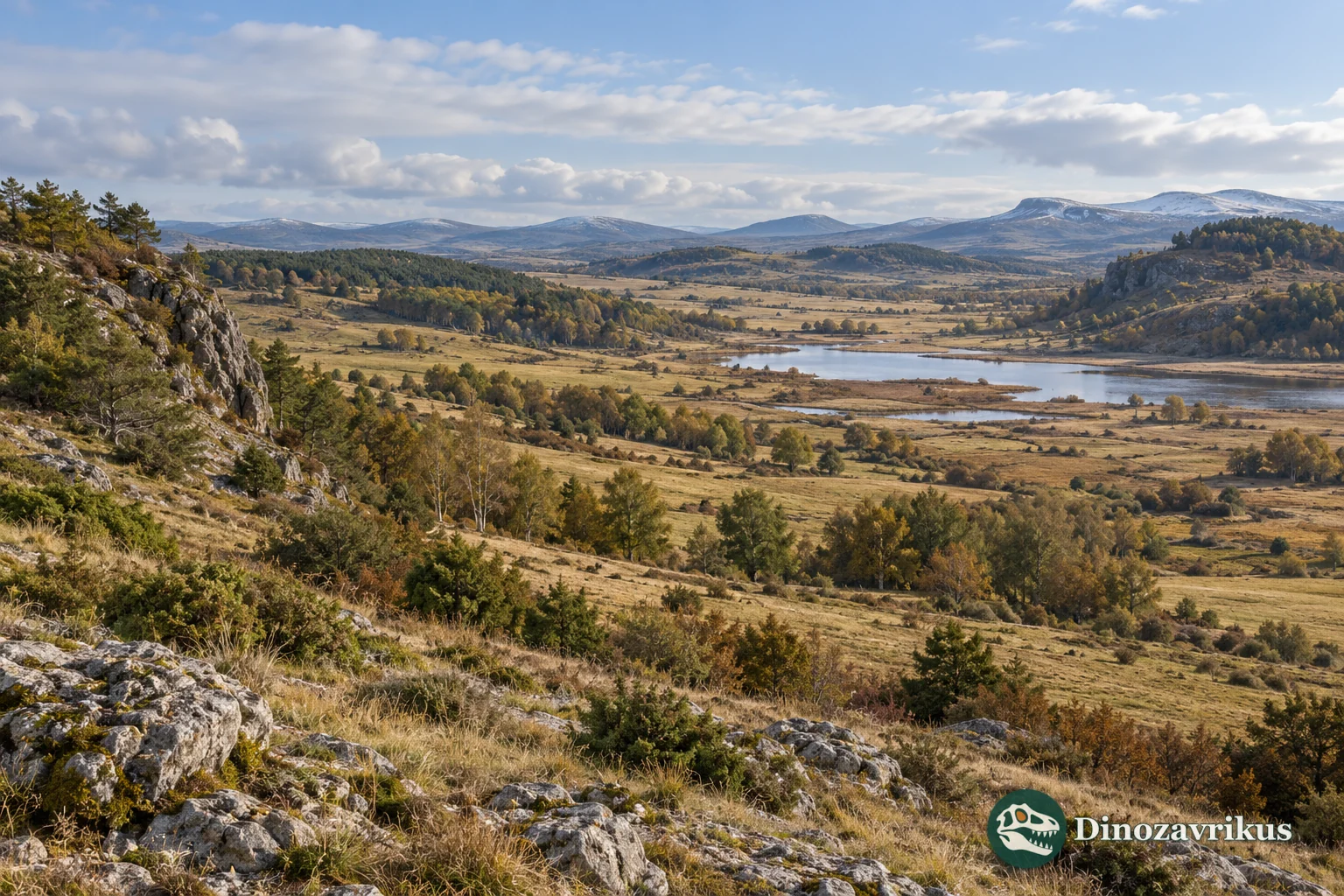
The study estimated body masses for some ungulates through comparative dental regressions, rather than weighing fossils. Senèze skeletons offer stronger evidence about proportions, but they do not preserve social behavior, coat or running speed. The skull and landscape images are educational artwork, not photographs of specimen 5008 or the Senèze excavation.
Frequently asked questions
Why was the genus renamed?
The species was first placed in Palaeoryx; Guérin established Gallogoral in 1965 after studying fuller material.
Where are the most complete fossils from?
The Senèze collection in Haute-Loire, France includes several adult skeletons and newborn remains.
What did it eat?
Dental wear from Coste San Giacomo supports mixed feeding for the studied sample, without identifying every plant.
Was Gallogoral a living goral?
No. It shares some traits with living gorals and serows but differs in skull, horns and other bones.