

Genibatrachus baoshanensis was an Early Cretaceous frog from northeastern China. The adult type specimen is about seven centimetres long from snout to vent. Fossils from the same area record a series of younger stages, including individuals with developed limbs and a remnant of the larval tail.
Quick facts
| Group | Frogs |
|---|---|
| Age | Early Cretaceous, about 125 million years ago |
| Region | Asia, northeastern Inner Mongolia, China |
| Length | About 7–8 cm in measured adults |
| Type species | Genibatrachus baoshanensis |
| Scientific name | Genibatrachus |
| Diet | Exact prey is unknown |
What can the fossils tell us?
Adults and younger individuals preserve different stages of skeletal development. Some specimens retain tiny bones in the hand and wrist.
The forelimbs and hind limbs ossified at similar rates. Contact between the two ilia along a suture marks the end of metamorphosis.
The joint between the sacrum and urostyle suggests the frog could jump. It gives no measure of jump distance or how often the frog jumped.
Fossils near the Geni River
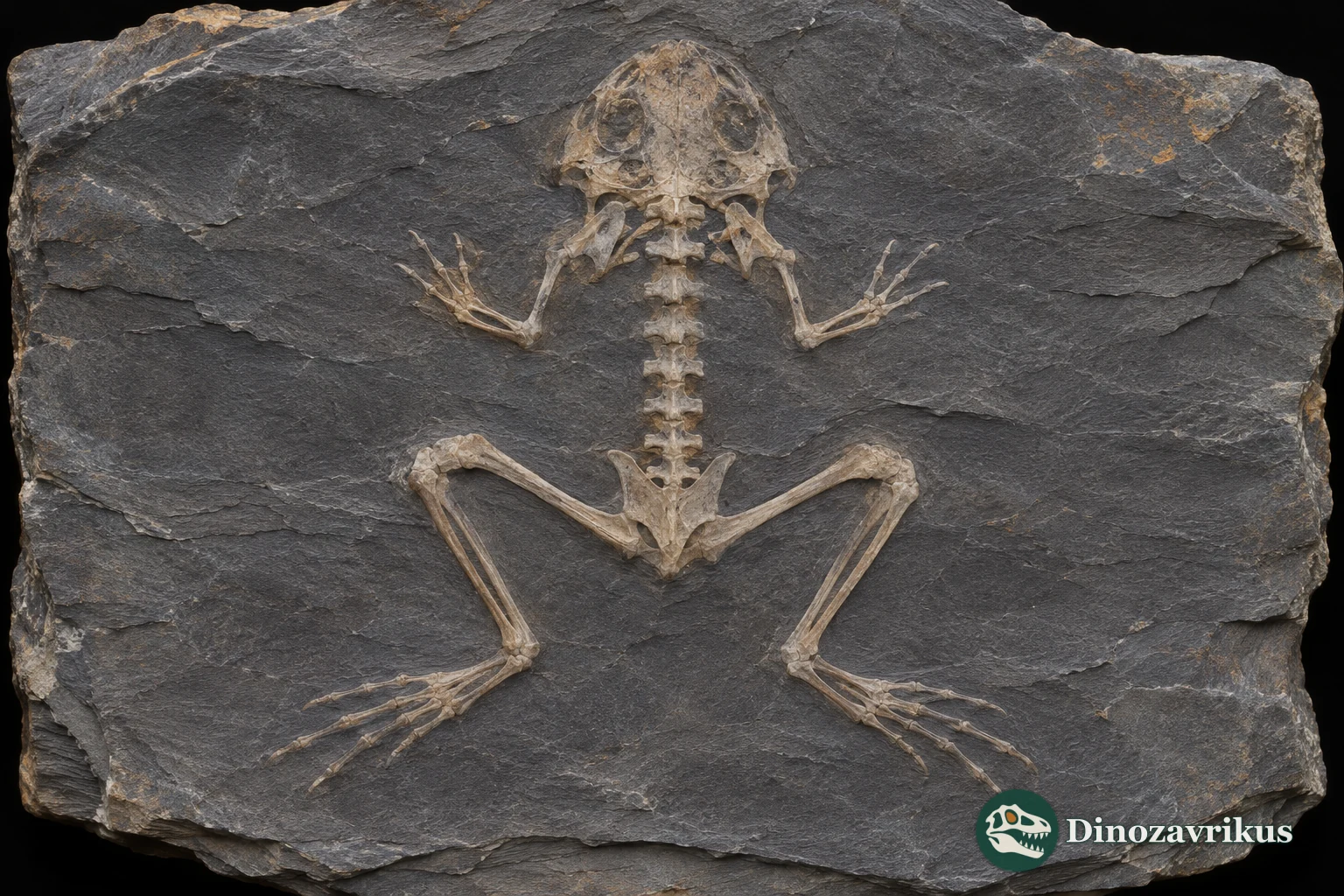
Ke-Qin Gao and Jianye Chen named Genibatrachus in 2017 from a series of twelve specimens. The holotype, PKUP V0401, is held at Peking University. One face of the split volcanic shale holds most of the skeleton, while the counterpart carries an impression of its back. The beds belong to the Guanghua Formation, dated to around 125 million years ago in the original study. Several adults reach eight centimetres in snout-to-vent length. The same area also yielded the salamander Nuominerpeton.
Bones of the skull, trunk and hand
Skin impressions show a rounded body outline in adults. The holotype has a 23-millimetre skull. The two frontoparietals meet behind an opening in the skull roof. The back has eight presacral vertebrae, with free ribs on the second through fourth. Especially fine fossils preserve elements of the wrist and the two bones of the prepollex, a small structure on the inner side of the hand.
Growth through metamorphosis
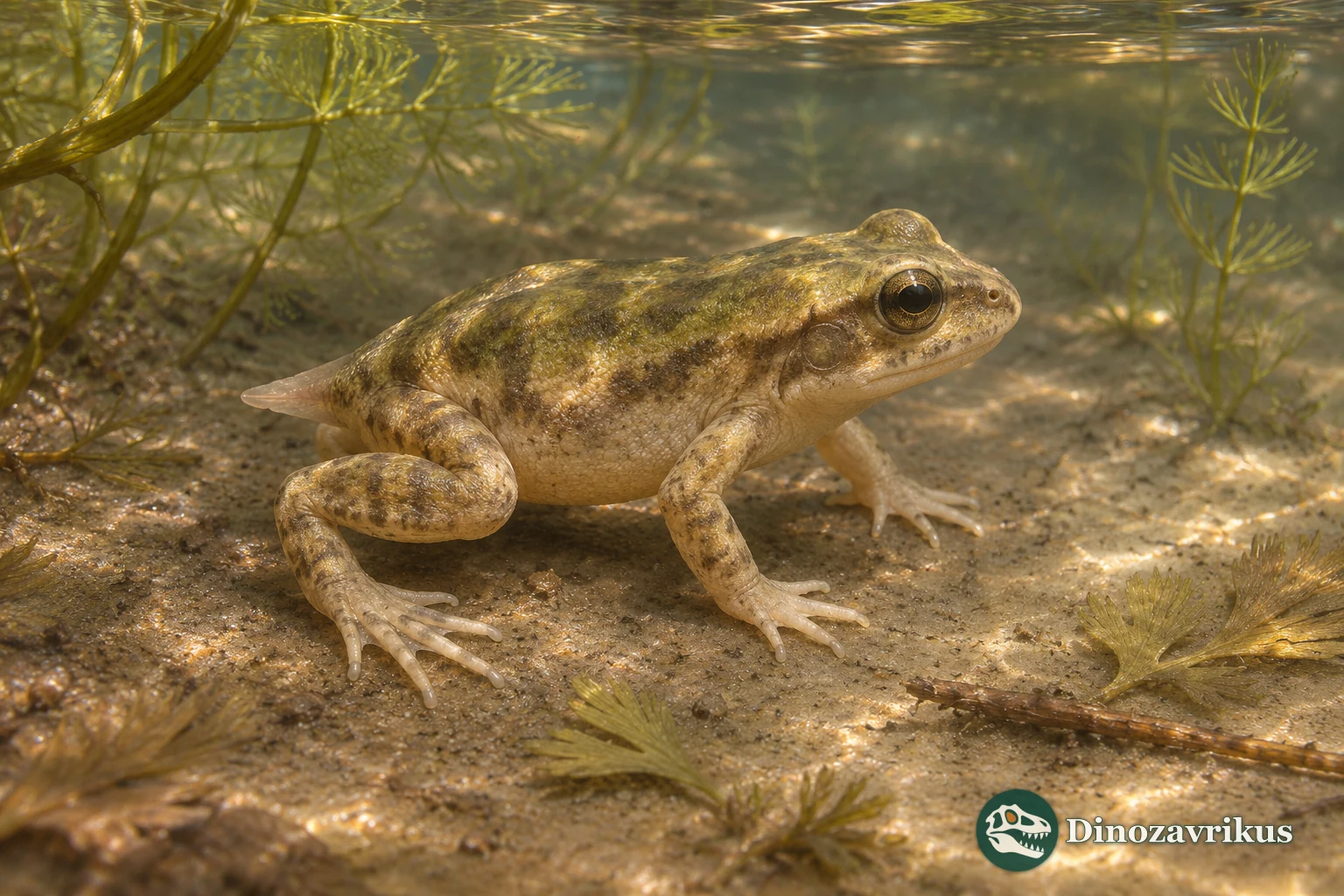
A 2023 study compared 84 fully grown frogs with 75 metamorphosing larvae and juveniles. The forelimbs and hind limbs show comparable degrees of ossification at different stages. Parts of the hyoid apparatus begin to ossify while a small tail is still present. By the end of metamorphosis the two ilia meet along a suture. The series helps distinguish features that change with age from those that can be compared across frog species.
Relationships and locomotion
Comparisons with other fossils suggest links to some Early Cretaceous frogs from Japan and to living Alytoidea. The two points of articulation linking the sacrum to the urostyle suggest Genibatrachus could jump. The joint offers little insight into how much time the frog spent in water. Its diet remains unknown.
Frequently asked questions
Where does the name Genibatrachus come from?
The name combines Geni, the river near the fossil locality, with batrachos, the Greek word for frog.
How large were the adults?
The holotype measures 70 millimetres from snout to vent. Several adults in the original description reach 80 millimetres.
Did Genibatrachus have ribs?
Yes. Three pairs of free ribs are attached to the second through fourth presacral vertebrae.
Why are the young specimens valuable?
They show which bones were forming while the frog still had a tail and how the pelvis changed as metamorphosis ended.