

Geosternbergia names a large toothless pterosaur best known from a partial Kansas skull with a high bony crest. Some researchers retain its type species in Pteranodon. Their disagreement concerns the genus boundary, not whether the fossil or crest exists.
Quick facts
| Scientific name | Geosternbergia sternbergi, also Pteranodon sternbergi |
|---|---|
| Holotype | FHSM VP 339, incomplete skull and jaw fragment |
| Locality | Graham County, Kansas, United States |
| Rock | Lower Smoky Hill Chalk Member, Niobrara Formation |
| Type horizon age | Late Coniacian to early Santonian |
| Key anatomy | Tall bony cranial crest |
| Taxonomy | Separate genus is disputed |
What can the fossils tell us?
FHSM VP 339 preserves an incomplete skull with a high crest and part of the lower jaw. The front of the snout is missing.
The bony crest helps comparisons with other pteranodontids, but variation and growth complicate a sharp genus boundary.
The type skull is from lower Smoky Hill deposits dated late Coniacian to early Santonian. Other assigned fossils can come from younger beds.
Kellner separated Geosternbergia from Pteranodon in 2010. A 2017 study judged the case for a separate genus insufficient.
A Kansas skull and a changing name
Harksen described the species in 1966 as Pteranodon sternbergi. Its type fossil, FHSM VP 339, formerly SMM 5426, consists of an incomplete skull and a lower jaw fragment. The front of the skull is missing but its high crest survives. The fossil came from Graham County, Kansas, in the lower Smoky Hill Chalk Member of the Niobrara Formation.
Miller proposed the separate genus name Sternbergia in 1972. Because the name was already occupied, he replaced it with Geosternbergia in 1978. Kellner revived its use as a distinct pteranodontid genus in 2010. These names track classification of fossils, not stages in the animal's evolution.
What survives of the crest
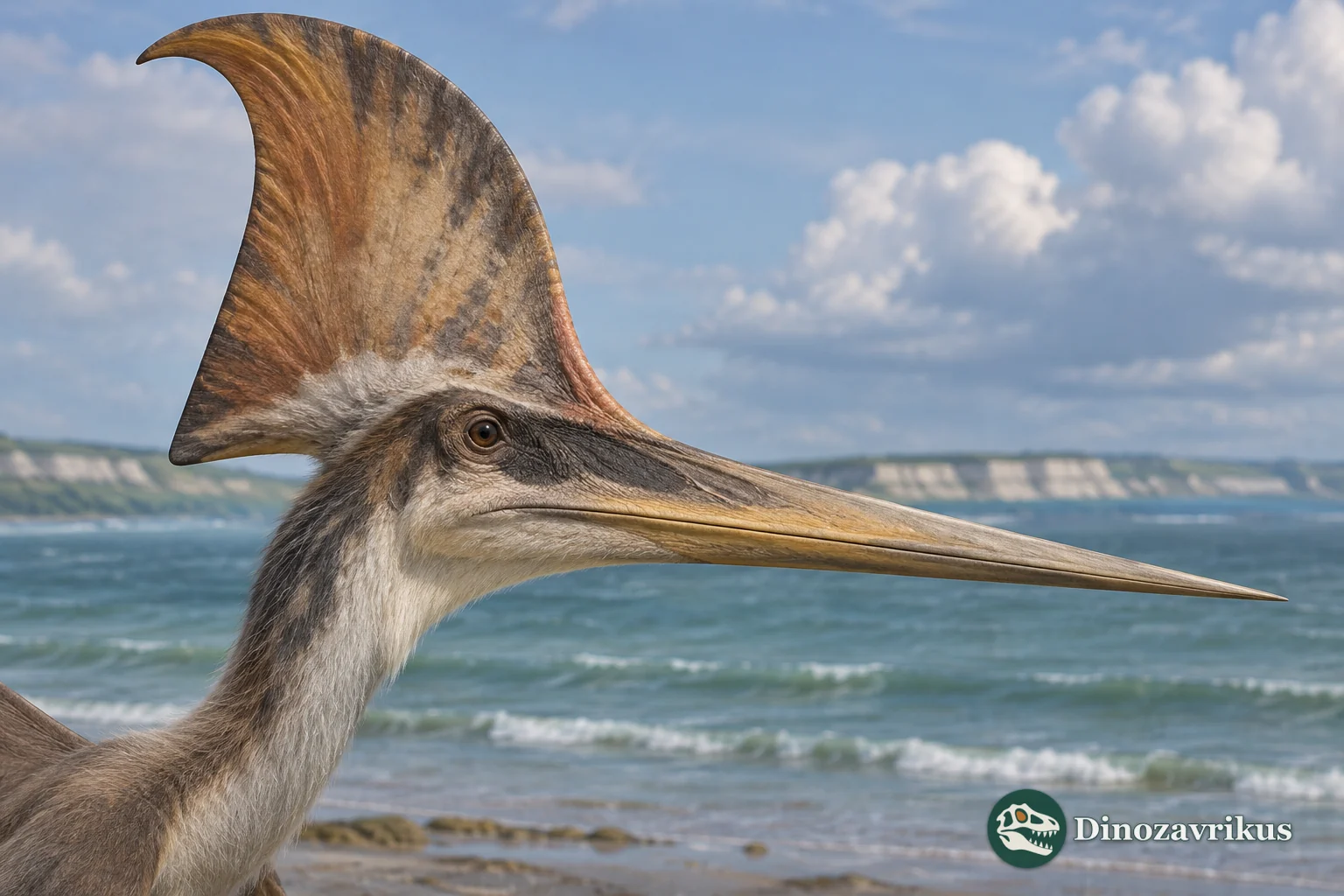
The type skull bears a tall bony crest rising behind the head. Its profile differs from many Pteranodon specimens and helped motivate separation. Comparisons still depend on preservation, individual growth and variation within the group. The fossil lacks a complete snout, soft crest covering and evidence of living colour.
Pteranodontid jaws were toothless. No food item survives with FHSM VP 339. Marine sediments and the group's anatomy permit discussion of offshore feeding, but do not record how this particular animal caught food.
Rock age and the genus dispute
Kellner placed the lower Smoky Hill type horizon in the late Coniacian to early Santonian. Calling the type species simply Campanian would confuse different fossil horizons. He tentatively assigned another species, G. maiseyi, based on KUVP 27821 from the younger Campanian Sharon Springs beds. That assignment is distinct from the age of FHSM VP 339.
Martin-Silverstone and colleagues argued in 2017 that the evidence did not justify separating Geosternbergia and preferred a broader Pteranodon. Other authors use Kellner's division. Both combinations therefore appear in research. The related Dawndraco debate likewise concerns pteranodontid genus boundaries rather than the existence of the fossils.
A sea setting and reconstructed life
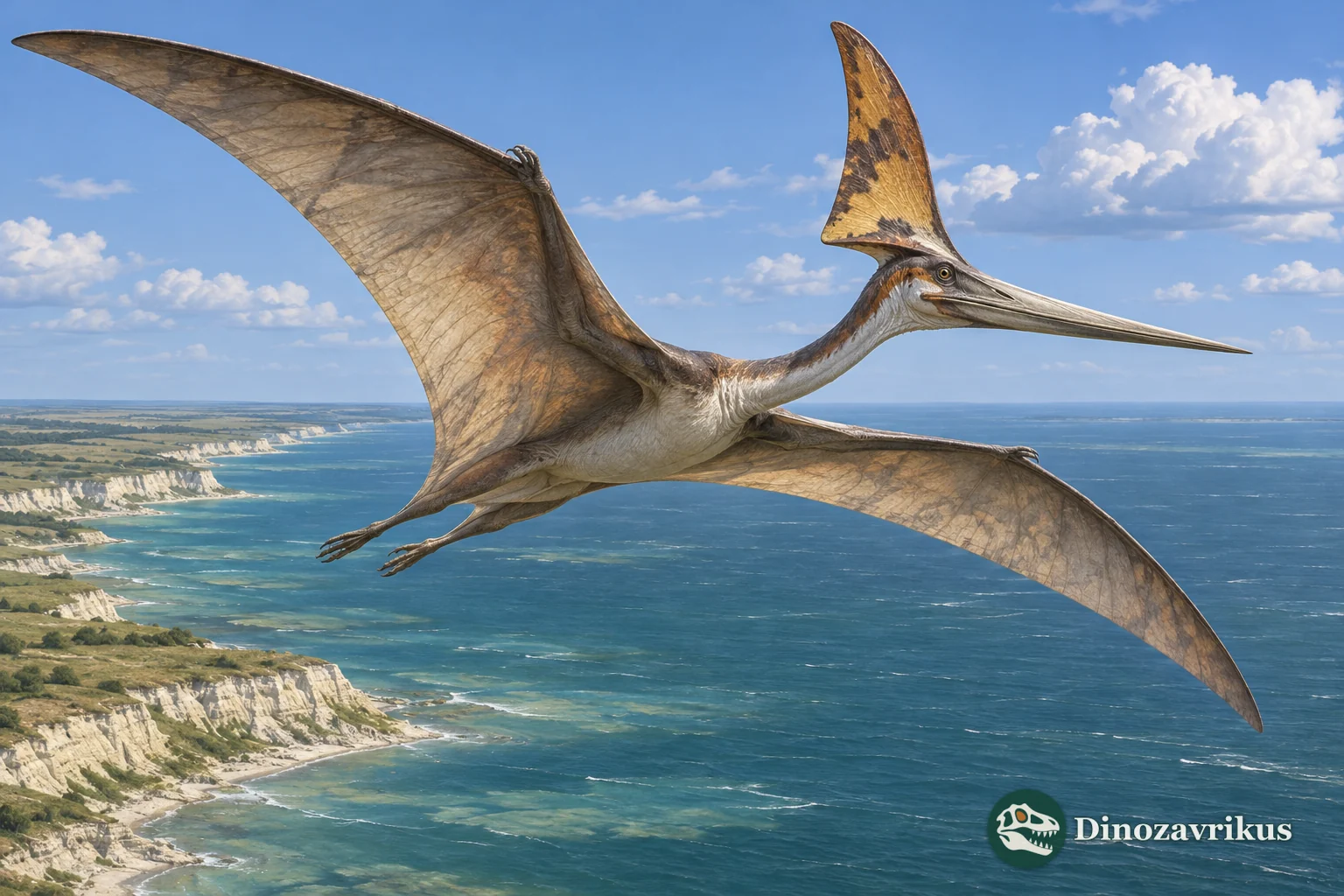
The Niobrara sediments of Kansas formed in a Cretaceous inland sea. That setting is geological evidence for where the fossil was buried. It does not reveal an exact flight path or hunting action. Crest and toothless jaws constrain life art better than colour or behaviour do.
The cover and coastal flight scene are artistic reconstructions. Missing proportions, colour and the sea beneath the wings are not direct observations of FHSM VP 339.
Frequently asked questions
Are Geosternbergia and Pteranodon the same genus?
The type species was first named Pteranodon sternbergi. Some studies separate it as Geosternbergia; others retain it within Pteranodon.
What survives of the type fossil?
FHSM VP 339 preserves an incomplete skull with a high bony crest and a piece of lower jaw. The front of the skull and full body are absent.
Why do some sources call it Campanian?
A later fossil tentatively assigned to the genus came from Campanian beds. The type skull is older, from late Coniacian to early Santonian deposits.
Is its exact wingspan known?
Not from the type skull. A span would require comparison with other pteranodontids rather than direct measurement of its missing wings.