

Glaberagnostus was a Cambrian agnostoid with strongly subdued shell relief. On a well-preserved head, an elongated node lies well forward of the midpoint. A fossil from Tasmania lacks the head and shows which other details can support an identification.
Quick facts
| Group | Agnostida |
|---|---|
| Age | Cambrian |
| Genus established | E. V. Romanenko, 1985 |
| Type species | Glaberagnostus altaicus |
| Type area | Gorny Altai, Russia |
| Tasmanian material | Pygidium with two attached thoracic segments |
What can the fossils tell us?
The feature stands out on the otherwise smooth and convex head of G. bituberculatus.
Additional Swedish material helps compare both the features and the rock intervals in which the species occurs.
A broad thoracic axis supports the generic assignment. The missing head leaves the species uncertain.
The type species from the Altai
E. V. Romanenko established the genus in 1985. G. altaicus, the type species, came from the Glyptagnostus reticulatus Zone in Gorny Altai. That species of Glyptagnostus helps correlate early Furongian marine beds. G. altaicus has also been reported in older Cambrian strata in Scandinavia.
The name Toragnostus in earlier studies
Richard Robison established Toragnostus for smooth agnostoids with an elongated node near the front of the head. Angelin’s Agnostus bituberculatus was its type species. In 2000 Shanchi Peng and Robison moved it to Glaberagnostus and treated Toragnostus as a junior synonym.
The neotype of G. bituberculatus, cephalon NRM Ar9563a, comes from the Andrarum Limestone Bed in Scania. It preserves the convex outline and the elongated forward node. Additional material from northern Jämtland occurs in the lower part of the Lejopyge laevigata Zone.
A tail and thorax from Tasmania
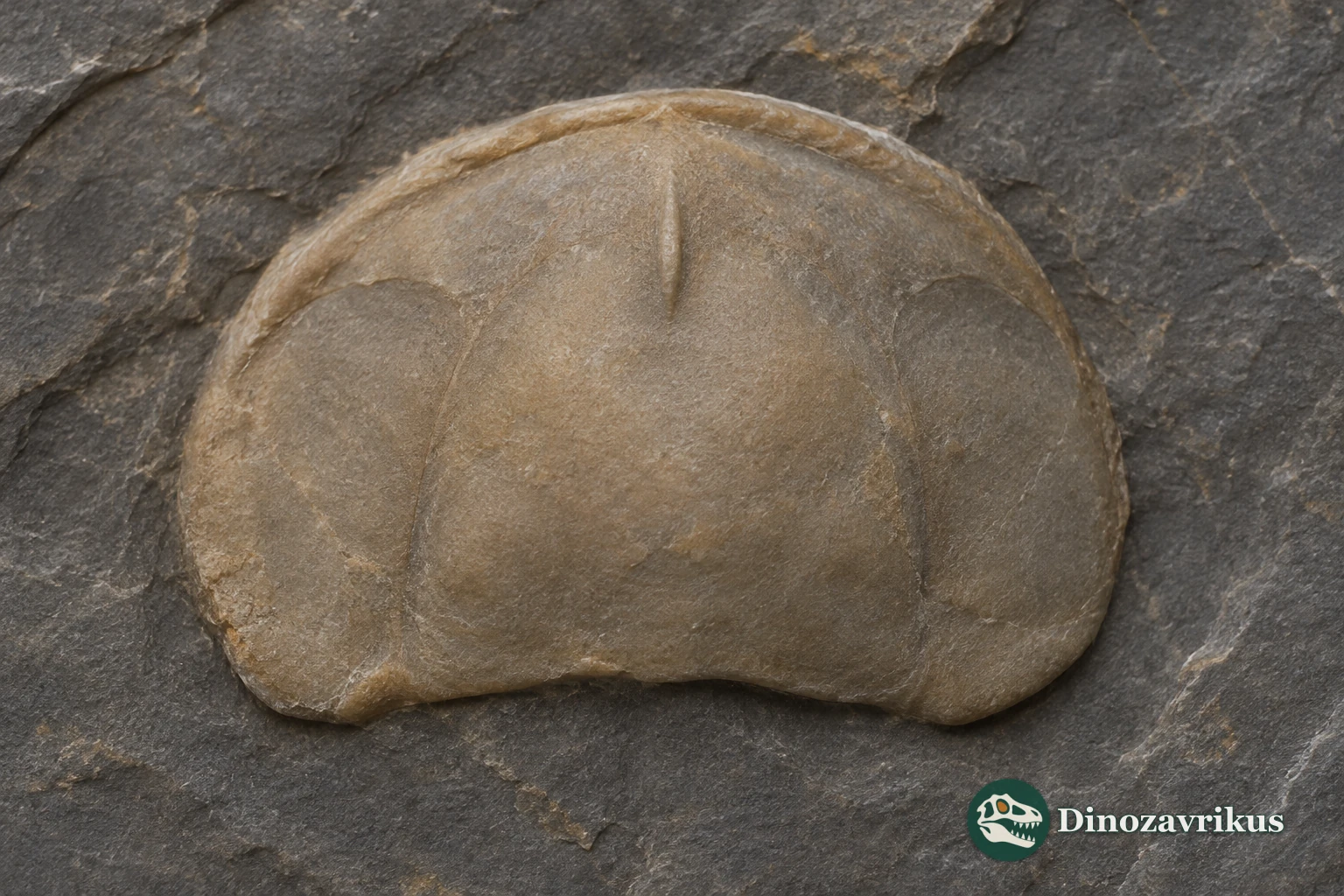
Specimen UTGD125921 comes from a Guzhangian site near Riana. It preserves both thoracic segments attached to the pygidium. The broad thoracic axis is characteristic of the genus. The tail is slightly longer than wide, mostly smooth, with a flat border that broadens towards the rear.
A small node near the back of the tail axis could be an artefact of preservation. The investigators compared the pygidium with other Tasmanian fossils and called it Glaberagnostus sp. The head node cannot be checked on this specimen, and its tail alone did not support a more precise species assignment.
Frequently asked questions
Where was the type species found?
In Gorny Altai, Russia, in the Glyptagnostus reticulatus Zone.
What makes the head of G. bituberculatus distinctive?
An elongated node lies well ahead of the centre on an otherwise smooth, convex shield.
Which parts are preserved in the Riana specimen?
The tail shield and two thoracic segments still joined to it.
Why does the name Toragnostus appear in older papers?
The name was introduced for similar agnostoids and later treated as a synonym of Glaberagnostus.