

Gladocephaloideus jingangshanensis is known from two Early Cretaceous Liaoning fossils. An unusually long snout and roughly fifty pointed teeth can be examined directly. A second, more complete skeleton changed interpretations of its growth and relationships.
Quick facts
| Scientific name | Gladocephaloideus jingangshanensis, Lü and colleagues, 2012 |
|---|---|
| Holotype | IG-CAGS 08-07, skull and some body bones |
| Second specimen | JPM 2014-004, nearly complete young skeleton |
| Localities | Two sites in Liaoning Province, China |
| Rock and age | Yixian and Jiufotang formations, Early Cretaceous |
| Skull | Prenarial rostrum about 63% of skull length |
| Teeth | Approximately fifty pointed teeth estimated |
What can the fossils tell us?
IG-CAGS 08-07 preserves an almost complete skull, lower jaw, front neck vertebrae and parts of the limbs. Its snout and tooth positions anchor the name.
JPM 2014-004 from the Jiufotang Formation is a nearly complete young skeleton. It adds wing, leg and vertebral anatomy absent from the type.
Bone microstructure indicates continuing growth in both specimens. The smaller one was an early juvenile; the type was older but not fully grown.
The first paper assigned the genus to gallodactylids. Analysis of the second skeleton instead recovered it among ctenochasmatids, near Pterofiltrus.
The first skull from Yixian
Lü Junchang, Ji Qiang and colleagues named Gladocephaloideus jingangshanensis in 2012 from holotype IG-CAGS 08-07. It came from Jingangshan in western Liaoning, in the Early Cretaceous Yixian Formation. The specimen preserves an almost complete skull and lower jaw, front neck vertebrae and parts of the limbs. The genus name refers to the sword-like length of its skull, while the species name recalls the locality.
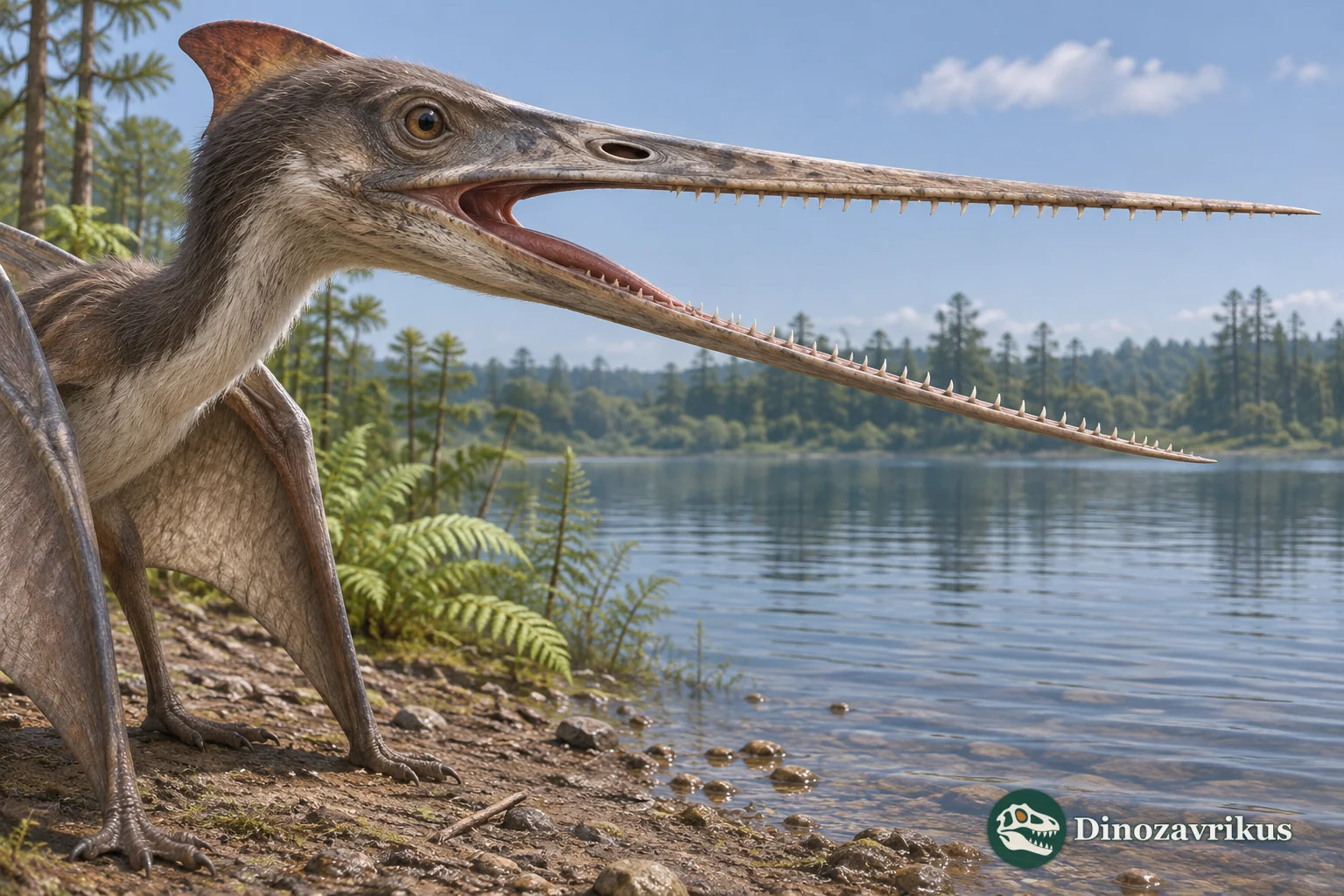
The part of the snout in front of the nasoantorbital opening measures about 63% of skull length; the opening itself occupies about 13%. Researchers counted or reconstructed roughly fifty pointed teeth across the jaws. These are anatomical observations, although crushing and missing sections limit fine detail.
A younger skeleton in another formation
In 2016 Lü and colleagues described JPM 2014-004 from Sihedang in Liaoning. This nearly complete young skeleton came from the Jiufotang Formation. It supplied vertebral, wing and hind-limb details difficult to examine in the holotype. The two finds belong to different rock units, not to a single death event.
Microscopic bone structure in the smaller individual points to an early juvenile stage. The larger type also shows active growth. Previously considered adult, it was reinterpreted as a late juvenile or subadult. This assessment comes from bone tissue, not from their size difference alone.
Teeth, food and classification
The long snout held about fifty pointed teeth, rather than the close filtering comb of some pterosaurs. Ctenochasma provides a useful contrast in jaw design. Small prey could have been caught with the teeth, but neither Gladocephaloideus fossil documents a specific meal.
The original study assigned Gladocephaloideus to Gallodactylidae. The 2016 analysis, informed by the second skeleton, placed it among ctenochasmatids closer to Pterofiltrus. This is a revised relationship hypothesis, not a changed locality. Gegepterus from Early Cretaceous Liaoning offers another comparison with a much denser tooth row.
Filaments and the lake setting
The first authors reported fine filaments near the holotype skull and interpreted them as traces of external covering. They cannot reveal full-body colour or exactly how the wings looked. Yixian and Jiufotang deposits preserve parts of Early Cretaceous lake ecosystems, but do not establish identical behaviour for animals from different horizons.
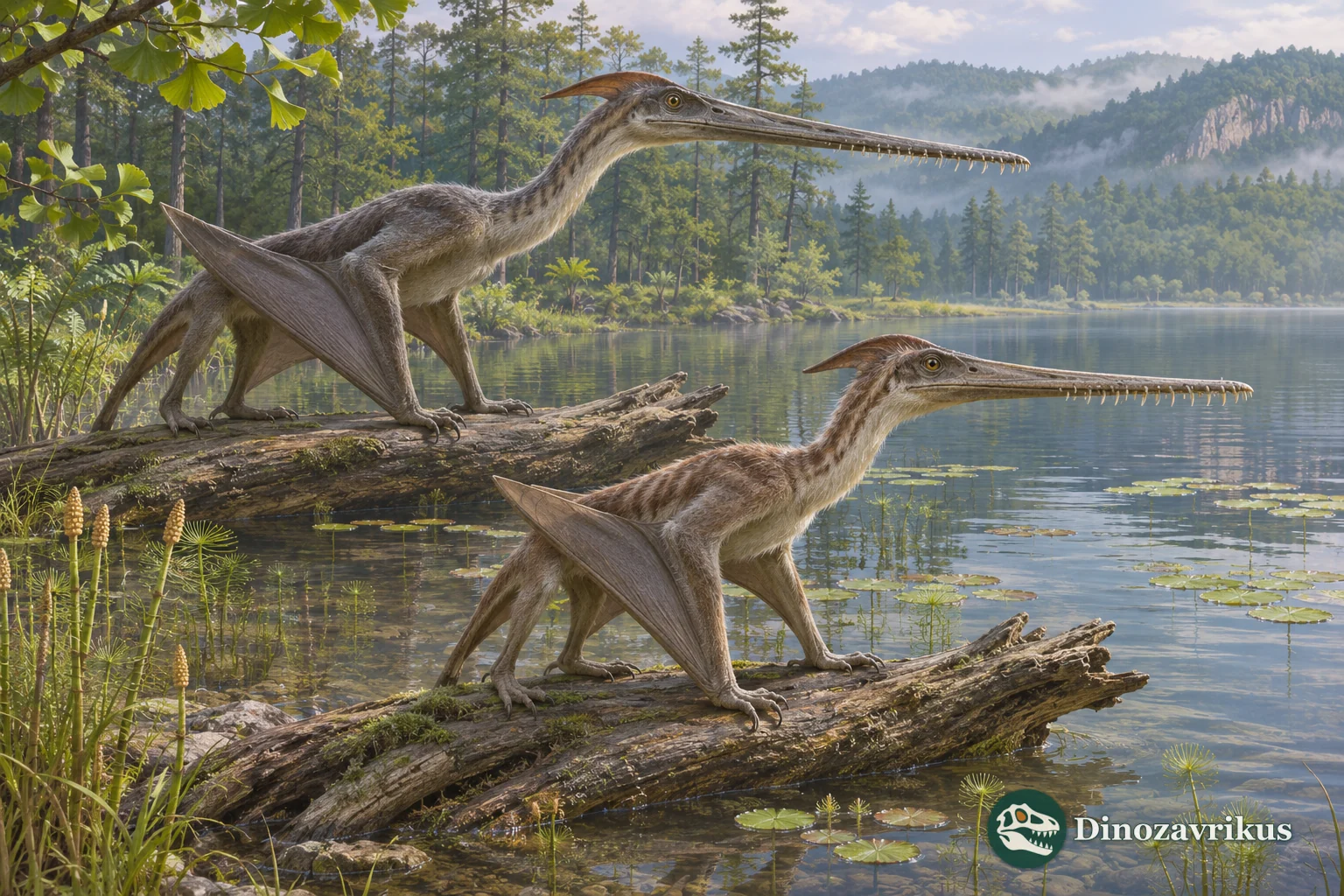
The cover imagines a living pterosaur beside water. Pose, plants and colour are artistic choices. An exact adult wingspan cannot be read from two individuals that were still growing.
Frequently asked questions
Where was Gladocephaloideus found?
The type came from Jingangshan in the Yixian Formation; another specimen came from Sihedang in the Jiufotang Formation. Both are in Liaoning, China.
How many teeth did it have?
Researchers estimated about fifty pointed teeth in both jaws, far fewer than a densely packed filtering comb.
Was the holotype an adult?
It was first treated as adult, but bone microstructure shows continuing growth. The type was likely a late juvenile or subadult.
Is its exact food known?
No. Its jaws suggest ways to catch small prey, but no direct food remains are associated with the fossils.