

Glaphyraspis was a Cambrian trilobite. Fine granules stud the head shields of many specimens. Articulated fossils of G. ornata from the Appalachians preserve eight thoracic segments without spines along the axis.
Quick facts
| Group | Trilobites |
|---|---|
| Age | Cambrian, late Miaolingian and Furongian |
| Region | North America (United States) |
| Diet | Unknown |
| Type species | Glaphyraspis parva |
| Genus named by | Charles Resser, 1937 |
What can the fossils tell us?
There are no nodes or spines on the central rings. The outer parts of the segments bend backwards and downwards.
Some collections of G. ornata preserve granules across a range of sizes. Specimens of G. oderi can be either smooth or granular.
The type species was described from Wyoming. G. ornata occurs in the Aphelaspis Zone elsewhere. A genus-level identification alone cannot date a bed precisely.
From separate shields to a thorax
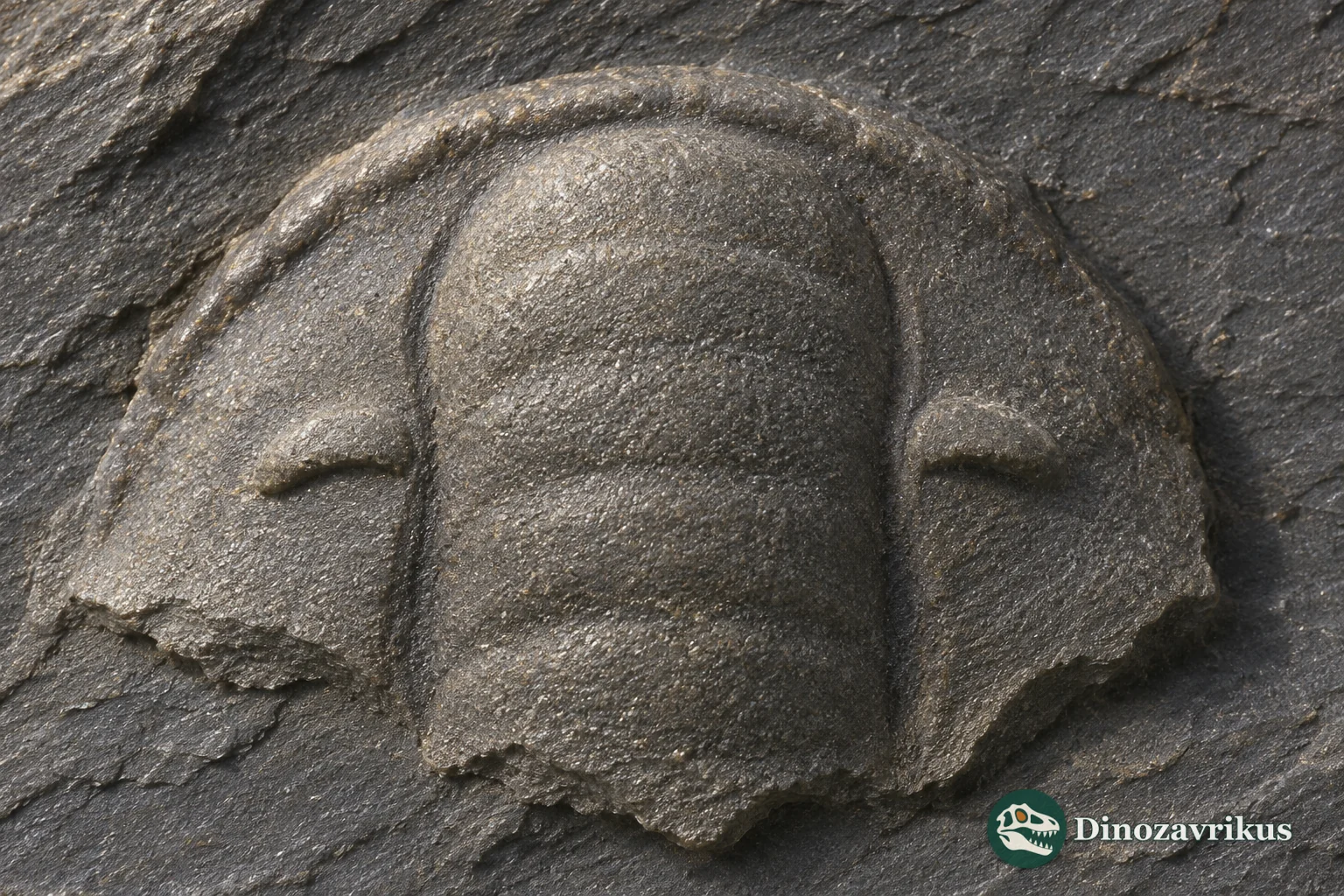
Charles Walcott named the Wyoming type species Liostracus parvus in 1899. Charles Resser established Glaphyraspis in 1937. In the type species, the sides of the glabella are nearly parallel and a slight central indentation breaks its front edge.
Franco Rasetti examined articulated G. ornata preserved in shale. The figured cast of an articulated impression, USNM 144551, shows eight thoracic segments. Their tips bend down and back towards the sides of the shell. Such articulated finds reveal features that cannot be read from isolated head and tail shields.
Distinguishing the species
The glabella of G. ornata tapers towards the front and has distinct lateral furrows. Material from McGill, Nevada, has coarse granules on head shields of several sizes. Rasetti recorded both granular and smooth cranidia of G. oderi on the same rock. Identification draws on the proportions and relief of the head as well as its sculpture.
Occurrences of G. parva, G. ornata and G. oderi help track faunas around the Crepicephalus and Aphelaspis zones. Researchers use other trilobites, such as Cedarina, to compare earlier North American deposits.
Frequently asked questions
How many thoracic segments did G. ornata have?
Articulated specimens show eight, without spines along the axis.
Which species defines the genus?
The type is G. parva, originally described by Walcott from Wyoming under a different genus.
Were all the head shields granular?
No. Rasetti documented smooth, granular and intermediate head shields assigned to G. oderi.
In which beds is G. ornata found?
It occurs in Aphelaspis Zone deposits in Nevada, Utah and the Appalachian region, among other places.