

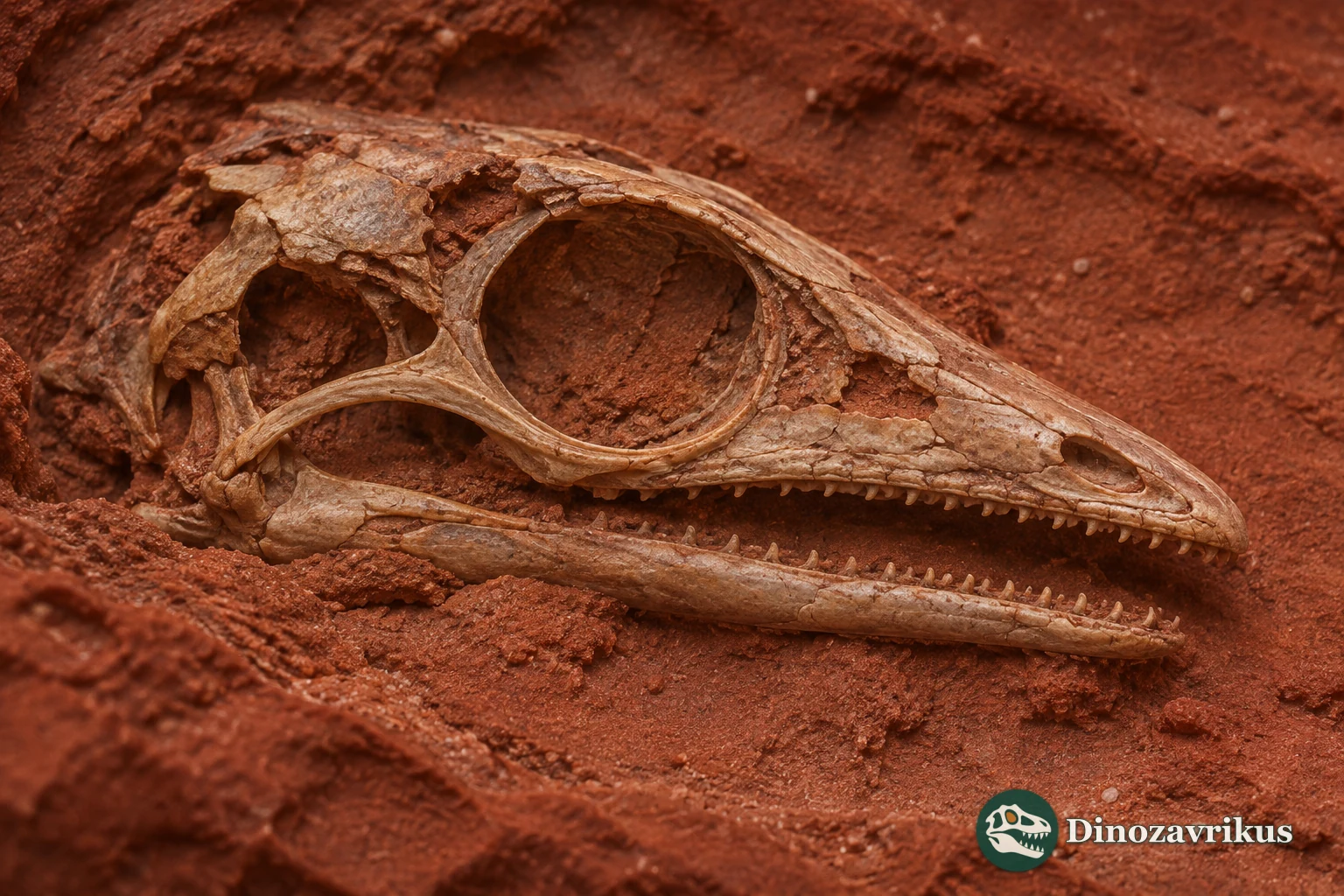
Globaura was a small Late Cretaceous lizard from the Mongolian Gobi. It has a tapering snout, large eye sockets and an arched cheek bone. A series of skulls from several localities lets researchers compare the jaws, palate and braincase.
Quick facts
| Group | Squamate lizards, precise affinities debated |
|---|---|
| Age | Late Cretaceous |
| Region | Asia, Mongolia |
| Skull length | 14–25 mm in described specimens |
| Type species | Globaura venusta |
| Scientific name | Globaura |
| Diet | No direct evidence |
What can the fossils tell us?
Specimen ZPAL MgR-III/40 includes a 21.5 mm skull, both lower jaws and several neck vertebrae.
The original description linked Globaura to lacertoids. A later morphological analysis grouped it with Eoxanta and Hymenosaurus.
Large eye sockets describe skull proportions. They do not establish when the lizard was active or how long its body was.
Discoveries in the Gobi
Magdalena Borsuk-Białynicka named Globaura venusta in 1988 from material collected by the Polish–Mongolian expeditions. Holotype ZPAL MgR-III/40 came from the red beds at Khermeen Tsav. Other specimens studied in the original description came from Khulsan, Nemegt and Bayn Dzak. A later study described the nearly complete skull and jaws IGM 3/164 from Khulsan.
What different skulls reveal
The described skulls span 14–25 mm in length. The holotype measures 21.5 mm. The elongated nostril openings face mostly upwards. The jaws carry closely spaced, tapering teeth with a small accessory cusp. Another Mongolian lizard, Isodontosaurus, has posterior tooth crowns that widen more conspicuously.
Why the proposed relationship changed
The original description compared the bones around the eye, the palate and the lower jaw, and linked the genus to lacertoids. A later analysis united Globaura, Eoxanta and Hymenosaurus. It recovered that group near living skinks, but that position had weak support. The preserved anatomy lets researchers test alternative relationships as more fossils become available.
Frequently asked questions
Where was the type specimen found?
It comes from the red beds of Khermeen Tsav in the Mongolian Gobi.
How small is the skull?
The holotype skull is 21.5 mm long. Specimens measured in the original description span 14–25 mm.
What was found with the type skull?
Both lower jaws and several neck vertebrae were preserved with it.
Do large eye sockets show it was active at night?
The sockets establish skull proportions. An inference about night activity would require additional evidence and tests against living species.