

Isodontosaurus was a Cretaceous iguanian lizard from the Gobi. The first fossils were parts of the lower jaw. Later skull finds revealed how the tooth row was built and preserved pronounced surfaces for the muscles that closed the jaw.
Quick facts
| Group | Iguanians (Iguania) |
|---|---|
| Age | Late Cretaceous, Campanian |
| Region | Asia, Mongolia and China |
| Type species | Isodontosaurus gracilis |
| Scientific name | Isodontosaurus |
| Diet | No direct evidence |
What can the fossils tell us?
AMNH 6647 comes from Bayn Dzak. IGM 3/84 from Ukhaa Tolgod preserves nearly the entire skull and both sides of the lower jaw.
The teeth attach along the inside of the jaw. A pronounced ridge on the back of the dentary is associated with the muscles that closed the jaws.
Tooth shape and muscle attachment reveal how the jaw is built. They do not establish the diet or measure its bite force.
Fossil finds in two countries
Charles Gilmore described Isodontosaurus gracilis in 1943. The holotype, AMNH 6647, comprises lower jaw material from Bayn Dzak in Mongolia. Later specimens came from Ukhaa Tolgod, Zos and Tugrugeen Shireh in Mongolia, and from Bayan Mandahu in China. At Tugrugeen Shireh, specimen IGM 3/91 preserves parts of the skeleton behind the skull.
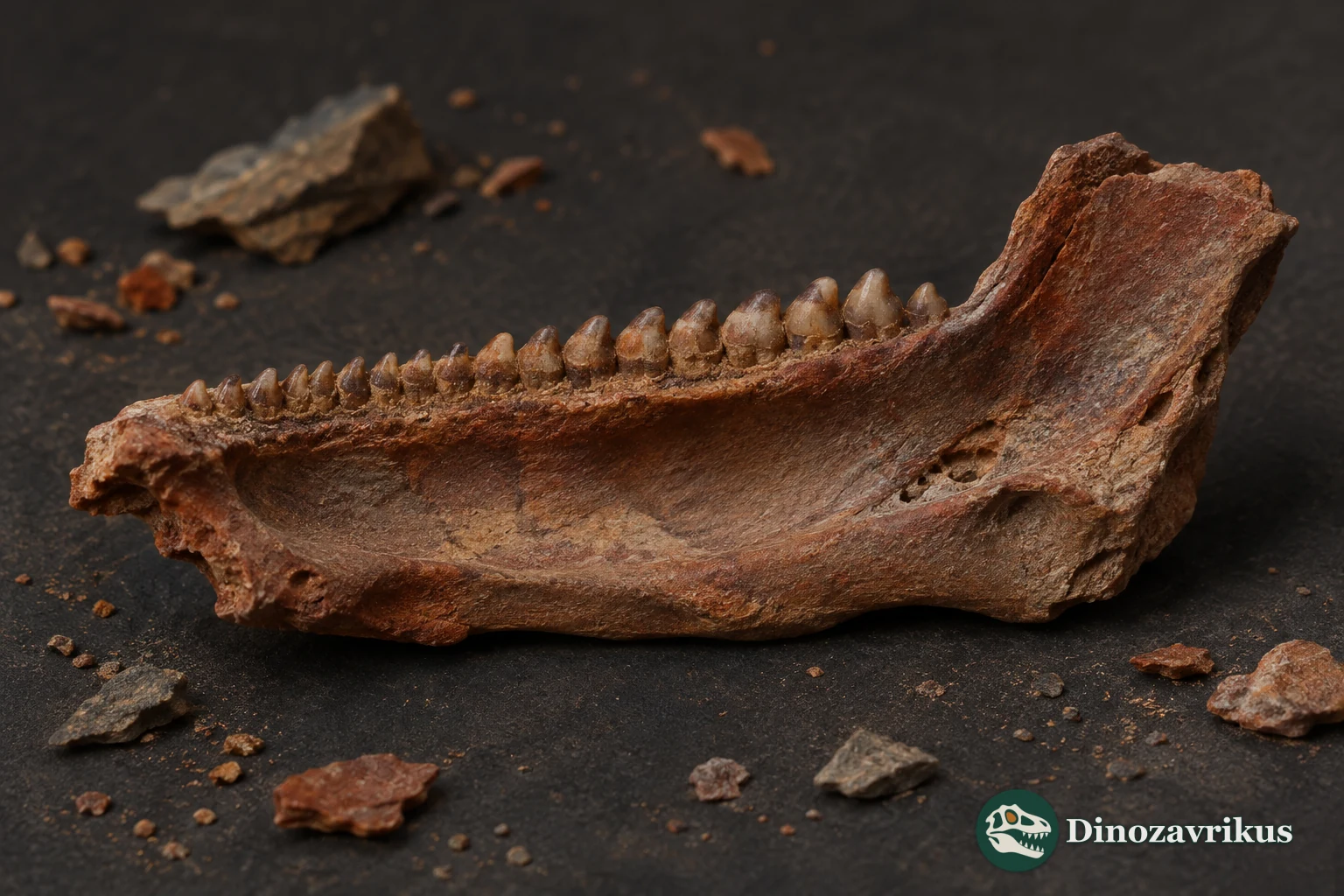
How the teeth sit in the jaw
Studied jaws have up to 14 teeth on each maxilla and up to 16 on each dentary. The crowns widen towards the back of the row, with a much reduced last tooth. The bases attach along the inner surface of the bone, a condition called pleurodont attachment. In Mimeosaurus, another Gobi iguanian, much of the row was fused to the crest of the jaw.
Surfaces for the jaw muscles
The outer rear part of the lower jaw has a distinct ridge and a depression for the muscles that closed it. On the top of the skull, the fused frontal bones narrow between the eye sockets. These features are among those used to compare Isodontosaurus with other iguanians. Its precise position within the group depends on the fossils and characters included in an analysis.
Frequently asked questions
Was Isodontosaurus a dinosaur?
It belongs to the iguanian branch of squamate lizards. The ending of its name does not identify it as a dinosaur.
Where were the first remains found?
The type material is from Bayn Dzak in the Mongolian Gobi.
Are complete skulls known?
Several specimens preserve much of the skull. One of the most complete comes from Ukhaa Tolgod.
What did it eat?
Teeth and jaw muscle scars are preserved. The fossils give no direct evidence of particular prey.