

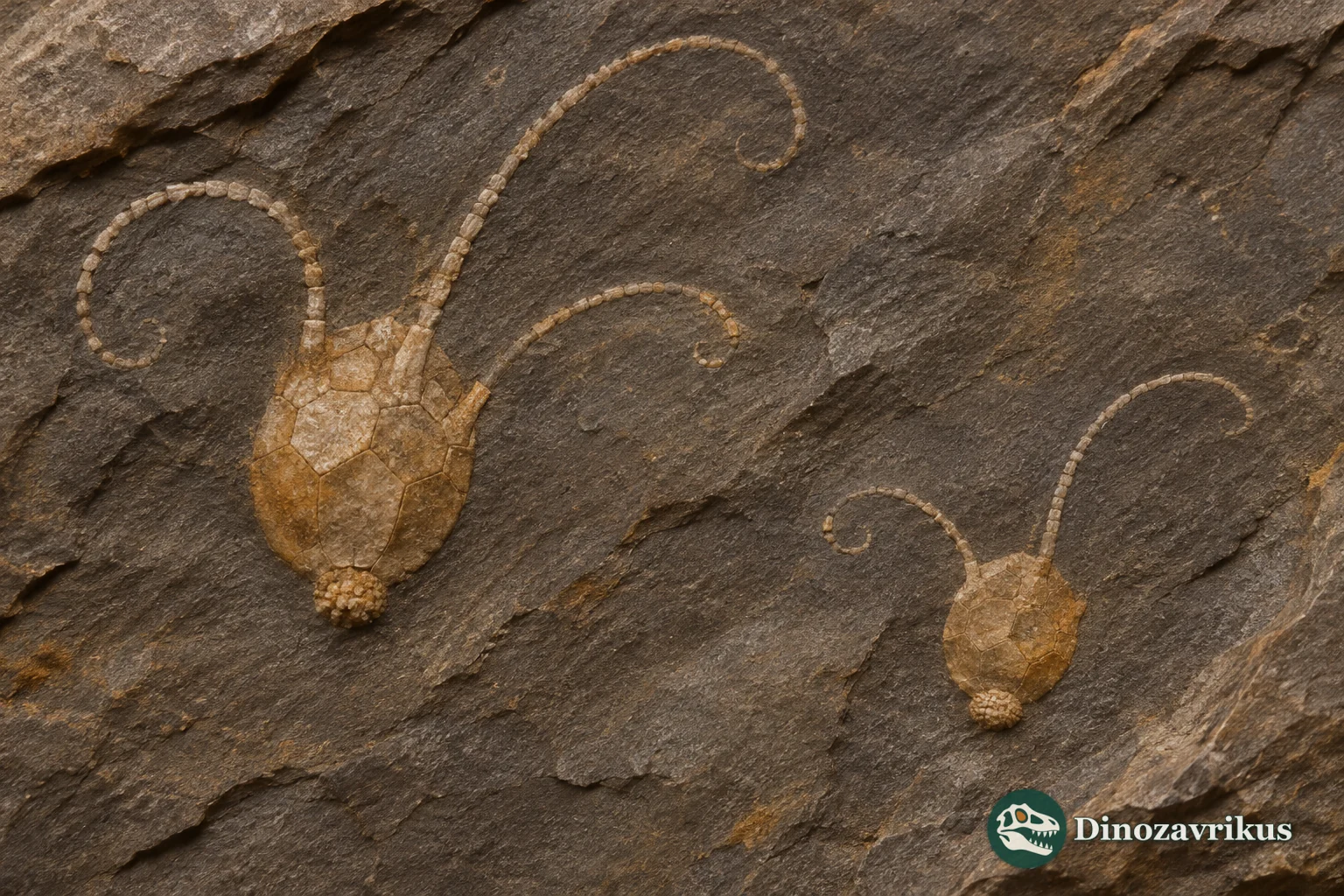
Gogia was a bottom-dwelling echinoderm. Long, jointed brachioles rose above its plated body and collected particles from seawater. Some fossils retain their attachment structures, making it possible to compare how different species held their position on the seabed.
Quick facts
| Group | Echinoderms |
|---|---|
| Age | Early to Middle Cambrian |
| Region | North America, Europe |
| Diet | Filter feeder |
| Type species | Gogia prolifica |
| Class | Eocrinoidea |
What can the fossils tell us?
Articulated fossils retain the arrangement of the plates. Compaction flattened many specimens, which limits estimates of the original depth of the cup.
Two rows of elements are visible in the appendages of well-preserved examples. Their disposition supports a suspension-feeding interpretation without identifying the particles caught.
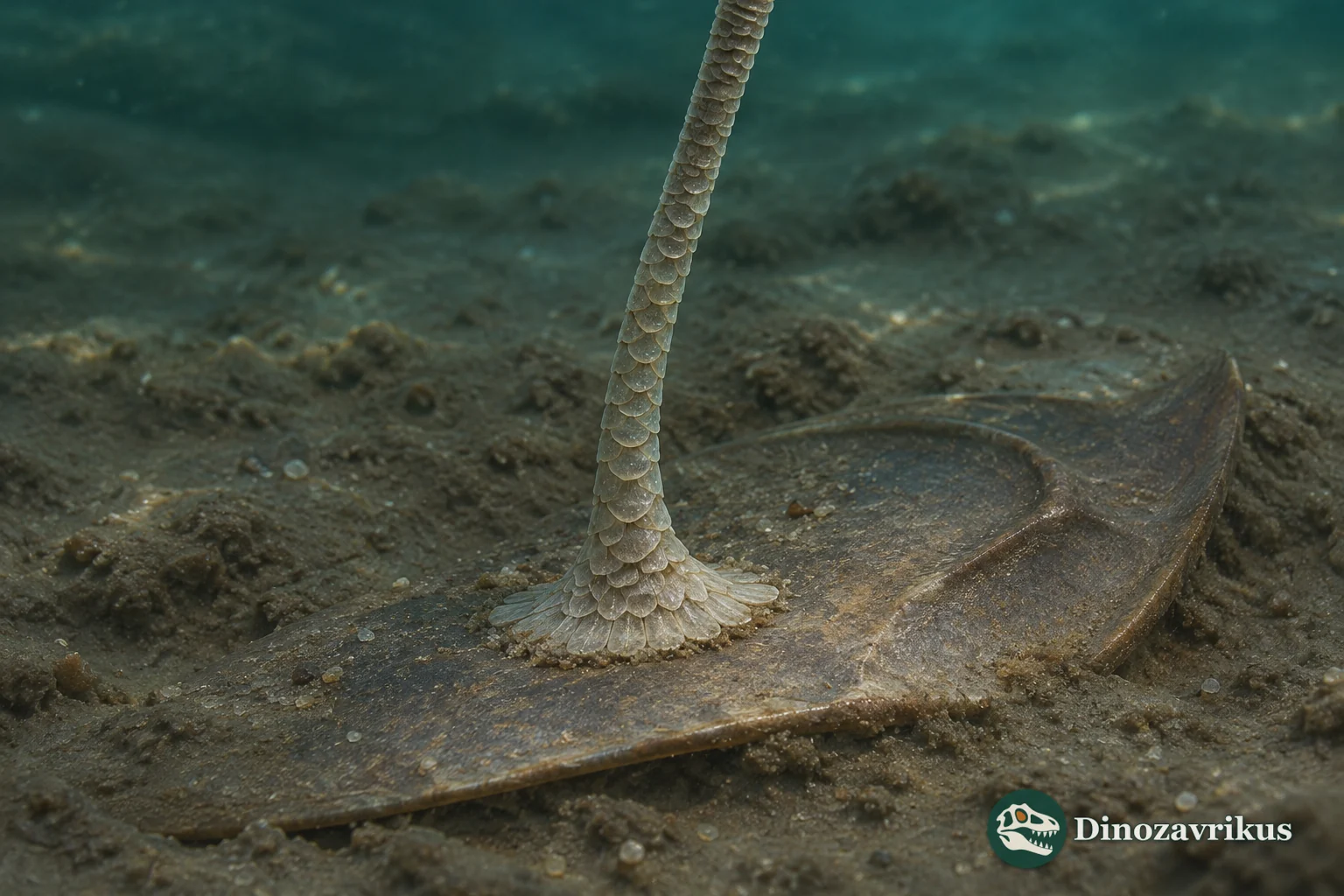
Some Gogia spiralis occur on trilobite shell fragments. In Gogia parsleyi, a broad patch of tiny plates meets the base of the cup. The holdfast is missing in many fossils.
The plated body and brachioles
Charles Walcott named Gogia in 1917. The type species, Gogia prolifica, is from the middle Cambrian of British Columbia. Richard Robison revised the genus in 1965, establishing a lectotype from the original material and describing the Utah species G. spiralis and G. granulosa.
Calcitic plates of different sizes form the cup, or theca. The slender appendages that rise around the mouth are called brachioles. They contain two rows of small skeletal elements. In several species the brachioles coil. Palaeontologists infer suspension feeding from their arrangement and structure. The fossils do not show the exact food particles collected.
Attachment and a muddy bottom
Some specimens of G. spiralis are attached to pieces of trilobite shell. The shell fragments provided hard spots on an otherwise muddy seabed. The University of Kansas specimen KUMIP 314064 comes from the Wheeler Formation in Utah’s House Range. The same formation preserves the trilobite Asaphiscus.
In Gogia parsleyi from Spain, several specimens retain an expanded holdfast made of small rounded plates. The holdfast is detached in one paratype and apparently remains in contact with the lower cup in others. The material supports a reconstruction with the holdfast directly below the cup and no intervening stalk.
Fifteen Spanish specimens
Samuel Zamora, Rodolfo Gozalo and Eladio Liñán studied complete and partial specimens from the Murero Formation of the Iberian Chains. The holotype of G. parsleyi, MPZ2004/162a and b, is nearly complete except for the holdfast. The cup measures 12 by 11 mm. One juvenile cup is about 5 mm long. These measurements describe flattened fossils.
Some of the pores at the boundaries between the plates are covered by small domes or tiny plates. These pores, called epispires, have been interpreted in connection with respiration. Their form and the structure of the holdfast help distinguish this species from other Cambrian gogiids.
Frequently asked questions
What kind of animal was Gogia?
Gogia was an echinoderm of the extinct class Eocrinoidea.
How did Gogia feed?
It is interpreted as a suspension feeder. Its thin brachioles collected particles from the water.
What did Gogia spiralis attach to?
Some fossils retain attachment to detached trilobite shell pieces, which provided firm points on muddy seafloors.
How large is the type of Gogia parsleyi?
The flattened cup of the holotype measures 12 by 11 mm. Its holdfast is missing.