

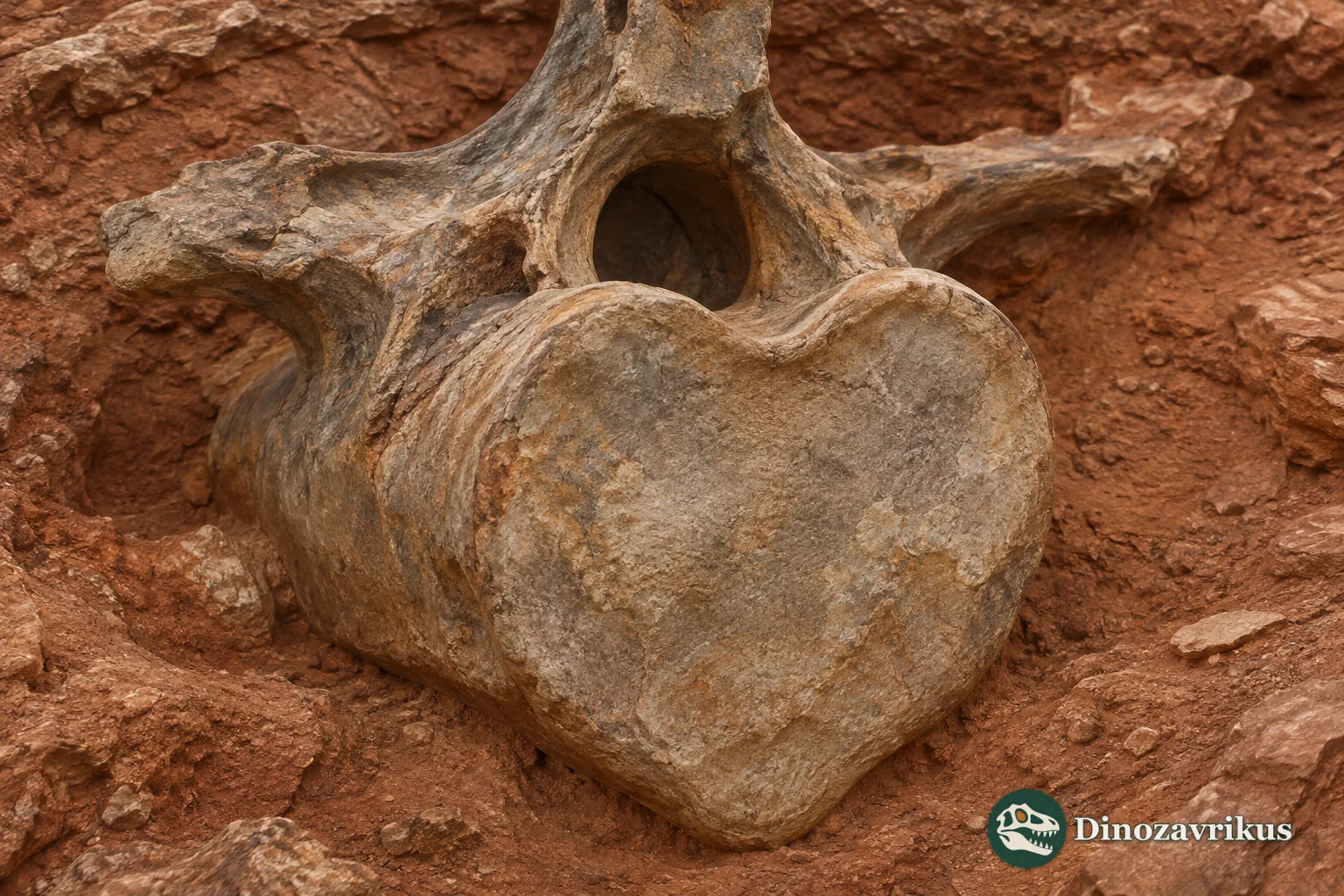
Gondwanatitan was a Late Cretaceous sauropod from what is now western São Paulo state, Brazil. The type material includes bones from the neck, trunk, limbs and tail. On several of the tail vertebrae, the rear face of the centrum has an outline reminiscent of a heart.
Quick facts
| Group | Sauropods (Titanosauria) |
|---|---|
| Age | Late Cretaceous |
| Region | South America (São Paulo state, Brazil) |
| Diet | Herbivorous sauropod |
| Type species | Gondwanatitan faustoi |
| Holotype | MN 4111-V, a partial skeleton |
| Deposits | Adamantina Formation, Bauru Group |
| Length | About 6–7 m for the holotype, estimated from vertebrae |
What can the fossils tell us?
The distinctive joint surfaces occur in front and middle tail vertebrae. Other parts of those same vertebrae were used to compare Gondwanatitan with its relatives.
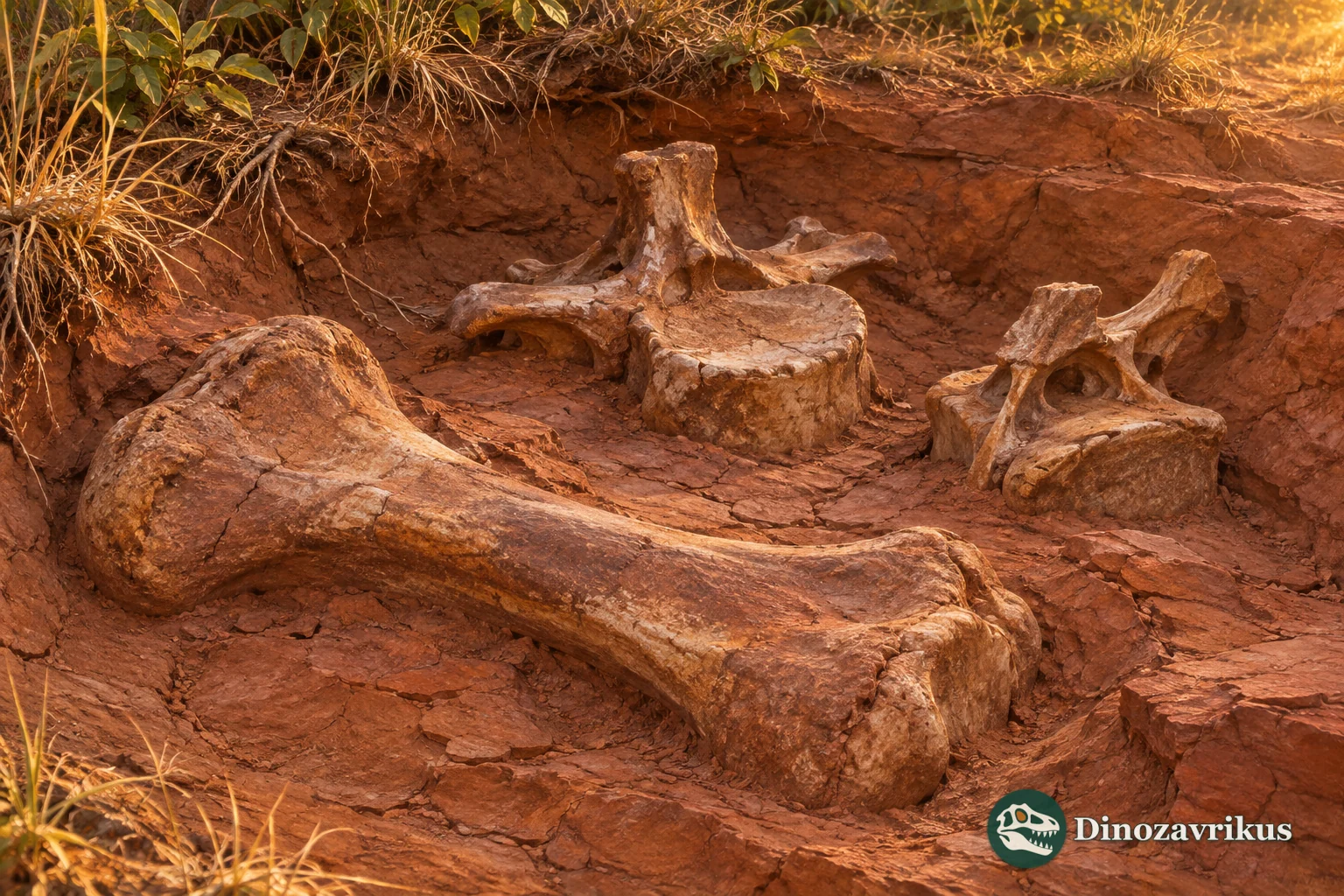
Several tail vertebrae remained in articulation. Most elements were separate but clustered in a small area, and some were damaged by plant roots.
The estimate refers to the fossil individual, using proportions of other titanosaurs. The incomplete specimen leaves the full adult size range open.
The farm discovery and the type skeleton
Yoshitoshi Myzobuchi found bones on his farm near Álvares Machado in 1983. Fausto Luiz de Souza Cunha of the Museu Nacional recognized titanosaur remains and led excavations from 1984 to 1986. Preparation resumed in 1997. In 1999 Alexander Kellner and Sergio de Azevedo named the genus and honoured Cunha in the species name.
MN 4111-V preserved two partial neck vertebrae, seven back vertebrae, six sacral vertebrae, 24 tail vertebrae and several bones from the shoulder, pelvis and limbs. Some of the tail remained articulated. Most bones were found apart but close together. Some were distorted after burial or damaged by later plant roots. A 2025 account of the Bauru Group titanosaurs reports that the specimen was destroyed in the 2018 Museu Nacional fire.
What the tail and limbs reveal
In a number of the front and middle tail vertebrae, the upper part of the rear articular face has a shallow notch bounded by broader sides. The heart-shaped outline helped diagnose the genus. The forward-leaning neural spines of several vertebrae also resemble those of Aeolosaurus. Some researchers proposed transferring the Brazilian species to that genus. Other analyses have recovered the two as separate closely related members of Aeolosaurini.
The humerus has a pronounced deltopectoral crest that curves inward toward the shaft. The upper end of the tibia also has a distinctive projection. By comparing the lengths of the neck, back and tail vertebrae with those of other titanosaurs, the authors estimated about 6–7 metres for the type individual. Its sauropod anatomy supports herbivory. The type material provides no jaw or gut remains to identify particular foods.
Frequently asked questions
Where was Gondwanatitan found?
On a farm near Álvares Machado in western São Paulo state, Brazil.
Which part of the tail was heart-shaped?
The shape refers to the rear joint face of several vertebral bodies in the front and middle of the tail.
How was its length estimated?
Researchers compared its vertebrae with those of other titanosaurs and estimated a length of about 6–7 metres for the type individual.
Who was the species named after?
Fausto Luiz de Souza Cunha, the Museu Nacional palaeontologist who recognized the significance of the find and led the excavation.