

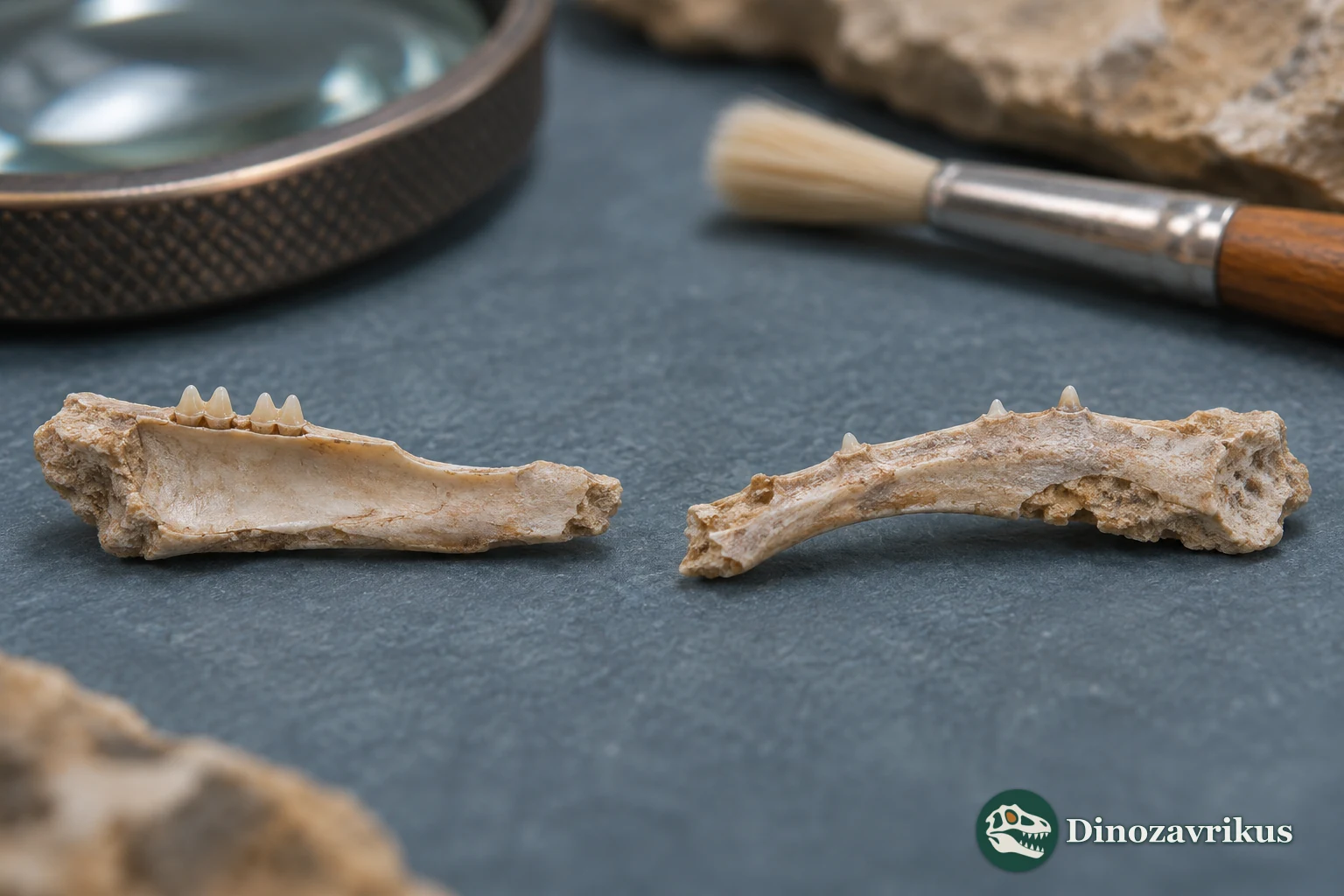
Gracilicerta was a small lacertid lizard from Eocene western Europe. Fossils of its dentary, the bone that carries the lower teeth, preserve a main cusp and a smaller cusp in front. Features on the inner face of that bone help distinguish the genus from other small lizards with similar teeth.
Quick facts
| Group | Lacertoids (Lacertoidea), lacertid lizards (Lacertidae) |
|---|---|
| Age | Middle and late Eocene |
| Region | Europe, France and Spain |
| Type species | Gracilicerta sindexi |
| Scientific name | Gracilicerta |
| Diet | No direct evidence |
What can the fossils tell us?
UM-SND 623 comes from the Quercy phosphorites in France. Comparable dentaries have been identified at Sossís in Spain.
The shelf underlying the teeth is particularly deep at the front. French material of the species has 24 to 26 tooth positions.
Some other Eocene dentaries with two-cusped teeth differ too much from the type to be identified confidently as Gracilicerta.
French and Spanish records
Marc Augé named Gracilicerta sindexi in 2005. Its holotype comes from late Eocene La Sindou in southwestern France, assigned to European mammal reference levels MP18 to MP19. Published French records span MP16 to MP19. Several fragments from the late Eocene site of Sossís in Catalonia were assigned to the species, including a partial left dentary, IPS 56171, with eight teeth preserved.
Distinguishing two-cusped lizards
The lower edge of the dentary is more arched in Gracilicerta than in Dormaalisaurus. The crowns in Gracilicerta lack the fine striations found on the inner surface of the teeth of Dormaalisaurus. A deep shelf rises under the tooth row. At the front of the dentary, the Meckelian groove opens downward.
A similar jaw from La Bouffie
A specimen from late Eocene La Bouffie has 22 tooth positions. A third cusp on the rear teeth, a shallower subdental shelf and differences in the groove separate it from the La Sindou type material. The specimen was left as an unidentified lacertid. This comparison shows why a two-cusped tooth alone is insufficient to identify the genus.
Frequently asked questions
Where was the type fossil found?
It comes from La Sindou, one of the Quercy phosphorite localities of southwestern France.
How many teeth were in a row?
The French material shows 24 to 26 tooth positions on a dentary. The Spanish fossils preserve smaller portions of the row.
How does it differ from Dormaalisaurus?
The dentary is more arched, and its crowns have no striations on their inner surfaces.
Can the cusps tell us what it ate?
They help compare jaws from different lizards. On their own they provide little evidence for a specific diet.