

Granastrapotherium was a very large astrapothere from Miocene South America. Its best documented Colombian material includes a nearly complete lower jaw and large canines, while a partial upper skull from Peru has been referred only as G. cf. snorki. That qualification reflects a close but not certain identification.
The genus is included in the ancient mammal catalogue. It can be compared with the related Astrapotherium, but the two genera have different fossil records and should not be treated as interchangeable reconstructions.
Quick facts
| Scientific name | Granastrapotherium Johnson & Madden, 1997 |
|---|---|
| Known species | Granastrapotherium snorki Johnson & Madden, 1997 |
| Group | Astrapotheria; Uruguaytheriinae |
| Age | Middle Miocene; type record about 13.6–12.8 million years old |
| Range | La Venta, Colombia; tentative referral from Tumbes, Peru |
| Best material | Nearly complete mandible IGM p881230 and associated canines |
| Estimated size | Published model: 3.75 m head–body length and 1.8–2.5 tonnes |
| Key limitation | Mass and trunk-like appearance are inferred, not directly preserved |
What do the Granastrapotherium fossils show?
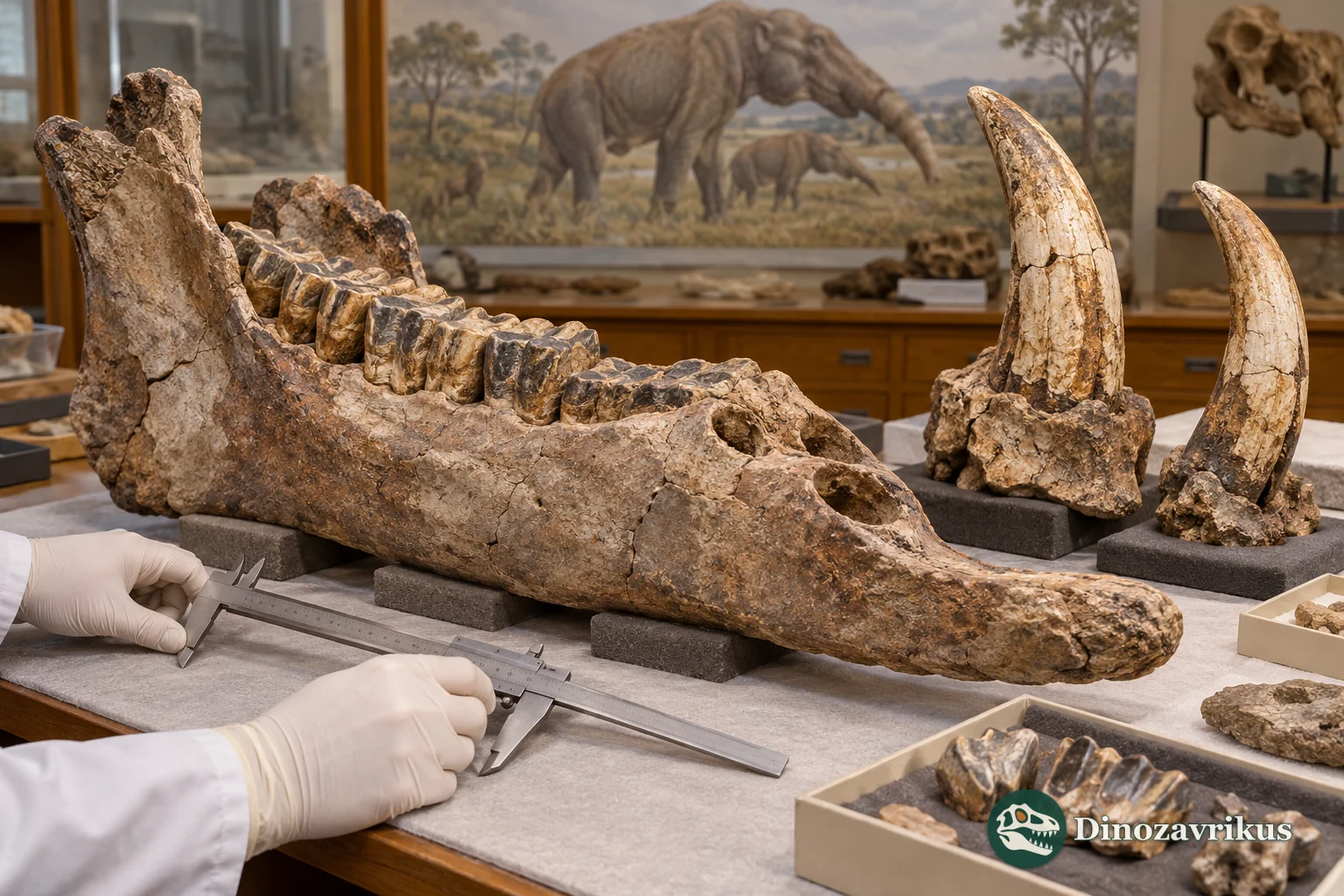
The Colombian specimen IGM p881230 preserves a nearly complete mandible and lower canines. It directly records jaw proportions and tooth positions, but does not preserve the upper skull or an articulated postcranial skeleton.
Lower and upper canines were reported in association with the main Colombian material. Their size and orientation are observable; a fleshy trunk, precise feeding motion and social display are not.
Croft and colleagues described partial upper cranial material from Tumbes, Peru, as Granastrapotherium cf. snorki. The “cf.” preserves uncertainty: resemblance supports comparison, but it is not an unqualified species identification.
A published reconstruction estimated a head–body length near 3.75 metres and a mass of 1.8–2.5 tonnes. These values depend on reconstructing missing proportions and applying comparative models; they are not measurements from a complete skeleton.
Naming and the Colombian material
Granastrapotherium snorki was established by William Johnson and Richard Madden in their 1997 treatment of Uruguaytheriinae from tropical South America. The genus is based on fossils from the La Venta fauna in Colombia. Its name reflects its relationship to other astrapotheres, while the species name honours Snork, the nickname used for the distinctive animal in the research collection.
Expedition work by the Instituto Colombiano de Geología y Minería and Duke University recovered a substantial lower jaw catalogued as IGM p881230. The mandible is nearly complete and preserves the lower canines; upper canines were also reported with the material. This association gives a firmer picture of the jaws than isolated teeth alone, but no complete skull or limb skeleton was found with it.
Tusks, teeth and feeding
The large canines are among the most conspicuous features attributed to Granastrapotherium. Their size, position and wear are fossil evidence. The cheek teeth and jaw provide additional anatomical context for interpreting how the animal processed food. Together, these structures support a broad herbivorous interpretation for astrapotheres.
They do not preserve an exact diet. No stomach contents or directly associated plant material identify particular foods for G. snorki. Suggestions that it browsed soft vegetation or fed in water are ecological interpretations, not direct observations of its behaviour.
The well-developed canines have inspired comparisons with tusked mammals, but they do not prove that the animal used them for combat, display or digging. Those functions would require characteristic wear, injuries or other evidence not established by the known jaw alone.
The Peruvian referral
A partial upper cranium from the Tumbes region of Peru was described as Granastrapotherium cf. snorki. It extends the geographic discussion beyond the type area in Colombia, but the authors retained “cf.” because the assignment is not fully certain. The fossil is incomplete and its comparison depends on the characters that survive.
The Tumbes material has been associated with the Zorritos Formation, although the stratigraphic correlation and age context require care. It should not be merged with the La Venta specimen as though both came from one population or one precisely dated horizon.
Size estimates and missing anatomy
One published reconstruction estimated Granastrapotherium at about 3.75 metres from head to body and 1.8–2.5 tonnes in mass. The estimate depends on the reconstructed proportions of an animal known from an incomplete skeleton and on comparative scaling. Different methods for estimating body mass in extinct astrapotheres can yield widely varying results, so the range is a model rather than a direct measurement.
The lower jaw establishes a large animal with powerful jaws, but it cannot by itself determine shoulder height, limb proportions or the outline of the body. A short proboscis is often proposed for astrapotheres from skull and tusk arrangements, yet soft tissues do not fossilize here. The exact shape and length of any trunk-like muzzle remain uncertain for this genus.
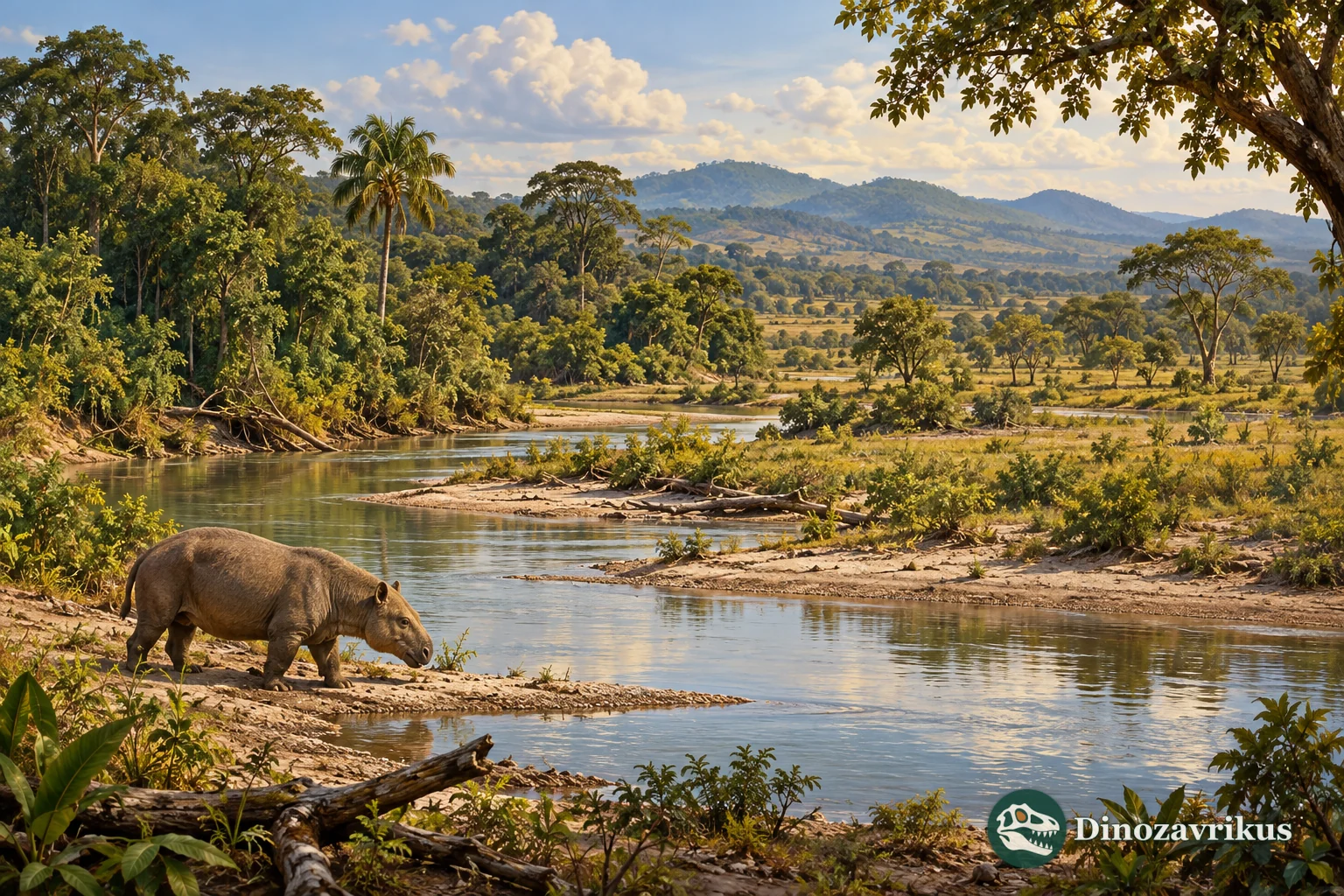
The cover presents a plausible large astrapothere in a riverine setting. Its skin, colour, soft-tissue muzzle and behaviour are artistic choices. The image is not evidence that the species was semi-aquatic.
Age, habitat and classification
The type material comes from the middle Miocene La Venta fauna of Colombia. Published work places the relevant type interval in the Serravallian, roughly 13.6–12.8 million years ago. These ages depend on the stratigraphic framework for the fossil-bearing units and should not be applied automatically to every referred specimen.
La Venta preserves a diverse tropical South American mammal community. Sediments and associated fossils provide the environmental context; the anatomy of Granastrapotherium alone cannot prove a semi-aquatic lifestyle. The Peruvian referral adds a possible northern extension, subject to its taxonomic and stratigraphic uncertainties.
Within Astrapotheria, the genus has been classified among Uruguaytheriinae. The broader relationships of South American astrapotheres have been studied from dental and cranial characters, but the incomplete material limits what can be said about the exact position and the evolution of its unusual size.
Frequently asked questions
When did Granastrapotherium live?
The type material is from the middle Miocene La Venta fauna of Colombia, with a published Serravallian interval of roughly 13.6–12.8 million years ago.
How large was it?
A published model estimates about 3.75 metres head–body length and 1.8–2.5 tonnes. The values depend on reconstructed proportions and comparative scaling, not a complete measured skeleton.
Was it semi-aquatic?
That has been suggested for some astrapotheres, but the known fossils do not directly demonstrate swimming or a semi-aquatic lifestyle for Granastrapotherium.
What does “cf. snorki” mean for the Peruvian fossil?
It indicates a close comparison with G. snorki, while signalling that the incomplete Tumbes skull cannot be assigned to that species with full confidence.