

Gymnagnostus had an almost smooth shell. Paleontologists distinguish its species by looking closely at the edges of the shields: the width of a rim, the depth of a furrow and the presence of spines. Material from Mexico and Argentina shows how much those details vary.
Quick facts
| Group | Agnostida |
|---|---|
| Age of the material | Late Cambrian and Early Ordovician |
| Genus established | Robison and Pantoja-Alor, 1968 |
| Type species | Gymnagnostus gongros |
| Type locality | Nochixtlán, Oaxaca, Mexico |
| Holotype length | 3.2 mm, tail shield |
What can the fossils tell us?
In the type species a narrow furrow separates the rim from the rest of the tail shield. Two spines project near its back corners.
Specimen MLP 35144 measures 3.2 mm long and 3.3 mm wide. Its margin lacks spines.
The unnamed form was described from eight complete shells and detached parts. It has a very narrow head rim.
The type species from Oaxaca
Richard Robison and Jerjes Pantoja-Alor established the genus in 1968. Its type species, G. gongros, came from the Tiñú Formation in the Nochixtlán area of Oaxaca. The Mexican material is from beds close to the Cambrian–Ordovician boundary.
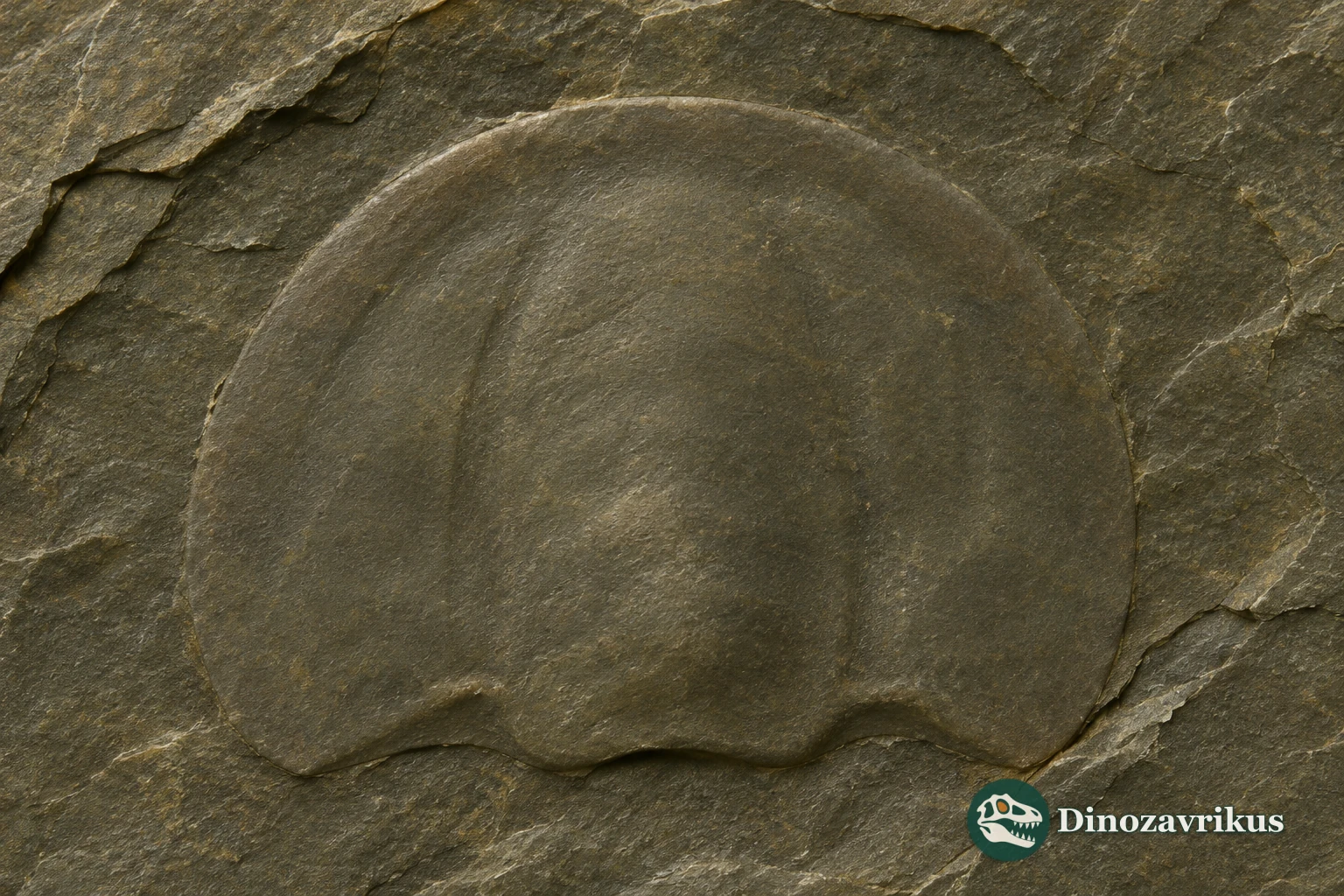
The type species has a conspicuous axial bump, a narrow border furrow and two posterolateral spines on the tail shield. The Argentine species from the Santa Rosita Formation has a wider furrow and a spineless tail margin.
A tail shield from the Santa Rosita Formation
Early Ordovician beds at Pantipampa and in the lower Rodeo Colorado section near Iruya yielded G. kobayashii. Its holotype, tail shield MLP 35144, measures 3.2 mm long and 3.3 mm wide. The type series also includes three head shields and eight other tail shields.
The rim on the tail shield is slightly convex. A shallow, relatively wide furrow separates it from the rest of the shield and shows as a break in slope. The head is almost identical to that of the Late Cambrian G. bolivianus. The shape of the tail’s central lobe and the width of the border furrow help distinguish the two species. The width of the head rim was also useful when comparing the Argentine material with fossils close to Leiagnostus from South Wales.
Complete shells from the Rupasca Formation
Early Ordovician beds of the Rupasca Formation near Alfarcito, Jujuy, yielded another form, reported as Gymnagnostus n. sp. A. The sample comprises eight complete shells, three head shields and nine tail shields. It has a particularly narrow head rim and a smooth tail margin.
Frequently asked questions
Where was the type species of Gymnagnostus found?
In the Tiñú Formation near Nochixtlán, in the Mexican state of Oaxaca.
How do the Mexican and Argentine tail shields differ?
G. gongros has two distinct marginal spines and a narrow rim furrow. G. kobayashii has a wider furrow and a spineless margin.
How large is the holotype from the Santa Rosita Formation?
Tail shield MLP 35144 measures 3.2 mm long and 3.3 mm wide.
How many complete shells were described from the Rupasca Formation?
Eight complete shells were described, along with detached head and tail shields.